Agencies compare estimated vs actual hours on fixed-fee projects with a variance report: actual hours per client and project divided by the hours the fee assumed, priced at loaded cost rates and reviewed monthly. The formula is easy. The actual hours are where most comparisons quietly fail, because the work that blows the estimate is the work nobody logs.
Quick Answer
Variance = (actual hours - estimated hours) / estimated hours, per client and project. Under 10% is healthy quoting, above 25% is a pricing problem. Compute it monthly from complete tracked hours, ranked by client, and act on the bottom of the list before renewal.
The Comparison That Matters
Variance = (actual hours - estimated hours) / estimated hours. Run it per deliverable inside a project and per client across the month, and convert it to dollars at each person's loaded cost rate so a partner's overrun reads differently than an intern's.
A $10,000 fixed-fee engagement scoped at 80 hours has a $125/hour implied rate. At 110 actual hours the effective rate drops to $91, and at a loaded cost of $85/hour the project earns $650 total instead of $3,200. That is the number the estimate-versus-actual comparison exists to catch, and it is invisible until the hours are counted honestly.
The dollar version matters more than the hour version. Ten hours of partner time at a $180 loaded rate and ten hours of associate time at a $65 loaded rate produce the same variance percentage and very different margin damage. Price variance at loaded rates, using Bureau of Labor Statistics Employer Costs for Employee Compensation data for the salary-plus-benefits-and-taxes figure per role.
Why Estimates Drift
Estimates drift because they are built from a scope document while actual hours accumulate from the whole relationship: revisions, meetings, unscoped asks, and senior review nobody scheduled.
Scope drift. The fee covered three concepts; the client approved one and asked for two more directions "just to see." Every added deliverable is real cost with no matching fee. According to the Project Management Institute's Pulse of the Profession research, roughly half of all projects experience scope creep, and fixed-fee work absorbs that creep as margin loss because the price cannot move.
Unlogged work. The 12-minute Slack answer, the extra revision round, the internal QA pass. Manual timesheets miss these systematically: an analysis in Harvard Business Review found timesheets filled in weekly are about two-thirds accurate at best, and the missing third is exactly the small tasks that estimates never counted.
Senior-time leakage. Work quoted at associate rates gets delivered with partner cleanup nobody scheduled. Hours match the estimate while cost blows through it, which is why variance must be priced, not just counted.
How to Run the Comparison
Build one table per month: client, project, estimated hours, actual hours, variance percent, variance dollars, effective rate. Sort by variance dollars descending and review the top and bottom of the list, not the average.
1. Record the estimate in hours, not just dollars. Every proposal needs an internal hours assumption per deliverable: 40 hours design, 20 development, 8 project management. Without that row the comparison has no denominator.
2. Capture actual hours per client and project. Every work session lands on a client and a deliverable. This is the step that decides whether the report is real; a variance report built on remembered timesheets measures the team's memory, not their work.
3. Convert to dollars at loaded rates. Actual hours multiplied by each person's loaded cost rate, compared against the fee allocation for that work. The output is margin variance, not just hour variance.
4. Review weekly in-flight, monthly in full. Account leads check active projects against pace mid-month; leadership reviews the full ranked grid monthly. A project 35% over estimate in week three can still be finished differently or re-scoped with the client.
5. Feed the actuals back into quoting. The point of the comparison is the next proposal. When "website redesign" has measured 95 hours across the last four projects, the old 60-hour template is fiction and the quote has to move.
Getting Actual Hours Without Timesheets
Automatic time capture records work sessions in the background and assigns them to clients and projects, so actual hours are complete without timers, start buttons, or Friday reconstruction.
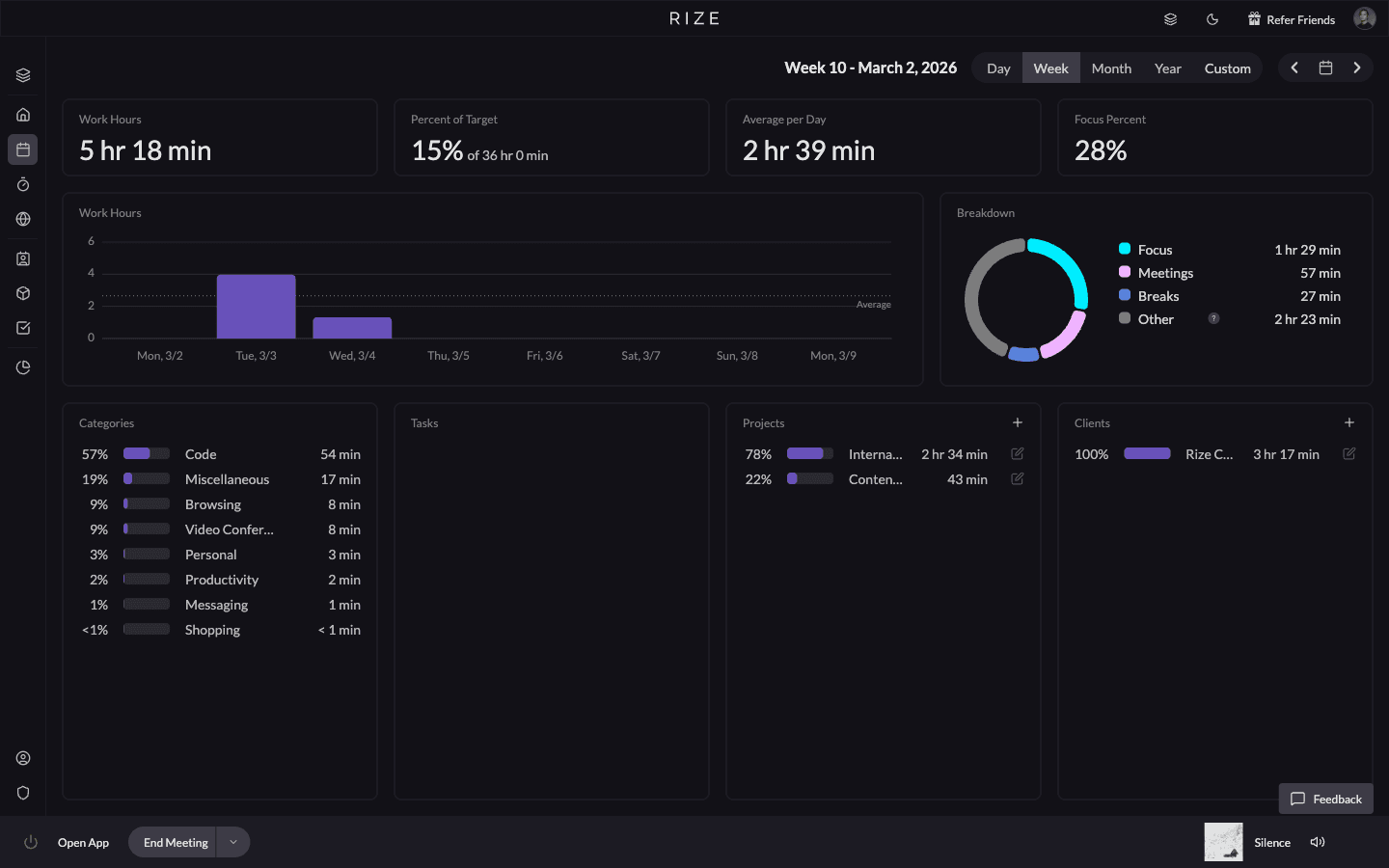
The comparison dies at the input for most agencies. Timers get remembered at the end of the day, reconstructed at the end of the week, and the hours that made the project unprofitable (the favors, the fifth revision, the unscheduled call) are the ones that never got logged. Rize captures every app, document, and browser session on Mac and Windows and assigns each one to a client, project, and task with AI and editable tag rules. Meetings come in through Google Calendar and Outlook sync. There is no keystroke logging and no GPS, and no screenshots by default; Vision screenshot capture is opt-in for orgs that enable it.
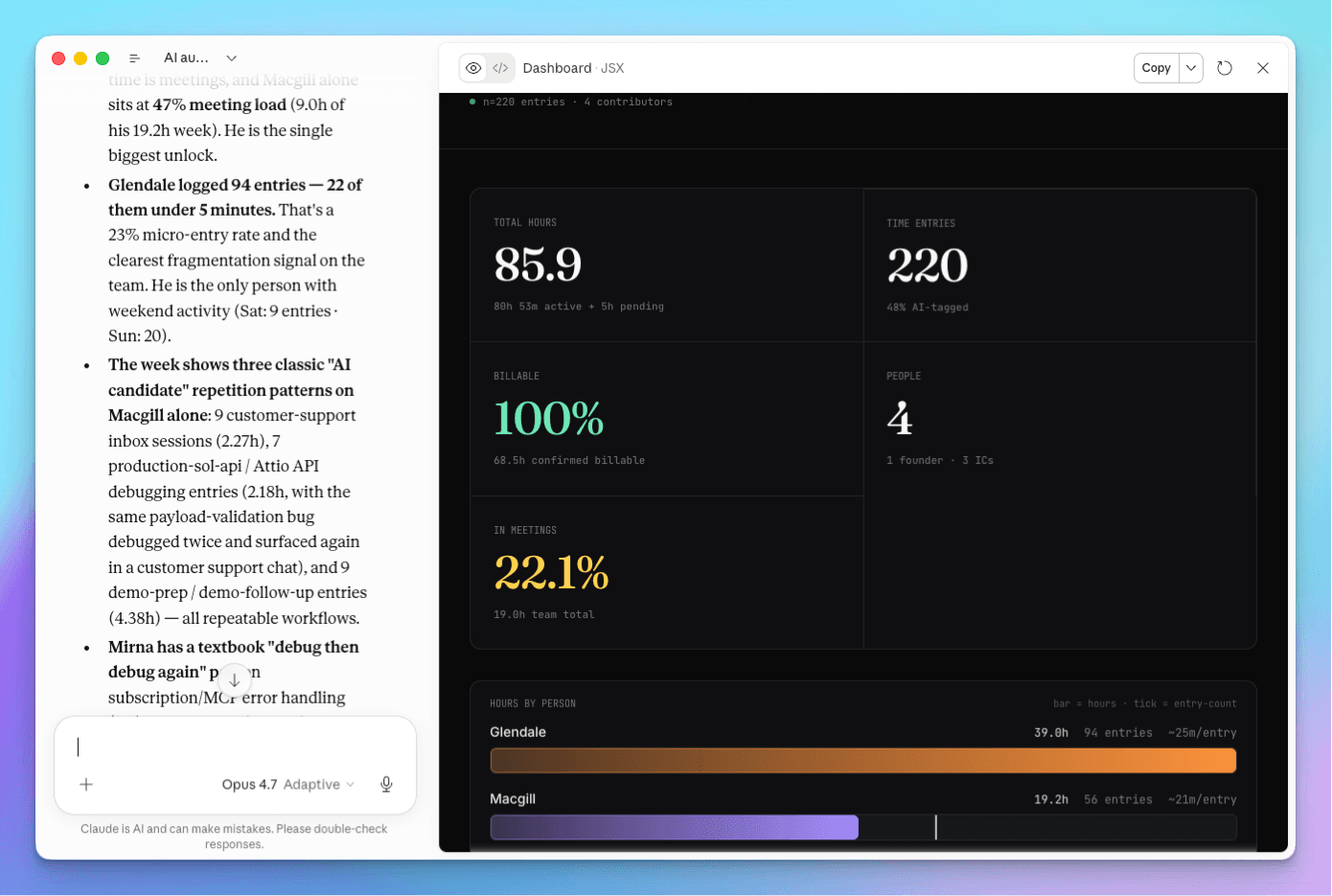
Drafted entries land in a review queue until each person approves them, and managers see hours by client, project, person, and label in Team Timesheets. Approved hours then feed the variance math directly: reports break down billable versus non-billable time, and project profitability shows margin per client at loaded rates, which is the dollar version of this whole comparison computed for you.
For agencies where the "actual" column already lives in timers and spreadsheets, the same report can run off a CSV export. It just inherits every gap the timers left. Pricing: Basic is $12.99/month ($9.99 billed annually); Team is $29.99/seat/month billed annually ($39.99 monthly), 2-seat minimum, 7-day free trial. See pricing.
Measure your own estimate variance
Rize captures actual hours by client and project automatically. Try it free for 7 days.
Start Free TrialWhat to Do With Chronic Variance
Chronic variance has three fixes, in order: fix the estimate from measured actuals, fix the scope with the client, or fix the price at renewal.
Fix the estimate. Rebuild quote templates from the tracked actuals on similar completed projects. If design phases have averaged 30% over estimate for a year, the template is wrong, not the team.
Fix the scope. Show the client where the hours landed by deliverable and agree on what the fee covers. Most clients accept boundaries backed by a burn report better than vague pushback, and they often pay for the extras once the work is visible.
Fix the price. At renewal, actual cost history is the evidence for the new fee. "We quoted 60 hours; it has been taking 85" is a pricing conversation clients can engage with, which is the entire argument in using time tracking data to raise a retainer.
The related problems on either side of this comparison are covered in the fixed-fee profitability test, retainer burn tracking, and spotting over-servicing before renewal. To put numbers on it, run your own accounts through the profitability calculator or book a demo.
Start tracking time automatically
Join thousands of professionals who stopped guessing where their time goes. Free for 7 days.
“Rize has been a no-brainer for me.” — Ali Abdaal Read more →
Macgill Davis is cofounder of Rize, an automatic time tracker that improves focus and builds better work habits.