Over-servicing is the work your agency delivers that the client never agreed to pay for — the extra revision round, the "quick favor," the unscoped Slack request. On retainers and fixed fees it is the single most common way margin dies, and it is invisible precisely because the hours that cause it are the ones nobody logs. Here is how to measure it, where it hides, and how to turn it into a scope conversation instead of a write-off.
What Over-Servicing Actually Is
Over-servicing is the gap between delivered work and scoped work. A retainer priced at 100 hours a month that absorbs 130 is being over-served by 30% — and the extra 30 hours are delivered at zero marginal revenue.
It is not the same as scope creep, which implies the client asked for more and you noticed. Over-servicing is mostly unregistered: nobody flagged a change order because nobody saw the request as a request. It is the account manager answering "one quick question" that takes forty minutes, the designer doing a fourth revision round because the third "wasn't quite there."
Why It Stays Invisible
Over-servicing survives because the measurement system depends on the same behavior it is measuring. Manual timesheets capture what people remember to enter — and the unscoped work is exactly what they forget. The five-minute fix never gets a timer; the extra revision gets bundled into "design – client X" as if it were scoped.
So the burn report reads 85% consumed and the account looks healthy, while the real delivery cost is 15-40% higher. The agency finds out in the P&L, months later, as an unexplained margin gap on accounts that "seemed fine."
Where It Hides
Revisions. "Two rounds included" becomes five because nobody counts rounds against the fee. Department-level burn usually shows one pod — design or copy — carrying the whole overrun.
Meetings and comms. Weekly status calls, ad-hoc Slack threads, "can you jump on a quick call" requests. Across a retainer base this is routinely 10-20% of delivered hours and almost never scoped.
Reporting the client never asked for. Custom dashboards, monthly decks, bespoke exports. Real work, real cost, zero fee coverage.
Senior time on junior work. The partner who "just fixes it quickly" at a loaded cost rate 2-3× the scoped rate. Hours-based burn misses this entirely; cost-based burn catches it.
How to Measure It
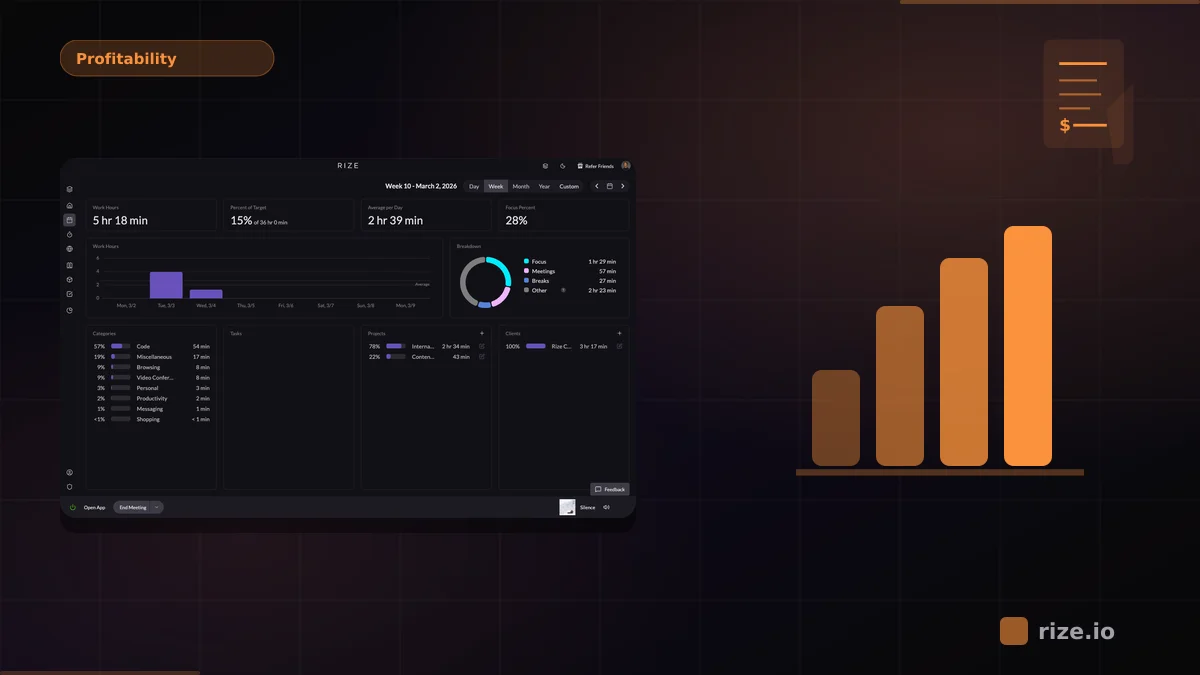
1. Get real hours. Automatic capture is the difference between measuring over-servicing and estimating it. Rize records every work session in the background and categorizes it by client — including the five-minute favors that never made a timesheet.
2. Price hours at loaded cost. Over-service at partner rates costs more than over-service at associate rates. Use fully-loaded cost per person, not a single blended number.
3. Compare against scope, not last month. Delivered-minus-scoped is the number. A client whose hours dropped 10% month over month but still runs 125% of scope is still over-served.
4. Split by department. The fix is targeted — a revision cap, a comms cadence, a reporting template — so the diagnosis has to be departmental too.
What to Do With the Number
Over-servicing has three honest resolutions, and the data is what makes all three possible:
Re-scope. "Here is where the 130 hours went; the fee covers 100. Which 30 should we stop, or should we reprice?" Clients engage with evidence. Many will pay for the extras once they can see them — over-service they couldn't see was never buying goodwill anyway.
Enforce boundaries. Change orders for out-of-scope requests, revision caps with a per-round price, comms batched into the weekly call. The burn report makes the boundary objective rather than personal.
Price it as retention. Sometimes the answer is deliberate over-delivery on an account worth keeping. That is a strategy — as long as it is a decision made with the cost visible, not a default the agency discovers at renewal.
The agencies that got ahead of this stopped asking for timesheet discipline and fixed the data. If your over-service number is a guess, see how Rize tracks agency profitability from automatically captured hours, or read the retainer burn guide.