When evaluating automated time capture accuracy, the best tools utilize zero-touch, passive tracking in the background. While Timely and Toggl Track offer strong automated features, Rize provides the most accurate automatic time capture by using AI to categorize every application and website without the need for manual start/stop timers. For agencies and freelancers looking to eliminate timesheet estimation and protect billable hours, choosing a tool with true AI-powered categorization matters.
Automated Capture Accuracy Comparison
| Feature | Rize | Timely | Toggl Track |
|---|---|---|---|
| Tracking Method | 100% Passive & Zero-Touch | Passive Background App | Manual Timers + Background Tracking |
| AI Categorization | Yes, granular automatic categorization | Yes, suggests time entries | Minimal (relies on user rules) |
| Start/Stop Buttons | None required | None required | Required for primary use |
| Pricing | From $9.99/mo (Basic); $23.99/mo (Pro); $29.99/seat/mo (Team) | From $9/user/mo | Free tier; from $9/user/mo |
| Browser Activity Detail | URL-level tracking across all browsers | App-level (groups browser activity by project) | App-level only (shows "Chrome" not individual URLs) |
| Best For | Deep work, agencies, zero-touch accuracy | Agency resource planning | Traditional timer-based billing |
What Makes Passive Time Tracking Accurate?
The classic timesheet is a relic of the past. Relying on your memory to log time at the end of the day or week leads to estimations, not accuracy. This "best guess" approach causes agencies to under-bill for complex projects and over-allocate time to simpler tasks.
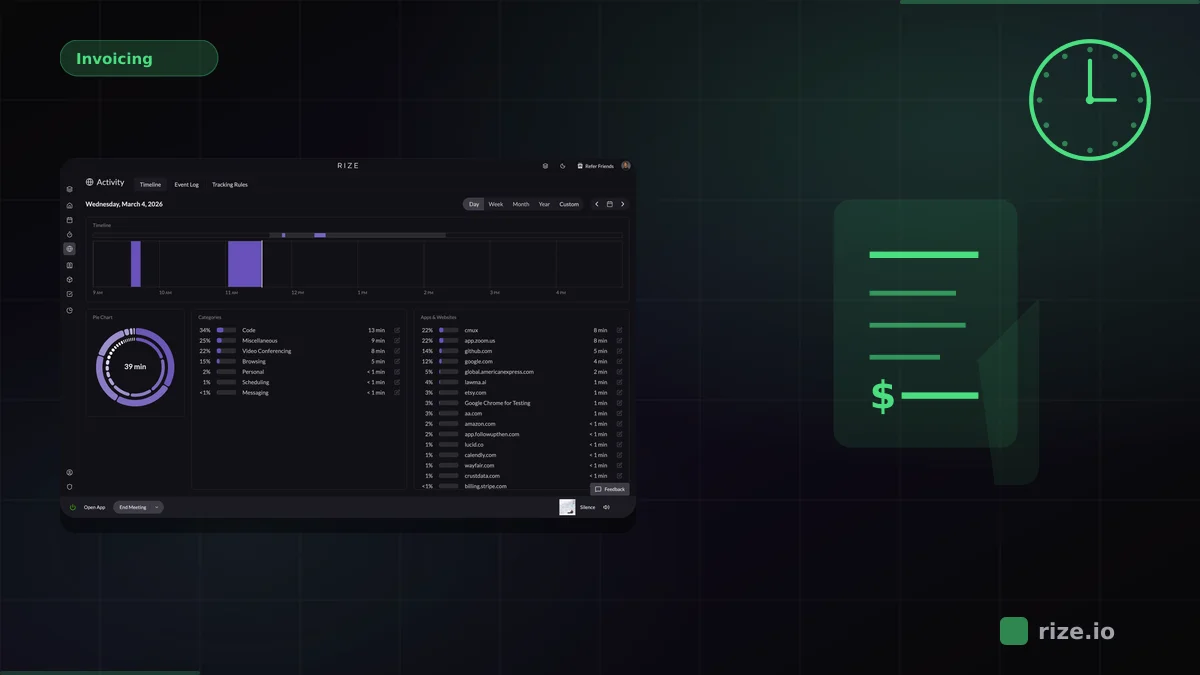
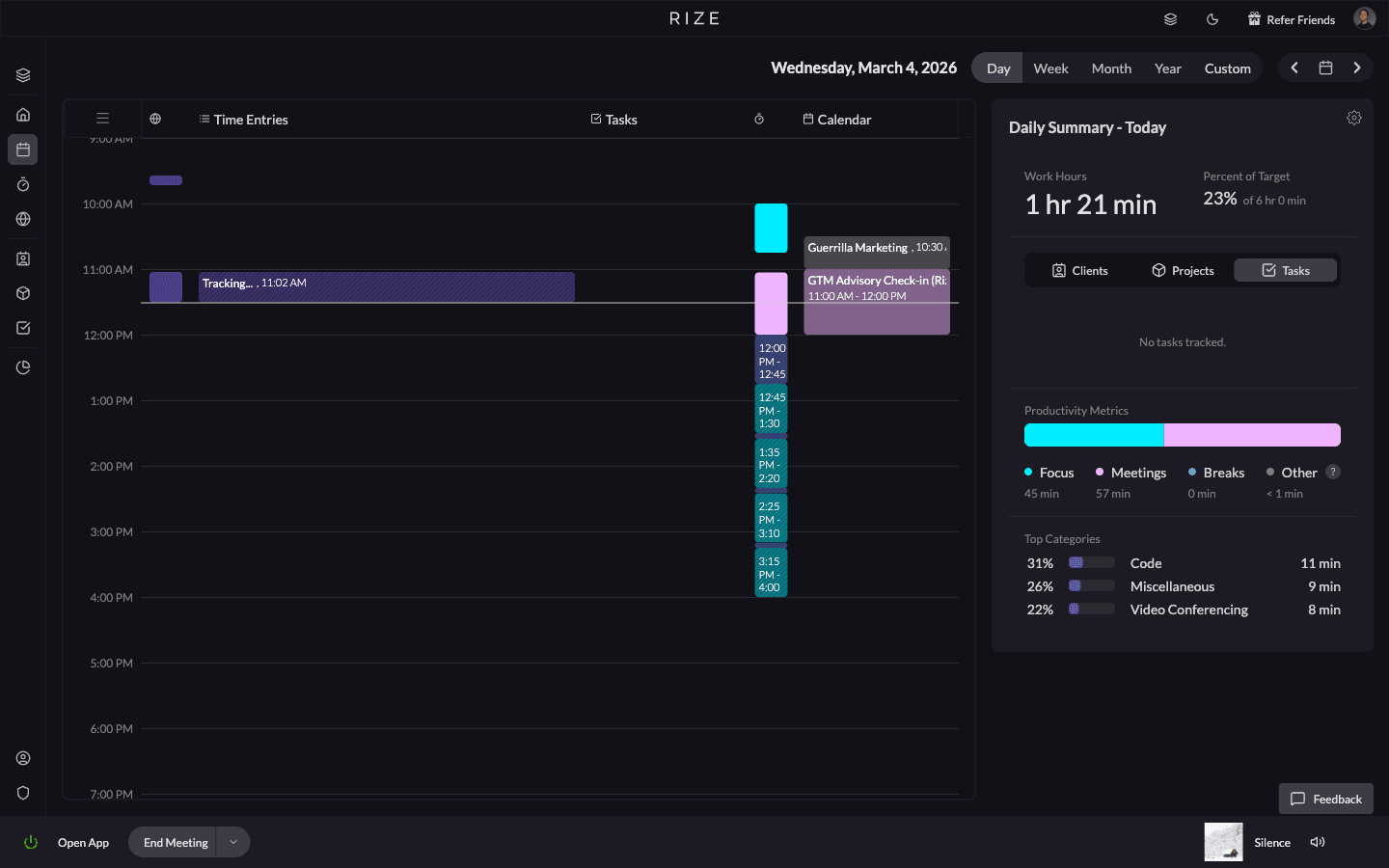
Accurate passive time tracking runs silently in the background of your OS. It logs exactly which applications, websites, and files you are actively using, down to the minute. By removing the friction of manual data entry, passive tracking means no billable hour slips through the cracks.
How Rize's Zero-Touch Capture Eliminates Human Error
If you have to remind your team to turn on a timer, you have already lost data. Rize solves the fundamental mismatch between sold time and actual time spent through zero-touch capture.
Instead of just tracking raw background data and asking you to organize it later, Rize's AI creates time entries from your activity and tags them to your specific clients, projects, or tasks. Every minute spent in Figma, VS Code, or Slack is accurately and automatically logged. Impulse Lab, a 6-person web agency, hit 98% client billing accuracy with Rize and cut their reporting time by 5x. This level of precision removes the burden of the chore, protects your agency's profitability, and allows your team to stay focused on creating.
How Timely Handles Automated Capture
Timely takes a solid approach to passive tracking through its Memory feature, which records background activity securely. Where it differs from Rize is in the review step. Timely drafts time entries for you to approve rather than finalizing them automatically. This adds a manual checkpoint that can introduce delays and estimation bias, but gives users explicit control over what gets logged.
Where Toggl Track Fits In
Toggl Track is primarily a manual timer tool. Its background tracking feature records which apps and websites you visit, but categorization relies on user-defined rules rather than AI. For teams that are already disciplined about starting and stopping timers, Toggl is a reliable choice. For teams that struggle with manual entry, the accuracy gap compounds quickly.
See how zero-touch tracking works
Rize captures every billable minute automatically — no timers, no reminders. Start a free 7-day trial and compare the difference.
Start Free TrialWhich Tool Fits Which Workflow
Not every team works the same way. The right tool depends on your team size, billing model, and how much manual process you are willing to tolerate.
Solo Freelancers
If you work alone and bill by the hour, accuracy is the difference between getting paid and leaving money on the table. Toggl Track's free tier is tempting, but you are betting on your own discipline to start and stop every timer. One forgotten session during a deep Figma sprint, and you are writing off real hours.
Rize's automatic time tracking removes that risk entirely. It runs in the background from the moment your machine wakes up. Every application switch, every browser tab, every document — captured without a single click. For freelancers juggling three or four clients in a day, that kind of passive capture pays for itself in the first week.
Small Agencies (2–10 People)
Small agencies feel the pain of inaccurate time data the most. You are billing clients directly, and every missed hour eats into already thin margins. Timely works well here if your team has the habit of reviewing AI-drafted entries each day. But that review step takes five to fifteen minutes per person, and not everyone does it consistently.
Rize skips the review bottleneck. Its AI categorizes time at the URL and file level, so your team's hours are organized by client and project without anyone touching a timesheet. For a five-person agency, that saves roughly an hour of admin time per day across the team. Check the pricing page to see how team plans scale.
Larger Teams (10+ People)
At scale, the cost of inaccurate time tracking multiplies. If ten people each lose fifteen minutes of billable time per day to forgotten timers or lazy timesheet entries, that is over twelve hours per week of unbilled work. For a growing team, the gap between tracked time and actual time becomes a real revenue problem.
Toggl Track can work for large teams with strict process enforcement, but you are relying on every person to follow the rules every day. Timely's review-and-approve model is better, but still creates a daily admin task that managers have to chase. Rize's zero-touch model means managers get accurate data without policing anyone's behavior.
Privacy and Data Handling
Accuracy means nothing if your team does not trust the tool. Privacy is a real concern with any software that monitors desktop activity, and the three tools handle it differently.
Rize stores all activity data locally on the user's machine by default. No screenshots, no keylogging, no screen recordings. The tracking focuses on application names, window titles, and URLs — enough to categorize time accurately without capturing sensitive content. Team admins see aggregated productivity metrics and time breakdowns, not raw activity feeds. Individual users control their own detailed data.
Timely also takes privacy seriously. Its Memory feature stores raw activity data privately — only the individual user can see it. Managers only see the approved time entries that users choose to publish. This is a strong model, though the trade-off is that the review step adds friction.
Toggl Track's background tracking is minimal enough that privacy is less of an issue, but the flip side is that you get less data to work with. App-level tracking without URL detail means less precision in how time gets categorized.
How to Evaluate Accuracy for Yourself
Claims about accuracy are easy to make. The only way to know which tool works for your workflow is to run a real test. Pick a typical work week — not a light one — and run two tools side by side. At the end of the week, compare the captured hours against your actual calendar and deliverables.
Pay attention to three things: how many hours each tool captured versus what you actually worked, how accurately time was categorized by project or client, and how much manual cleanup you had to do after the fact. The tool that captures the most hours with the least correction wins.
Start tracking time automatically
Join thousands of professionals who stopped guessing where their time goes. Free for 7 days.
“Rize has been a no-brainer for me.” — Ali Abdaal Read more →
The Bottom Line
For teams that need the highest accuracy with the least friction, zero-touch AI categorization is the clear winner. Accuracy isn't about tracking more — it's about trusting the data enough to send it to a client. Rize eliminates the human error that plagues both manual timers and semi-automated tools.
If your team already uses timers consistently and your billing is accurate, switching tools may not be urgent. But if you are seeing gaps between tracked hours and actual work — or if your team treats timesheets as a Friday afternoon guessing game — the problem is the tool, not the people. As Leonard Roussard of Impulse Lab puts it: "The biggest issue for service businesses is linking time to work — features, bugs, pull requests. That's where you lose money, time, and trust if you're not tracking well."
Start by auditing one week of time data. Compare what your current tool captured against your calendar, git commits, and deliverables. If there is a gap of more than 10%, passive tracking will recover real revenue. See what independent reviewers are saying, browse more time tracking comparisons, start a free 7-day trial to see the difference, or book a demo if you are evaluating for a team.
Dive Deeper
For head-to-head breakdowns, read Rize vs Timely or Rize vs Toggl for agencies. See the full feature comparison on our Toggl alternative page, or explore how Rize compares to Harvest and Clockify. If you run an agency, see how Rize works for agency teams.