Fifty billion dollars. That is the estimated annual cost of untracked billable hours across professional services globally. While the time tracking industry grows past $6 billion in market value, most teams still rely on methods that miss a third of the hours they actually work. Here is what the data says about where this market is heading — and what it means for your team.
Key Takeaway
The time tracking market will nearly double to $11.43B by 2030, driven by AI automation and the collapse of surveillance-based monitoring. Automated tracking captures 91%+ of billable hours versus 68% with manual timesheets, while average billable utilization has fallen to 66.4% — a four-year low. Teams that switch to automatic capture recover the equivalent of $9,375 per employee per year in previously lost revenue.
The Market Is Growing Faster Than You Think
The global time tracking software market hit $6.1 billion in 2025 and is on pace to reach $11.43 billion by 2030 — a 13.38% compound annual growth rate (Mordor Intelligence).
Three forces are driving that growth.
Cloud owns the market. Cloud-deployed time tracking holds 77.8% market share, and mobile time tracking apps are growing even faster at 14.8% CAGR (MRFR). The desktop-only, install-it-yourself era is over. Teams expect their tools to work across devices, sync in real time, and require zero IT setup.
Small businesses are the biggest buyers. SMEs account for 62.8% of market revenue (Straits Research). Enterprise players like SAP and Oracle still exist, but the volume is in 5-to-200-person teams that need billing accuracy without a six-month procurement cycle.
The market is wide open. The top five vendors hold a combined 48% market share, leaving plenty of room for tools that solve real problems instead of just counting clicks. That headroom explains why incumbents are making big moves — Harvest was acquired by Bending Spoons in 2025, followed by 10x+ price hikes that sent users looking for alternatives. Toggl launched AI-driven analytics in August 2025. The competitive map is being redrawn in real time.
AI Is Eating Time Tracking
AI adoption in business reached a tipping point in 2026: 91% of companies now use AI in at least one capacity, and the generative AI market grew 55% year-over-year to $161 billion (Statista).
For time tracking, AI means the difference between logging what you remember and capturing what actually happened. Manual timesheets catch roughly 68% of billable hours. Automated tracking — where AI categorizes activity in the background — captures 91% or more. That 23-percentage-point gap is where firms are hemorrhaging revenue without realizing it.
But there is a catch. Workers save an average of 5.4% of weekly hours (about 2.2 hours per week) using AI tools, according to recent workplace studies. That time savings is real. What is less clear is whether it shows up on the bottom line.
80% of firms see no measurable bottom-line impact from AI adoption despite spending on it. And PwC's 2026 analysis found that 74% of AI's economic value is being captured by just 20% of organizations. The gap is not about whether you have AI — it is about whether you can measure what AI actually changes in your workflow.
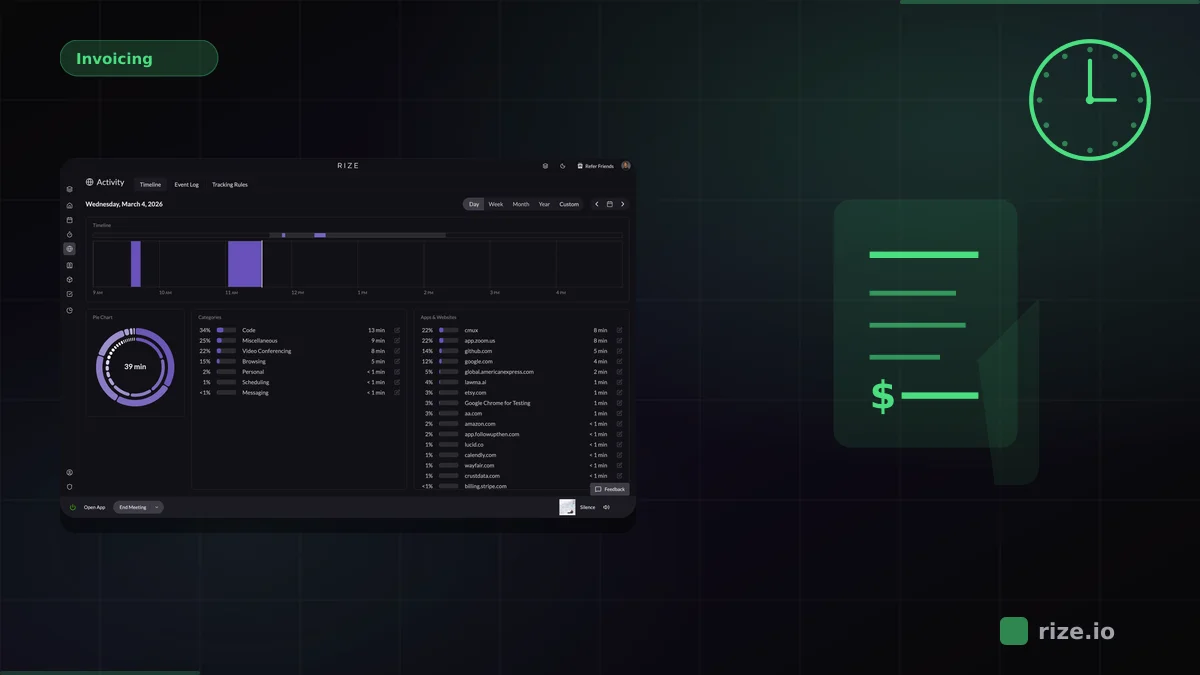
This is where automatic time tracking becomes an operating system for AI measurement, not just a billing tool. If your team uses Copilot, ChatGPT, or Claude to write code, draft proposals, or analyze data, you need a way to see whether those tools are saving time or just shifting it. Automatic time tracking captures the before and after without asking anyone to fill out a form.
Automatic time tracking — background time capture that logs every app, document, and website without manual timers, recovering the hours typically lost to manual logging.
The Privacy Pivot
The surveillance era of time tracking is ending. According to Hubstaff's own research, 72% of employees say monitoring does not improve their productivity — and 42% of monitored employees plan to leave within a year, compared to 23% of unmonitored workers.
That turnover gap is staggering. Companies that rely on screenshots, keystroke logging, and activity scores are paying for attrition they cannot see on a dashboard.
Regulators noticed. The EU AI Act, which took effect in 2026, classifies workplace AI systems as "high-risk" and outright bans emotion recognition in the workplace. Any tool that scores employees based on inferred emotional states or attention levels is now on the wrong side of the law in Europe.
Search behavior is shifting, too. Queries for "employee monitoring" are declining while searches for "productivity tracking" and "automatic time tracking" climb. Buyers are moving away from tools that watch people and toward tools that help people understand their own work patterns.
The distinction matters. A monitoring tool answers "Is this person working?" A productivity tracker answers "Where is the team's time going — and how do we bill for it?" One creates friction and turnover. The other creates data your team actually wants to use.
With 36.2 million Americans working remotely by 2025, the old model of presence-as-productivity was already broken. The data confirms what most managers already suspected: trust outperforms surveillance.
The Utilization Crisis
Average billable utilization fell to 66.4% in 2025 — a four-year decline — according to SPI Research. That means a third of every service team's capacity goes unbilled, and the trend is getting worse, not better.
The dollar impact is brutal. TMetric reports that 47% of firms lose up to $500,000 per year on untracked hours. At the individual level, if one employee misses just 15 minutes per day at a $150/hour billing rate, that is $9,375 per year in revenue that never gets invoiced. Scale that across a 20-person team, and you are looking at $187,500 walking out the door annually.
Here is where it compounds:
- Context switching burns 2.1 hours per day. Every Slack ping, email check, and meeting transition costs real time that rarely appears on a timesheet.
- Write-off leakage hits 23%. Nearly a quarter of billable time never gets billed — not because the work did not happen, but because nobody tracked it accurately enough to justify the invoice.
- Projects without task tracking overrun by $8,700 on average. Meanwhile, 89% of projects with task tracking come in on-budget, versus 61% without.
The pattern is clear: teams that track accurately bill more, overrun less, and retain higher margins. Teams that rely on memory and Monday morning timesheet submissions leave money on the table every single week.
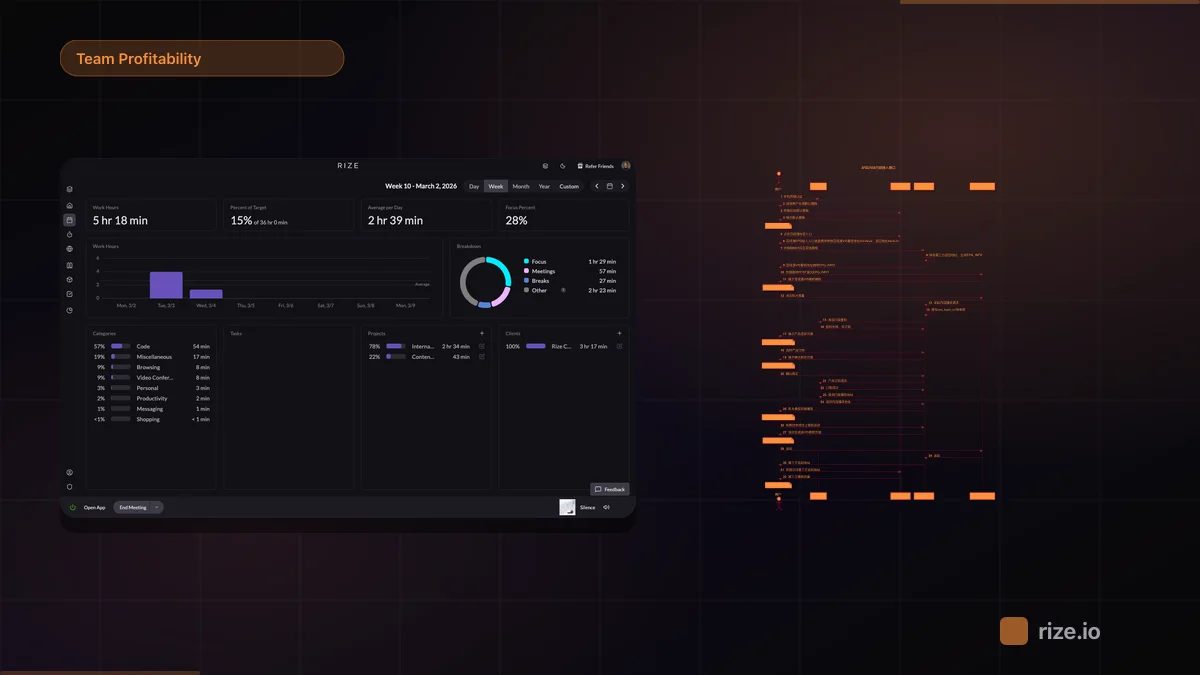
For agencies and professional services firms, utilization is the metric that determines whether you grow or stall. A two-percentage-point improvement in utilization — from 66% to 68% — can mean six figures in additional annual revenue for a mid-sized team. Project profitability tracking makes that gap visible before the quarter ends.
What the Data Means for Your Team
The time tracking industry is splitting into two camps: surveillance tools losing users and trust, and AI-powered automatic trackers gaining market share and regulatory favor. The data points to five actions that separate high-performing teams from the rest.
1. Automate capture, stop relying on memory. The 23-point gap between automated and manual tracking (91% vs. 68%) is not a rounding error. It is the difference between billing for the work your team actually does and writing off a quarter of it.
2. Measure AI's real impact. If 80% of firms see no bottom-line effect from AI despite adopting it, the problem is not AI — it is visibility. Use time data to compare team velocity before and after AI tool adoption. Actual hours-per-deliverable beats survey responses every time.
3. Drop surveillance, keep accountability. The 42% turnover rate among monitored employees is a retention crisis hiding in your tech stack. Track time at the project and client level, not at the keystroke level. Your team will stay longer and bill more.
4. Close the utilization gap. At 66.4% average utilization, most teams have a 5-10 point improvement available just by capturing the hours that currently go unlogged. That is not about working more — it is about billing for the work already happening.
5. Audit your tools against the new rules. The EU AI Act is not theoretical. If your time tracking or monitoring tool uses emotion recognition, attention scoring, or behavioral inference, you have a compliance risk that grows with every new regulation.
The $50 billion lost annually to untracked time is not a hypothetical. It is spread across hundreds of thousands of teams in increments of 15 minutes here, a forgotten task there, a context switch that never made it onto the invoice. The firms that close that gap are the ones that stop asking people to remember and start letting software do what software does best — capture everything, automatically.
See Rize pricing or book a demo to see how automatic time tracking works for your team.