Employee monitoring software was built to answer one question: "Is this person working right now?" But most teams searching for these tools actually need something different -- accurate project time data, utilization rates, and billable hour reports. You do not need screenshots or keystroke logs to get those answers. You need time tracking.
Quick Answer
Best alternative to employee monitoring software: Rize tracks time automatically by capturing app and website metadata -- no screenshots, no keylogging, no screen recording. AI categorizes every work session into projects and clients. Managers get utilization dashboards and billable hour reports without surveillance. Start a free 7-day trial.
Employee Monitoring vs. Time Tracking: Two Different Problems
Employee monitoring and time tracking solve different problems. Monitoring tools like Hubstaff, Time Doctor, ActivTrak, and Teramind capture screen content, keystrokes, and mouse activity to verify whether someone is working. Time tracking tools capture which applications, websites, and projects consume time so teams can bill accurately and plan capacity.
The distinction matters because the tool you choose shapes your team culture. According to Gallup research, replacing a mid-level knowledge worker costs 50-200% of their annual salary. If invasive monitoring pushes even two experienced people out the door per year, the recruiting cost exceeds the subscription price of any monitoring tool. The teams most likely to accept surveillance are the ones with the fewest options -- which means you are selecting for compliance, not competence.
If your actual need is "where did time go?" rather than "is this person active?", you need a time tracking tool, not a monitoring tool. Here are seven alternatives that deliver accurate time data without surveillance.
Comparison: Employee Monitoring Alternatives
| Tool | Tracking Method | Screenshots | Keylogging | Project Tagging | GDPR Compliance | Best For |
|---|---|---|---|---|---|---|
| Rize | Fully automatic (metadata) | Never | Never | AI auto-categorization | Compliant by default | Agencies, knowledge teams |
| Timely | Background capture + manual review | Never | Never | Manual assignment | Compliant by default | Mid-size teams, resource planning |
| Memtime | Background capture + manual export | Never | Never | Manual assignment | Compliant by default | Consultants, professional services |
| DeskTime | Automatic + productivity scoring | Optional | Never | Category rules | Requires screenshot opt-out | Small teams wanting productivity scores |
| TimeCamp | Rule-based auto-tracking | Optional | Never | Keyword rules | Requires screenshot opt-out | Budget-conscious teams |
| Toggl Track | Manual timer + basic auto-detect | Never | Never | Manual assignment | Compliant by default | Freelancers, simple tracking |
| Clockify | Manual timer | Optional (paid) | Never | Manual assignment | Requires screenshot opt-out | Small teams on a budget |
1. Rize -- Fully Automatic, Privacy-First Time Tracking
Rize is the best alternative to employee monitoring software for teams that need accurate project time data without surveillance. It runs a lightweight desktop app that captures app names, window titles, and browser URLs in the background. AI categorizes every work session into projects, clients, and tasks in real time -- no timers to start, no timesheets to fill.
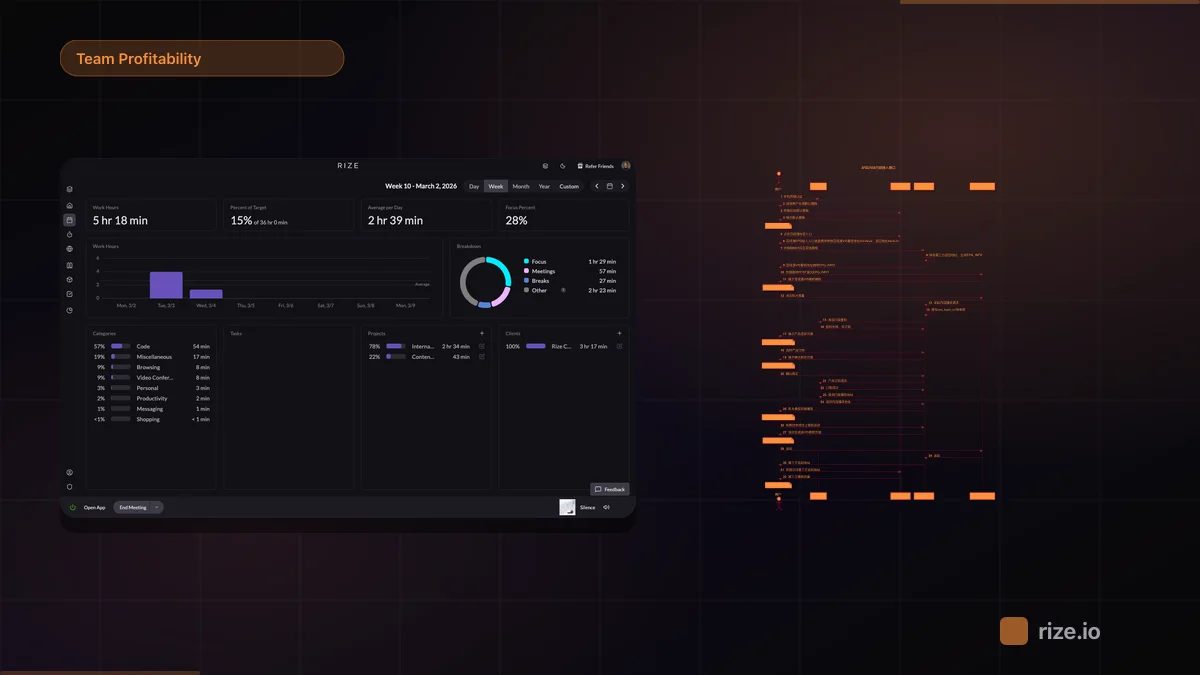
Rize never takes screenshots, records screens, or logs keystrokes. It reads metadata only -- the same information your operating system already tracks in its activity logs. Managers see team utilization dashboards, billable vs. non-billable breakdowns, and project-level time allocation without reviewing individual activity. All raw data stays on each team member's device; what syncs to the dashboard is project-level time totals.
Ben Jackson, CEO of 12-person creative agency Momentum Studio, saw the difference after switching from manual tracking: "I'm a trusting leader, but I don't even trust myself to remember what I worked on two days ago." After rolling out Rize, the team recovered 20% more billable time and saved 8 hours per week on admin work that had been spent chasing timesheets. Leonard Roussard, CEO of product studio Impulse Lab, reported 98% billing accuracy and 5x faster client reporting after adopting Rize.
Pricing: From $9.99/month (Basic) or $29.99/seat/month (Team). Free 7-day trial with full features.
Pros: Fully automatic capture, AI project categorization, no screenshots by design, team utilization dashboards, GDPR-compliant by default, integrations with ClickUp, Linear, Asana, Jira, and Zapier.
Cons: Desktop only (macOS and Windows) -- no mobile app. Higher per-seat price than manual timer tools. No GPS tracking for field workers.
Track time without monitoring your team
Rize captures every work session automatically -- no screenshots, no keyloggers, no timers. Your team gets privacy, you get accurate data.
Start Free Trial2. Timely -- Background Capture With Manual Review
Timely captures background activity through its Memory feature, which logs app and website usage throughout the day. Users then review a visual timeline and drag entries into their timesheet to finalize them. No screenshots or keylogging.
The key trade-off is manual effort. Timely captures more data than a manual timer, but someone still needs to review and assign time blocks to projects daily. If review falls behind, the unprocessed timeline accumulates. Timely's strength is resource planning and team capacity dashboards for organizations with 20+ people.
Pricing: From $9/user/month. 14-day free trial.
Pros: No screenshots, strong resource planning, clean timeline interface, integrations with Asana, Jira, and Basecamp.
Cons: Requires daily timeline review. No AI auto-categorization -- users manually assign time to projects. Higher price than Rize for comparable features without the automation.
3. Memtime -- Offline-First Background Capture
Memtime records application activity locally on your desktop and displays it as a visual timeline. All data stays on your machine -- nothing syncs to a server unless you explicitly export it. No screenshots, no keylogging, no cloud storage of raw activity.
This makes Memtime a strong fit for consultants and professional services firms in regulated industries where data residency matters. The downside is the manual workflow: you review your timeline and create time entries by hand, then export to your billing system. There is no AI categorization or automatic project assignment.
Pricing: From $14/user/month. 14-day free trial.
Pros: Data stays on-device, strong privacy posture, integrations with SAP, DATEV, and ERP systems, no cloud dependency.
Cons: Manual timeline review and entry creation. No team dashboards or utilization reporting. No AI categorization. Desktop only (Windows and macOS).
4. DeskTime -- Automatic Tracking With Productivity Scoring
DeskTime tracks applications and websites automatically and categorizes them as productive, unproductive, or neutral based on rules you define. It provides productivity scores, absence calendars, and team reports. Screenshots are available as an optional feature but can be disabled.
DeskTime sits between monitoring and time tracking. The productivity scoring system creates a lighter version of the surveillance dynamic -- employees know their app usage is being classified -- but it avoids the worst privacy issues if screenshots are disabled. It works well for small teams that want basic utilization data with a productivity lens.
Pricing: From $7/user/month. Free tier for 1 user. 14-day free trial.
Pros: Automatic app tracking, productivity scoring, affordable, project tracking with cost estimates, absence tracking.
Cons: Productivity scoring can feel like soft surveillance. Screenshots available (must be explicitly disabled). No AI categorization. Rule-based app classification requires ongoing maintenance.
5. TimeCamp -- Rule-Based Auto-Tracking With a Free Tier
TimeCamp offers automatic desktop tracking with a keyword-based rule system. You define rules that map application names, window titles, or URLs to projects. When you use an app that matches a rule, TimeCamp logs time to that project automatically.
The free tier includes one user with basic automatic tracking, which makes TimeCamp accessible for solo professionals testing the concept. Paid plans start at $3.99/user/month. The trade-off is setup and maintenance -- you need to create and update rules as your projects and tools change. New clients, new apps, or new workflows all require new rules.
Pricing: Free for 1 user. From $3.99/user/month (paid). 14-day free trial on paid plans.
Pros: Free tier, rule-based automation, integrations with Asana, Trello, Monday, and Jira, invoicing features, attendance tracking.
Cons: Rules require manual setup and maintenance. Optional screenshots (must be disabled). No AI categorization. Automatic tracking accuracy depends entirely on rule quality.
6. Toggl Track -- Manual Timers With Clean Design
Toggl Track is one of the most popular time tracking tools worldwide, known for its simple start/stop timer interface. The desktop app includes a basic Timeline feature that logs app usage in the background, but it does not create time entries automatically.
Toggl never takes screenshots or logs keystrokes. Its strength is simplicity -- the interface is clean, onboarding is fast, and the free tier supports up to 5 users. The weakness is accuracy: manual timers miss short tasks, context switches, and the small blocks of client work that add up to significant billable time. According to Harvard Business Review research, inaccurate timesheets cost businesses $7.4 billion per day globally.
Pricing: Free for up to 5 users. From $9/user/month (paid). 30-day free trial on paid plans.
Pros: Clean interface, generous free tier, no screenshots, 100+ integrations, strong reporting, project budgets.
Cons: Manual timers miss time. Timeline feature does not auto-create entries. No AI categorization. Accuracy depends on user discipline.
7. Clockify -- Free Manual Timer for Small Teams
Clockify offers a free plan for up to 5 users with manual time tracking (the free tier was capped at 5 users in April 2026), which makes it a common entry point for small teams evaluating time tracking for the first time. The free tier includes timesheets, basic reporting, and project tracking. Paid plans add features like screenshots, time audits, and GPS tracking.
Clockify does not take screenshots on the free tier. The screenshot feature is a paid add-on and can be disabled. For teams that just need a shared timesheet without surveillance, Clockify covers the basics at no cost. The trade-off is entirely manual data entry -- every timer must be started and stopped, and every entry assigned to a project by hand.
Pricing: Free (up to 5 users). From $3.99/user/month (paid). Paid plans add billable rates, report exports, screenshots, approvals, and scheduling.
Pros: Free for up to 5 users, manual timesheets, basic reporting, kiosk mode for hourly teams (paid), scheduling (paid).
Cons: Entirely manual. No automatic capture. Screenshots available on paid plans (must be disabled). No AI categorization. Accuracy relies completely on user input.
Why Teams Are Switching Away From Monitoring Software
The shift from employee monitoring to privacy-first time tracking is accelerating for three reasons: surveillance tools reward the wrong behavior, they drive away experienced talent, and they create unnecessary legal exposure.
Monitoring rewards performative busyness
When people know their screen is being captured, they optimize for appearances. Mouse jigglers -- both hardware and software -- exist because surveillance tools measure input activity, not output quality. A developer thinking through an architecture decision looks "idle" to a screenshot tool. A designer reviewing competitor work looks "off-task." The data these tools produce measures the wrong thing.
Surveillance drives away experienced talent
Senior professionals with options will not tolerate screenshot monitoring. According to Gallup research, replacing a mid-level knowledge worker costs 50-200% of their annual salary. If monitoring pushes even two experienced people out the door per year, the recruiting cost dwarfs any monitoring subscription. The teams most likely to accept surveillance are the ones with the least bargaining power.
Screenshot capture creates legal exposure
Under GDPR, capturing screenshots constitutes processing of personal data that requires explicit consent and documented legitimate interest. If a screenshot captures a personal banking tab, a medical appointment, or a private message, your company is now holding sensitive personal data it never needed. CCPA imposes similar requirements in California. Metadata-based time tracking avoids these obligations entirely because it records only app names and URLs -- not screen content.
Ben Jackson of Momentum Studio described the cultural shift after moving away from manual tracking: "It wasn't just a financial issue -- it was a relational one. You end up interrogating your team about time logs, and that breaks down trust." Privacy-first tools remove that friction from the employment relationship entirely.
How to Evaluate an Employee Monitoring Alternative
When evaluating alternatives to employee monitoring software, focus on five criteria that separate time tracking tools from surveillance tools.
1. Does it capture time automatically? Manual timers miss short tasks, context switches, and quick client emails. According to Harvard Business Review research, inaccurate timesheets cost businesses $7.4 billion per day. Automatic capture eliminates that gap. Rize and Timely capture automatically. TimeCamp uses keyword rules. Toggl and Clockify require manual timers.
2. Does it take screenshots or log keystrokes by design? Some tools include screenshots as an option that can be disabled. Others never include them at all. "Off by default" is not the same as "architecturally impossible." Rize, Timely, Memtime, and Toggl never take screenshots. DeskTime, TimeCamp, and Clockify include optional screenshot features.
3. Does it categorize time to projects automatically? Capturing raw activity is only half the job. The other half is mapping that activity to clients and projects. Rize uses AI to auto-categorize. Timely, Memtime, and Toggl require manual project assignment. TimeCamp uses keyword rules.
4. Does it provide team-level dashboards? Managers need utilization rates, billable vs. non-billable breakdowns, and capacity data -- not individual activity logs. Rize provides team utilization dashboards that show aggregate data without exposing individual screen activity.
5. Is it GDPR-compliant without configuration? Tools that include screenshots or keylogging require additional GDPR compliance work: explicit consent, data protection impact assessments, and documented legitimate interest. Tools that only capture metadata -- app names and URLs -- are compliant by default because they avoid processing sensitive personal data.
What Changes When You Switch From Monitoring to Time Tracking
The first thing that changes is data quality. When people are not gaming the system with mouse jigglers and tab-switching, the time data reflects actual work patterns. Momentum Studio recovered 20% more billable time after switching to automatic tracking -- not by working longer hours, but by capturing client work that previously went unlogged in manual timesheets.
The second thing that changes is team dynamics. When the system's message to your team shifts from "we're watching" to "let's capture time accurately so billing is fair," adoption rates climb. Privacy-first tools face less resistance during rollout because the tool is working for the team, not on the team.
The third thing that changes is what managers actually look at. Instead of reviewing screenshots and activity percentages, they review utilization trends, project hour allocations, and capacity data. These are the metrics that drive staffing decisions, pricing conversations, and client profitability analysis. For more on this shift, see our guide to remote workforce monitoring without surveillance.
The Bottom Line
If your team needs accurate project time data, utilization reports, and billable hour tracking, you do not need employee monitoring software. You need a time tracking tool that captures work automatically and respects your team's privacy.
Rize is the strongest option for teams that want fully automatic capture with AI categorization and zero surveillance features. Timely fits teams that prefer manual timeline review with strong resource planning. Memtime fits regulated environments that need all data on-device. DeskTime, TimeCamp, Toggl, and Clockify offer various levels of automation and privacy at lower price points.
The choice is not between visibility and privacy. It is between measuring activity and measuring output. The tools on this list prove you can have complete time data without a single screenshot. Compare how Rize stacks up against the leading monitoring tool in our Rize vs. Hubstaff comparison, or explore our full guide to privacy-first time tracking software.
Start tracking time automatically
Join thousands of professionals who stopped guessing where their time goes. Free for 7 days.
“Rize has been a no-brainer for me.” — Ali Abdaal Read more →