Most time tracking apps for Windows still rely on manual timers. You press start when you begin a task, press stop when you finish, and hope you remembered to do it for every context switch in between. Automatic time tracking eliminates that overhead entirely -- the app runs in the background, captures what you work on, and categorizes it for you.
This guide compares four automatic time tracking approaches for Windows: Rize (fully automatic with AI categorization), Timely (background capture with manual approval), TimeCamp (rule-based auto-tracking), and Toggl Track (manual timers with limited auto-detection). According to Harvard Business Review research, inaccurate timesheets cost businesses $7.4 billion per day globally.
Quick Answer
Best automatic time tracking for Windows: choose Rize for fully passive capture with AI categorization and no screenshots. Choose Timely for background capture with manual timeline review. Choose TimeCamp for rule-based auto-tracking with a free tier. Choose Toggl if you prefer manual timers with basic background detection.
Comparison: Windows Time Tracking Apps
| Feature | Rize | Timely | TimeCamp | Toggl Track |
|---|---|---|---|---|
| Tracking Method | Fully automatic (zero-touch) | Background capture + manual approval | Rule-based auto-tracking | Manual timer + basic auto-detect |
| AI Categorization | Yes (auto-tags with confidence scores) | Partial (activity grouping) | No (keyword rules) | No |
| Manual Effort Required | None after install | Daily timeline review | Rule setup + periodic review | Start/stop every task |
| Privacy | No screenshots, no keystrokes | No screenshots | Optional screenshots | No screenshots |
| Windows Versions | Windows 10 + 11 | Windows 10 + 11 | Windows 10 + 11 | Windows 10 + 11 |
| Integrations | ClickUp, Linear, Asana, Jira, Zapier | Asana, Jira, Basecamp, Zapier | Asana, Trello, Monday, Jira | 100+ via extensions |
| Pricing | From $23.99/mo (Pro, annual); $29.99/seat/mo (Team, annual) | From $9/user/mo | Free tier; from $3.99/user/mo | Free tier; from $9/user/mo |
Rize: Fully Automatic Time Tracking for Windows
Rize is the only fully automatic time tracker for Windows that requires zero interaction after install. It runs as a native Windows app in the system tray, launches at startup, and captures every application, browser tab, and document you work on. AI categorizes each activity into projects, clients, and tasks in real time.
The Windows app uses the Windows accessibility API for precise foreground window detection. CPU usage stays under 1% and memory impact is minimal. Every work session is logged automatically -- you never press start, stop, or fill out a timesheet. As of May 2026, Rize creates live time entries as you work (not in a batch after the fact) and shows a review panel where you can see the apps, websites, and events behind each entry with AI tag suggestions and confidence scores.
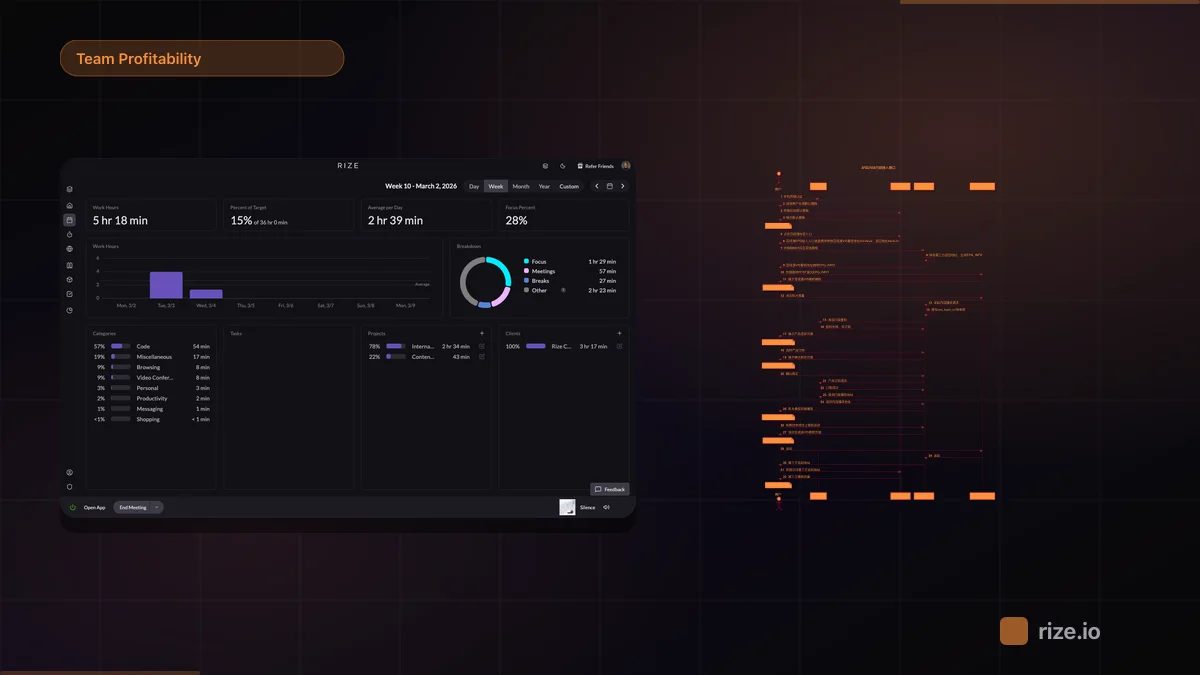
For teams, Rize provides utilization dashboards, project profitability tracking, and billable vs non-billable breakdowns without any manual data entry. Managers see aggregate team-level data -- never individual screenshots or keystroke logs.
Timely: Background Capture with Manual Review
Timely captures background activity on Windows through its Memory feature, which logs app and website usage throughout the day. Users then review a visual timeline and drag entries into their timesheet to finalize them.
This approach captures more data than manual timers, but it still requires daily review. If you skip a day or two, the unreviewed timeline accumulates and becomes a chore. Timely's strength is resource planning and team capacity dashboards for mid-to-large organizations. Pricing starts at $9/user/month.
The key difference from Rize: Timely captures activity but does not categorize it automatically. You manually assign time blocks to projects during review. Rize's AI handles that assignment in real time, so entries are ready when you look at them.
TimeCamp: Rule-Based Auto-Tracking
TimeCamp offers automatic desktop tracking on Windows with a keyword-based rule system. You define rules that map specific application names, window titles, or URLs to projects. When you use an app that matches a rule, TimeCamp logs time to that project.
The free tier includes one user with basic automatic tracking. Paid plans start at $3.99/user/month. TimeCamp integrates with Asana, Trello, Monday, and Jira, making it a reasonable mid-range option for teams that want some automation without a full AI engine.
The trade-off is setup and maintenance. You need to create and update rules as your projects and tools change. New clients, new apps, or new workflows require new rules. Rize's AI learns your patterns without manual rule configuration.
Toggl Track: Manual Timers with Basic Auto-Detect
Toggl Track is one of the most popular time tracking apps worldwide, known for its simple start/stop timer interface. The Windows desktop app includes a basic auto-tracking feature called Timeline that logs app usage in the background.
Timeline shows a visual record of which apps you used, but it does not create time entries automatically. You still need to manually review the timeline and assign blocks to projects. The free tier supports up to 5 users with manual timers. Paid plans start at $9/user/month.
For teams that prefer manual control over every time entry and want a well-designed, simple interface, Toggl is a solid choice. For teams that want automatic capture without any daily interaction, Toggl's Timeline feature is a step forward from pure manual timers but falls short of what Rize or Timely offer.
Integrations That Matter on Windows
Windows users typically run Jira, ClickUp, Linear, or Asana alongside their desktop apps. Rize supports native integrations with ClickUp, Linear, and Asana, plus Jira task creation from the review panel and Zapier connections to 8,000+ other apps. Time entries flow to the correct tool automatically based on your project mapping.
A common Windows workflow: code in VS Code or Cursor, manage tasks in Jira, communicate in Slack and Teams, document in Notion. Rize captures time across all of these without any per-app configuration. According to McKinsey research, knowledge workers spend 60% of their time on "work about work" -- coordination, status updates, and context switching. Automatic time tracking surfaces exactly how much of that overhead exists on your team.
Which Windows Time Tracker Should You Choose?
The right choice depends on how much manual effort you want to invest:
- Rize -- best for teams that want fully automatic tracking with zero daily interaction. AI categorization, live time entries, review panel, privacy-first. Starts at $9.99/month (Basic, annual); Pro is $23.99/month and Team is $29.99/seat/month on annual billing. Free 7-day trial.
- Timely -- best for teams that want background capture but prefer manual review and approval. Strong resource planning features. From $9/user/month.
- TimeCamp -- best for teams that want some automation via keyword rules and need a free tier. From $3.99/user/month.
- Toggl Track -- best for teams that prefer manual timers with a clean interface and basic background detection. Free for up to 5 users; from $9/user/month.
Teams using manual timers typically capture only 60-80% of actual work time. According to Atlassian research, the average employee switches between tools dozens of times per day -- each switch is a moment where a manual timer gets forgotten. Rize captures all of it automatically. You can start a free 7-day trial on Windows and be tracking in under two minutes.
Track every Windows work session automatically
No timers, no browser extensions. Rize runs in the system tray and captures everything -- including the short tasks manual tools miss.
Start Free Trial