The best remote employee productivity monitoring tools in 2026 are Rize for privacy-first automatic tracking, ActivTrak for workforce analytics, Hubstaff for screenshot proof-of-work, Time Doctor for distraction alerts, and Teramind for compliance-grade monitoring. For knowledge-work teams, Rize is the strongest choice: it captures every work session automatically through automatic time tracking, uses AI to assign time to projects and clients, and gives managers team utilization dashboards without screenshots, keyloggers, or activity scores. Remote teams lose 15-40% of billable hours to inaccurate manual time logs, and surveillance tools designed to fix the problem often make trust worse. The real question is how to track productivity without destroying it. See team pricing or download Rize to start a free 7-day trial.
Quick Answer
Best remote employee productivity tool: Rize tracks time automatically by capturing app and website metadata in the background. AI categorizes every work session into projects and clients. No screenshots, no keylogging, no manual timers. Managers get real-time utilization dashboards for distributed teams. Start a free 7-day trial.
Why Most Remote Monitoring Tools Measure the Wrong Thing
Traditional remote monitoring tools measure activity, not output. Screenshot tools like Hubstaff and Teramind capture what is on screen every few minutes. Activity scorers like ActivTrak and Time Doctor track mouse movements and keystrokes to calculate a "productivity percentage." Neither approach tells you which projects consumed the hours or whether a client engagement is profitable.
The gap matters because knowledge work does not correlate with input activity. A developer debugging a complex issue may sit still for 20 minutes thinking. A strategist reviewing competitor research in a browser looks "off-task" to a screenshot tool. According to Gallup research, replacing a mid-level knowledge worker costs 50-200% of their annual salary. If invasive monitoring pushes even two senior team members out the door, the recruiting cost exceeds the software subscription many times over.
What remote managers actually need is time allocation data: which projects are consuming hours, who is at capacity, which clients are profitable, and where admin overhead is creeping in. That is a time tracking problem, not a surveillance problem.
Comparison: Remote Productivity Monitoring Tools
| Tool | Tracking Method | Screenshots | AI Categorization | Team Dashboards | Price (per seat/mo) | Best For |
|---|---|---|---|---|---|---|
| Rize | Fully automatic (metadata) | Never | Yes | Real-time utilization | $19.99 | Remote knowledge teams |
| ActivTrak | Agent-based activity logging | Optional | Partial | Workforce analytics | $10 | Workforce analytics buyers |
| Hubstaff | Timer + screenshots + GPS | Yes (random) | No | Activity reports | $7 | Field teams, hourly workers |
| Time Doctor | Timer + screenshots + alerts | Yes (configurable) | No | Productivity reports | $7 | BPO, call centers |
| Teramind | Agent-based DLP + monitoring | Yes (continuous) | Rule-based | Security dashboards | $15 | Compliance, insider threat |
Rize: Automatic Time Tracking for Remote Teams
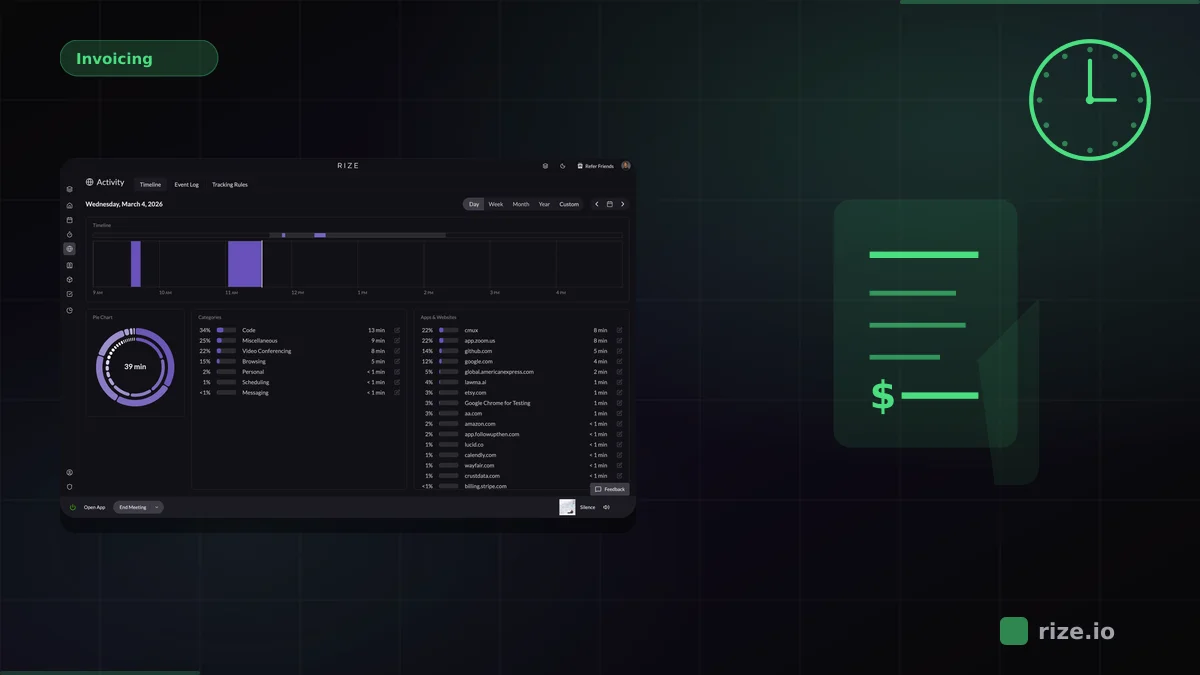
Rize is an automatic time tracker that captures every work session by reading app names, window titles, and browser URLs in the background. AI categorizes each session into projects, clients, and tasks without manual input. Managers see team utilization dashboards showing billable vs. non-billable breakdowns, project allocation, and capacity data in real time.
Rize never takes screenshots, records screens, or logs keystrokes. It reads the same metadata your operating system already tracks. All raw activity data stays on each team member's device; what syncs to the team dashboard is project-level time totals. This architecture means GDPR compliance is built in, not bolted on.
Leonard Roussard, CEO of 6-person product studio Impulse Lab, reported 98% billing accuracy and 5x faster client reporting after adopting Rize: "We use Rize to know: 'We spent 30 hours on this client and got this result.' That's powerful when you're working lean and launching quickly." For distributed teams, that accuracy matters more than screenshot frequency.
Pricing: From $9.99/month (Basic, billed annually) or $29.99/seat/month (Team). Free 7-day trial with full features.
Track remote team productivity without surveillance
Rize captures every work session automatically. No screenshots, no keyloggers, no timers. Your team gets privacy, you get accurate project data.
Start Free TrialActivTrak: Workforce Analytics With Optional Monitoring
ActivTrak positions itself as workforce analytics rather than employee monitoring. It tracks application and website usage through a lightweight agent, then produces dashboards showing team productivity patterns, focus time, and collaboration trends. Screenshots are available as an optional feature but are not required.
The trade-off with ActivTrak is transparency. The agent runs silently and logs every application transition, which feels closer to monitoring than time tracking even when screenshots are disabled. ActivTrak's strength is analytics depth: it produces benchmarks across teams, identifies workload imbalances, and tracks productivity trends over time. It does not auto-categorize time to projects or clients the way Rize does, which limits its value for billing.
Pricing: From $10/user/month. Free tier for up to 5 users.
Hubstaff: Timer-Based Tracking With Screenshots and GPS
Hubstaff combines manual timers with random screenshot capture and GPS tracking. It is designed for teams that need proof-of-work documentation, such as field service crews, hourly contractors, and BPO operations. Managers see activity levels based on mouse and keyboard input alongside screenshots taken at random intervals.
For remote knowledge workers, Hubstaff's approach creates friction. Manual timers miss short tasks and context switches. Screenshots trigger the same trust issues as any monitoring tool. The activity scoring system penalizes thinking time, reading, and research. Hubstaff works well when the job is repetitive and output is easily measurable, but it struggles with creative and strategic work.
Pricing: From $4.99/user/month (Starter). Free 14-day trial.
Time Doctor: Productivity Scoring With Distraction Alerts
Time Doctor tracks time through manual timers or a silent agent, captures screenshots at configurable intervals, and sends real-time alerts when it detects "unproductive" website or application usage. Managers see productivity reports with app-level breakdowns and time-use patterns.
The distraction alert feature is Time Doctor's most polarizing capability. It pops up a notification when a user visits a website categorized as non-work. For BPO operations with defined workflows, this keeps agents on-task. For knowledge workers who research broadly, it creates false positives and resentment. Time Doctor also does not auto-categorize time to specific projects, so billing teams still need manual entry.
Pricing: From $7/user/month. Free 14-day trial.
Teramind: Enterprise Security and Compliance Monitoring
Teramind is a data loss prevention (DLP) and insider threat detection platform with employee monitoring built in. It captures screen recordings, keystrokes, file transfers, and email content. Compliance teams use it to enforce data handling policies, detect anomalous behavior, and produce audit trails.
Teramind is not a time tracking tool. It is a security product that happens to track employee activity. If your requirement is "prevent a contractor from emailing client data to a personal account," Teramind fits. If your requirement is "know how many hours our remote team spent on the Acme project this week," it is the wrong category entirely. The price reflects its enterprise security positioning.
Pricing: From $15/user/month. Enterprise plans on request.
How to Choose the Right Tool for Your Remote Team
The right remote productivity tool depends on what question you are trying to answer. If the question is "where did team hours go?", you need time tracking. If the question is "is this person at their desk?", you need monitoring. Most remote managers need the first answer but buy the second tool.
Choose Rize if your remote team does knowledge work (design, development, consulting, marketing) and you need accurate project time data, billable hour reports, and utilization dashboards without surveillance. Rize's automatic time capture works across time zones without any manual input from team members.
Choose ActivTrak if you need workforce analytics and productivity benchmarking across large teams and can accept that the agent-based approach feels like monitoring even without screenshots enabled.
Choose Hubstaff if your team is hourly, field-based, or doing repetitive work where GPS tracking and proof-of-work screenshots are genuinely needed for client contracts.
Choose Time Doctor if you run a BPO or call center operation where distraction alerts and activity scoring align with measurable, process-driven output.
Choose Teramind if your primary concern is data security, insider threat detection, and regulatory compliance, not time tracking or productivity measurement.
How to Roll Out Productivity Monitoring Without Losing Trust
The rollout determines whether a monitoring tool produces good data or quiet sabotage. Announce the tool before installing it, explain exactly what it collects, and give every team member access to their own data before any manager sees a dashboard.
The stakes are measurable. According to American Psychological Association research, 56% of monitored workers report feeling tense or stressed at work, compared to 40% of workers who are not monitored. That stress gap translates into turnover risk and gamed metrics. A remote employee who feels surveilled will find the mouse jiggler before they find the utilization report.
Four practices separate successful rollouts from resented ones. First, choose metadata capture over screen capture: a tool that reads app names and window titles collects what the operating system already logs, while screenshots capture bank tabs and private messages. Second, write down what is collected and what is not, and put that document where the team can find it. Third, let individuals see their own data first. Rize runs with a visible tray icon and shows each person their full timeline, while managers see project-level rollups rather than individual activity feeds. Fourth, aggregate before you report. A dashboard that shows "Acme project consumed 82 hours this week" starts a planning conversation. A dashboard that shows "Sarah was idle at 2:14pm" starts a resignation letter.
Teams that follow this sequence get higher adoption, and adoption is what makes the data trustworthy. A tracker running on half the team measures nothing.
The Metrics That Predict Remote Team Output
Four metrics predict remote team output better than any activity score: utilization rate, billable vs. non-billable split, project allocation, and focus time. All four come from time data, and none of them require screenshots or keystroke logs to measure.
Utilization rate shows what share of available hours goes to productive or billable work, which makes it the fastest way to spot an overloaded team member or idle capacity. Billable split reveals how much of the week disappears into meetings, admin, and internal tools. Project allocation answers the pricing question: if a retainer client consumes 30% more hours than scoped, the time data is the evidence for the rate conversation. Rize surfaces all three in its team time visibility dashboards, and you can turn the utilization numbers into margin numbers with the profit calculator.
Focus time is the metric activity scores get exactly backwards. Research by Gloria Mark at UC Irvine found it takes about 23 minutes to refocus after an interruption. An activity monitor rewards the constant input of a distracted worker and penalizes the stillness of a focused one. Time-based tracking measures uninterrupted blocks instead, so managers can protect the conditions that produce output rather than the appearance of it.
A fifth metric, capacity headroom, falls out of the first four. When you know each person's utilization and where their hours currently go, you know who can absorb the next project without burning out and who is already past their limit. Remote managers cannot read capacity from body language in an office, so the time data has to carry that signal. Teams that plan staffing from real allocation numbers stop the two most expensive remote failure modes: quietly overloading their strongest people and discovering scope creep only when the retainer runs out.
Leonard Roussard, CEO of 6-person product studio Impulse Lab, runs his agency on these metrics rather than activity data: "We use Rize to know: 'We spent 30 hours on this client and got this result.' That's powerful when you're working lean and launching quickly." His team reached 98% billing accuracy and 5x faster client reporting with automatic capture, without a single screenshot taken.
What Changes When You Track Time Instead of Activity
When remote teams switch from activity monitoring to time tracking, three things shift. First, data quality improves because people stop gaming the system with mouse jigglers and tab switching. Second, adoption increases because the tool works for the team rather than against it. Third, managers start making better decisions because they see project hours and utilization rates instead of activity percentages.
Ben Jackson, CEO of 12-person creative agency Momentum Studio, saw this firsthand: "I'm a trusting leader, but I don't even trust myself to remember what I worked on two days ago. So how can I expect my designers to?" After rolling out Rize, his team recovered 20% more billable time and saved 8 hours per week on timesheet administration. The data was better because the tool removed friction instead of adding it.
For remote teams, the adoption question is everything. A tool your team resists produces worse data than no tool at all. Privacy-first productivity tracking succeeds because it answers the right question: not "are they working?" but "where are the hours going?" For a deeper look at this distinction, see our guides to employee monitoring alternatives without screenshots, remote workforce monitoring without surveillance, and best remote employee monitoring software.
Start tracking time automatically
Join thousands of professionals who stopped guessing where their time goes. Free for 7 days.
“Rize has been a no-brainer for me.” — Ali Abdaal Read more →
Macgill Davis is cofounder of Rize, an automatic time tracker that improves focus and builds better work habits.