Consulting firms and agencies live and die by project profitability, and project profitability starts with accurate time data. Yet manual timesheets consistently undercount billable hours by 15-40%, according to industry benchmarks. The PMI Pulse of the Profession reports that organizations waste 11.4% of every invested dollar due to poor project performance, with inaccurate time data as a primary driver. For firms billing by the hour, every unlogged minute is revenue lost. Rize addresses this by capturing every work session automatically and using AI to assign time to the right project and client, giving firm partners and agency owners complete visibility into where hours actually go.
Quick Answer
Best project time tracking for consulting firms: Rize captures every work session in the background and uses AI to assign time to projects and clients. No timers, no timesheets, no missed billable hours. For end-to-end PSA with resource planning and invoicing, consider Kantata or Scoro. Start a free 7-day trial.
Why Project Time Tracking Fails at Consulting Firms
Project time tracking fails at consulting firms because it depends on the busiest people in the organization to do the most tedious task. Senior consultants juggle 3-5 client engagements simultaneously, switching between deliverables, calls, and reviews throughout the day. Asking them to start and stop timers for each switch is asking them to interrupt the work that generates revenue.
The result is predictable: timesheets get filled out at the end of the week from memory. Short client interactions get rounded down or forgotten. Internal meetings get lumped into a generic "admin" bucket. By the time the data reaches a project manager, it undercounts billable hours and overstates non-billable overhead. According to Harvard Business Review research, this pattern costs businesses $7.4 billion per day globally.
The firms that solve this problem do not use better timesheets. They remove the timesheet entirely and replace it with automatic capture that logs every session as it happens. No memory required, no discipline required, no admin overhead.
Comparison: Project Time Tracking Tools for Firms and Agencies
| Tool | Time Capture | Project Categorization | Resource Planning | Invoicing | Price (per seat/mo) | Best For |
|---|---|---|---|---|---|---|
| Rize | Fully automatic | AI auto-categorization | Utilization dashboards | Export | $29.99 | Accurate project time data |
| Harvest | Manual timer + timesheet | Manual assignment | Capacity planning | Built-in | $9 + usage fees | Time-to-invoice workflow |
| Kantata (Mavenlink) | Manual timesheet | Manual assignment | Full resource mgmt | Built-in | Custom | Large consulting firms |
| Scoro | Manual timer + timesheet | Manual assignment | Full resource mgmt | Built-in | $28 | End-to-end agency mgmt |
| Wrike | Manual timer within tasks | Task-based assignment | Workload views | No | $24.80 | PM-heavy agencies |
Rize: Automatic Project Time Allocation With AI
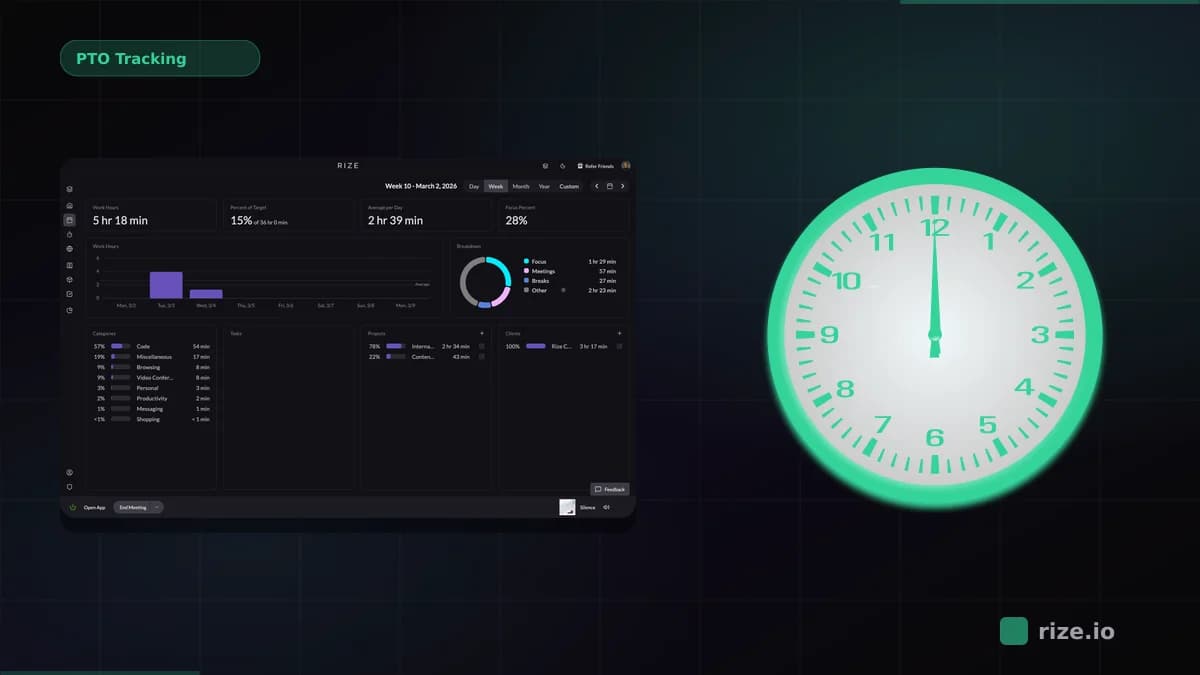
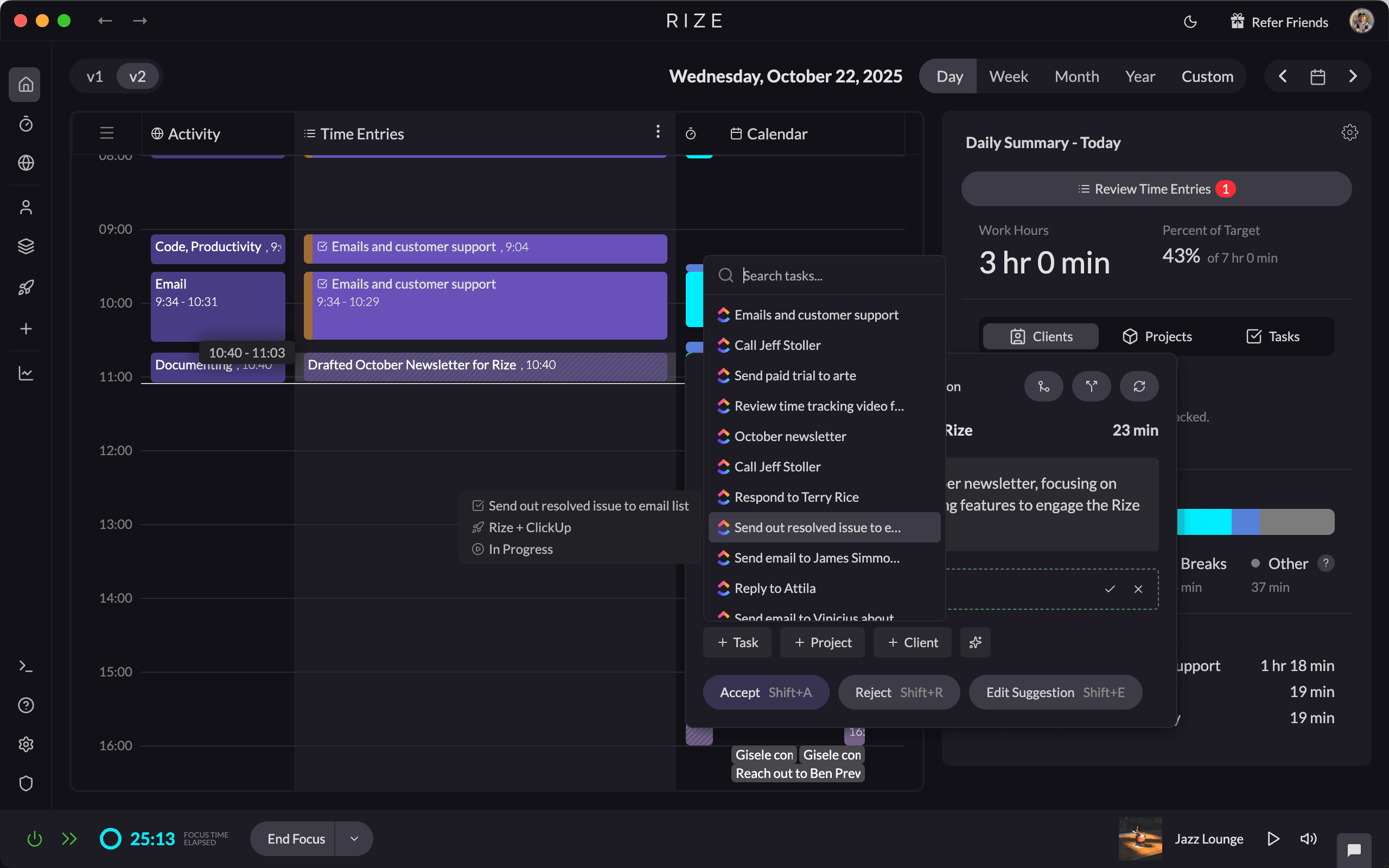
Rize is an automatic time tracker that assigns time to projects without manual input. It runs in the background on macOS and Windows, captures app names, window titles, and browser URLs, and uses AI to match activity to the correct client engagement. When a consultant switches from reviewing a client's financials in Excel to discussing deliverables in Slack to drafting a proposal in Google Docs, Rize categorizes all three as billable time for that client.
For consulting firms, this solves the multi-project switching problem. Senior consultants who work across 3-5 engagements daily no longer need to start and stop timers at every transition. Rize detects the context switch and assigns time to the correct project automatically. Managers see real-time project dashboards showing hours by engagement, utilization by team member, and budget burn by client.
Impulse Lab, a 6-person product studio, reported 98% billing accuracy and 5x faster client reporting after switching to Rize. CEO Leonard Roussard described the impact: "We use Rize to know: 'We spent 30 hours on this client and got this result.' That's powerful when you're working lean and launching quickly."
Pricing: $9.99/month (Basic) or $29.99/seat/month (Team). Free 7-day trial with full features.
Track project time without timesheets
Rize captures every work session automatically and assigns it to the right project with AI. Your consultants focus on client work, not timers.
Start Free TrialHarvest: Manual Tracking With Integrated Invoicing
Harvest is the most widely adopted time-to-invoice tool for agencies and consulting firms. It connects manual time entries to project budgets, capacity plans, and client invoices in a single platform. The workflow is straightforward: track time with timers or timesheets, review entries, and generate invoices from the tracked hours.
Harvest's strength is the billing pipeline. For firms where the primary pain point is generating invoices from tracked hours, Harvest removes a manual step. Capacity planning views show team availability by week. Budget tracking shows hours consumed vs. budgeted per project. The limitation is data accuracy. Ben Jackson of Momentum Studio named the problem directly: "The biggest issue with Harvest was designers would forget to track." When timers are forgotten, invoices understate the work.
Pricing: $9/seat/month (annual) plus usage-based fees for additional invoices, projects, and clients. Free 30-day trial.
Kantata (formerly Mavenlink): PSA for Large Consulting Firms
Kantata is a Professional Services Automation (PSA) platform designed for mid-market and enterprise consulting firms. It combines resource management, project accounting, time tracking, and invoicing in one system. Resource managers use it to plan staffing across engagements, forecast utilization, and model capacity scenarios.
For firms with 50+ consultants, Kantata solves the resource planning problem that standalone time trackers do not address. It answers questions like "Who is available for a new engagement starting next month?" and "What is our firm-wide utilization target this quarter?" The trade-off is that time tracking within Kantata is manual timesheets. Consultants submit weekly timesheets that go through an approval workflow. The platform is also priced for enterprise, with custom pricing that typically starts well above $30/user/month.
Pricing: Custom pricing. Demos available on request.
Scoro: End-to-End Agency and Firm Management
Scoro is an all-in-one work management platform that combines project management, CRM, time tracking, billing, and financial reporting. Agencies use it to manage the entire client lifecycle from quote to invoice. Time tracking is built into the project interface, with manual timers and timesheet entry alongside task management.
Scoro's strength is breadth. If you want project management, resource planning, time tracking, quoting, invoicing, and financial reporting in one tool, Scoro covers it. The platform reduces tool sprawl for agencies running 5-6 separate tools. The trade-off is complexity and cost. Scoro's learning curve is steeper than dedicated time trackers, and the starting price of $28/user/month reflects its all-in-one positioning. Time tracking is manual only, with no automatic capture.
Pricing: From $28/user/month (Essential). Higher tiers include resource planning and financial reporting.
Wrike: Project Management With Built-In Time Logging
Wrike is a project management platform with time tracking embedded in its task interface. Team members log time against specific tasks within Wrike projects, and managers see workload distribution, Gantt charts, and project dashboards. The time data lives alongside the project plan, making status reviews easier.
Wrike works well for agencies that manage all project work within its platform. Time logged against tasks creates a direct link between effort and deliverables. The limitation is that Wrike only captures time explicitly logged against tasks. Work that happens outside Wrike, such as client calls, email correspondence, or research in a browser, goes untracked unless someone manually adds it. There is no automatic capture and no invoicing integration.
Pricing: From $24.80/user/month (Business). Time tracking on Business plan and above.
Time Tracker vs. PSA: Which Do Consulting Firms Need?
The choice between a dedicated time tracker and a PSA platform depends on firm size and operational complexity. Firms under 25 people typically need accurate time data and basic project dashboards. Firms over 50 people often need resource forecasting, engagement accounting, and multi-level approval workflows that PSA platforms provide.
Choose a dedicated time tracker (Rize, Harvest) if your primary gap is time data accuracy. Most firms under 25 people do not need the resource planning capabilities of Kantata or Scoro. They need their team to actually log all their hours. Rize solves this with automatic capture; Harvest solves it with an integrated invoicing workflow that motivates manual logging.
Choose a PSA (Kantata, Scoro) if you have 50+ consultants and need to model capacity across engagements, forecast revenue from the pipeline, and manage multi-phase projects with approval workflows. PSA platforms assume accurate time data as an input, so firms often pair a PSA with automatic time capture for the best of both worlds.
Choose a PM tool with time tracking (Wrike) if your primary need is project management and time tracking is secondary. Wrike captures time at the task level, which is useful for project status but incomplete for billing.
How Automatic Project Tracking Improves Firm Profitability
Project profitability at consulting firms depends on three numbers: hours worked, hours billed, and hours budgeted. When any of these three is inaccurate, profitability analysis breaks down. Manual time tracking introduces error into the first number, which cascades through billing and budgeting.
Momentum Studio, a 12-person creative agency, saw a 15% increase in project profitability after switching to automatic tracking with Rize. The improvement came from two sources: recovering 20% more billable time that had been going unlogged, and reducing 8 hours per week of admin time spent chasing timesheets. Neither gain required working longer hours. The work was already happening; it just was not being captured.
For consulting firms, the same principle applies at larger scale. If a 20-person firm has an average bill rate of $200/hour and manual tracking misses 10% of billable time, that is $80,000 per month in unrecovered revenue. Automatic project time tracking with AI categorization closes that gap without adding any manual work.
For a deeper look at agency profitability and time tracking, see our guide to the best agency time tracking software, or explore how automatic tracking works on our automatic time tracking feature page. To see how project dashboards work for teams, visit Rize Teams.
Start tracking time automatically
Join thousands of professionals who stopped guessing where their time goes. Free for 7 days.
“Rize has been a no-brainer for me.” — Ali Abdaal Read more →
Macgill Davis is cofounder of Rize, an automatic time tracker that improves focus and builds better work habits.