The old agency model is dying. Not slowly — fast. After a long conversation with Garrett Jestice, a go-to-market advisor who works with dozens of early-stage agencies, I am more convinced than ever that the next five years will split the agency world into two camps: the ones who rebuilt around AI, and the ones who tried to protect the old model until it killed them.
Key Takeaway: A micro agency is 2 to 5 people, a strategic founder, and a roster of AI agents doing the execution. They are beating traditional agencies on margins because they do not carry the overhead of cheap junior labor. If you run an execution-heavy agency, the question is not whether to pivot — it is how fast.
What is a micro agency?
A micro agency is a small operation — typically 2 to 5 people — built around a strategic founder, a lean operations team, and heavy use of AI agents for execution. Garrett sees them competing directly with larger people-backed agencies and winning on margins.
Traditional agencies scaled one way: hire more bodies, throw them at the work, mark up the capacity. That was the only real lever most agency owners had. A 20-person agency could take on more clients than a 5-person agency because there were more hours to sell. Margins came from the spread between what you paid junior staff and what you billed clients. The Bureau of Labor Statistics still projects 8% growth in marketing manager roles through 2033, but the composition of those teams is the part that is shifting fast.
Micro agencies break that math entirely. Instead of a pyramid of senior strategists on top and junior executors on the bottom, the pyramid flattens. The founder stays close to the work. A small operations team keeps things moving. AI agents handle the grunt work that used to pay a 22-year-old's salary — drafts, research, QA, meta descriptions, first passes at ad creative.
"It's way better to have a small micro team of an expert founder, a small operations team, and AI agents that help fill in the gaps on execution," Garrett told me. He has a friend running a LinkedIn paid ads agency whose entire model is: only hire experts with real experience, everyone works directly with clients, AI fills the gaps. No junior-to-senior handoff. No account coordinator routing work. No "traffic manager" role.
If you want the broader operational context, Tessa Rolfe made a similar point in our earlier conversation on how AI is reshaping agency operations — the T-shaped employee is becoming a dash, and roles are converging fast.
Why AI makes micro agencies possible
AI makes micro agencies possible because it compresses execution cost to near zero. Tasks that used to require a junior staffer working for a week now take one expert plus an AI agent a few hours, and the output is often better.
I see this at Rize every day. In December 2025, roughly 40% of our code was AI-generated. By March 2026, that number was 99%. We did not fire anyone. We did not slow down. We shipped more. The same compression is hitting agencies — content production, client reporting, scoping, research, first drafts of everything.
Garrett made a point that stuck with me. He said the old agency model was the only real lever owners had: hire, mark up, repeat. Now there are other options. Niching is a lever. Specialist expertise is a lever. AI execution is a lever. Agencies that keep pulling the "hire more people" lever are not wrong — they are just competing in a market where the other levers pay more. McKinsey's State of AI report shows marketing and sales functions are where companies are seeing the largest AI-driven cost reductions, which maps directly onto agency execution work.
There is a catch. AI output is only as good as the inputs and the expertise to judge it. "We've all seen people who aren't copywriters think they produced something great with AI because they don't have the expertise to judge it," Garrett said. Micro agencies work because the humans in them are senior enough to catch when the AI is wrong. You cannot replace that with another AI.
Micro agency — a small agency of 2 to 5 people built around a strategic founder, a lean operations team, and AI agents that handle most of the execution work traditional agencies assigned to junior staff.
The pricing shift: outcome-based over hourly
Agencies should shift from billable hours and retainers toward outcome-based pricing when AI does the execution. As execution cost drops, clients are unwilling to pay for hours, so value has to be captured through results, not time.
This is the hardest shift for most agency owners. Billable hours and monthly retainers have been the default for 15 years. Both are now broken.
Garrett put it bluntly: "It's not just paying per seat or per hour — it's paying per outcome. AI is one of the things starting to change that. It's less about the execution because the cost of execution is going down with AI. It's more about: can you help me actually achieve this result?"
The math on hourly billing falls apart fast. If a designer builds a full brand system in two hours with AI that used to take two weeks, what do you bill? Two hours at $200 is $400. Two weeks at the old rate was $16,000. The value delivered is the same. The hours are not. Clients are not going to keep paying $16,000 for two hours of work once they know what AI can do — and they already know.
The agencies pricing well in 2026 are doing one of three things:
- Performance-based pricing — billing tied to measurable outcomes like revenue generated, leads delivered, or rankings achieved. Common in paid media and ecommerce.
- Productized services — fixed-price packages for a defined deliverable, with the internal cost structure invisible to the client.
- Outcome-plus-retainer hybrids — a base retainer for strategy and access, with performance bonuses tied to hitting targets.
What none of the winners are doing: billing for hours.
Outcome-based pricing — billing tied to measurable results (revenue, leads, rankings) rather than hours worked or monthly retainers, so agencies capture the full value of AI-compressed delivery.
Tracking work when AI does most of it
You still need to track time when AI does the execution — human time and agent time — because visibility into where effort is spent is the only way to protect margins as cost structures change.
This sounds counterintuitive. If you bill by outcome, why track time? Garrett answered this one directly: "You want to have visibility on where you are spending your time and where your employees are spending your time — even in the future, where your agents are spending time across which clients."
The shift from hourly billing to outcome billing does not remove the need for time data. It changes what the data is for. Time tracking used to feed the invoice. Now it feeds the profit and loss statement. The question shifts from "did everyone log their hours?" to "which clients are profitable when I include AI tool costs, and which ones are quietly killing my margin?"
At a micro agency, the founder is usually the highest-output person in the business. If you are spending 15 hours a week on a client that only generates $3,000 of revenue — and half of those hours are late-night fire drills — you need to know that before the client becomes 30% of your stress and 8% of your revenue. That only shows up in the data. Harvest's project data shows that professional services teams routinely under-track 20-30% of client time, which is exactly the gap that eats micro-agency margin.
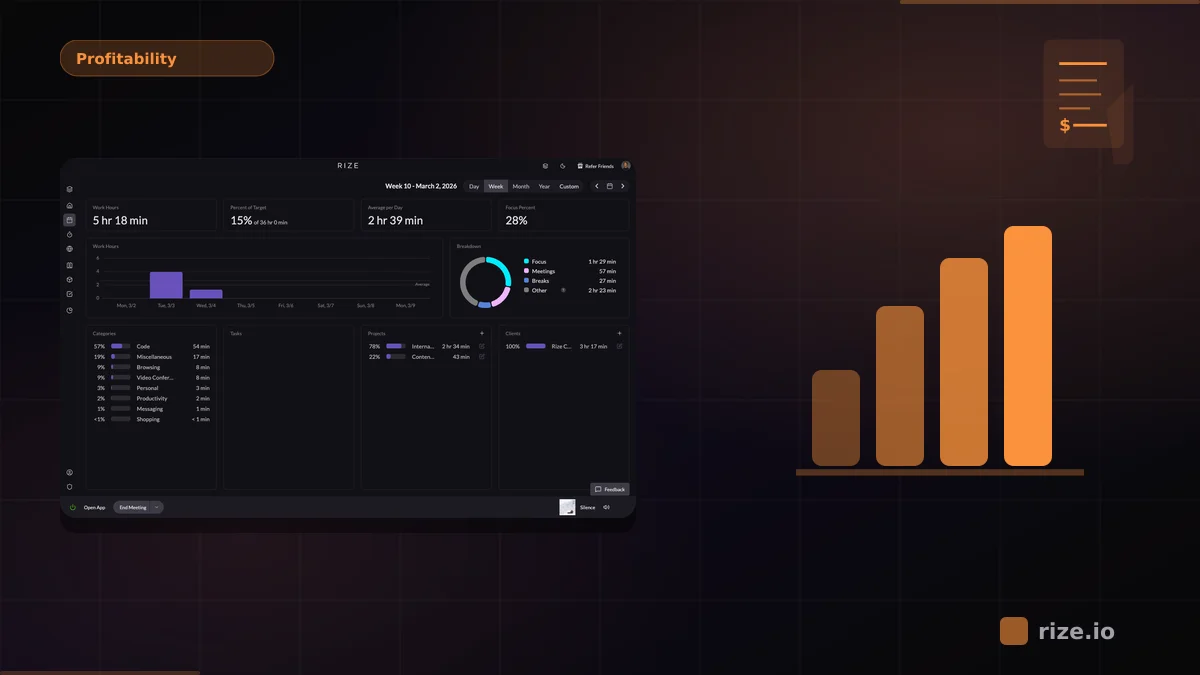
Manual time tracking does not work for this. Every agency owner I talk to has the same story: the team hates it, the data is unreliable, and by the time you compile it, the month is over. Rize's automatic time tracking features run in the background and categorize work by client and project using AI, so the data is there when you need it — no manual entry, no culture tax.
The other side is agent time. Most agencies are not tracking how much their AI tools actually cost per client yet. A $200/month Claude subscription spread across 8 clients is $25/client. A $400 API bill from one power user doing image generation on a single project matters. If you are not reconciling agent spend against client margin weekly, you are guessing at profitability. Pair automatic time tracking with your AI tool dashboards and you have a real picture.
This connects directly to project profitability tracking — which is now less about "did we go over budget" and more about "does this client still make sense given my real cost structure?"
Signs you should pivot to a micro agency model
Pivot to a micro agency model when junior execution roles are getting replaced faster than senior strategy work, when clients push back on retainers, and when margins shrink despite steady revenue.
The signals are usually there for months before owners act on them. Watch for these:
- You are hiring juniors and they cannot ramp fast enough to be profitable. The old 18-month runway to profitability on a junior hire does not work when AI is doing the work they would have learned on.
- Clients are asking for discounts or threatening to leave retainers. This is the biggest tell. If three clients in a quarter ask why they are paying monthly, the market has already moved.
- Your senior people spend most of their time fixing junior work. That is AI labor masquerading as human labor, and you are paying twice for it.
- Your margins shrink while revenue stays flat. Usually means operating expenses from AI tools and overhead are rising faster than you realized. Also means you have no visibility into real cost per client.
- You cannot clearly answer "what problem do we solve better than anyone." Full-service agencies are getting crushed by specialists. Garrett was blunt: "Gone are the days of a full-service integrated marketing agency. Brands can see right through that."
- You are doing custom scopes for every client. Custom scopes fight AI. Productization enables it.
The pivot itself is not all-or-nothing. Garrett's advice, which I agree with, is to avoid the two extremes — ignoring AI entirely, or rebuilding the whole business around AI overnight. The middle ground is strategic: find standardized processes, integrate AI on top of them, and let the team structure follow. Most of the agencies making it work pivoted over 6 to 12 months, not in a single quarter.
One practical first step: run the numbers on your current book. Use our agency profit calculator to see how much billable time your team is actually losing to untracked work and admin drag. If the number is north of 20%, the old model is already costing you more than a pivot would.
Track where your agency's time actually goes
Rize runs automatically in the background — human time, agent time, every client. No timers, no compliance battles. Free for 7 days.
Start Free TrialWhat the next two years look like
The agencies that come out ahead in 2027 will look very different from the ones that led the industry in 2022. They will be smaller. Their pricing will be weirder — more variable, more outcome-linked, less predictable month to month. Their teams will skew senior. Their tool stack will include three or four AI agents that used to be entry-level roles on an org chart.
The ones that struggle will be the 15-to-50 person execution shops still selling capacity. The math is against them. A 5-person micro agency with good positioning, outcome pricing, and tight time data can beat them on margins and compete on delivery. And the micro agencies will keep getting better as AI tools get better, which is a compounding advantage the incumbents do not have.
The good news: this is a much better business to run once you make the shift. You spend less time managing people and more time on strategy. Your margin per client goes up. You can say no to bad fits because the unit economics are clearer. The work is more interesting because you are not supervising junior execution all day.
That is the micro agency playbook. Fewer people, better tools, sharper positioning, outcome pricing, and real-time visibility into where every hour goes — human or agent. The old model is not coming back. The sooner you build for what is replacing it, the more of 2026 you get to enjoy.
If you are running an agency right now and thinking about this shift, I would love to talk. I run Rize, I talk to agency founders every week, and the patterns are getting very consistent. We built Rize for exactly this moment — automatic time tracking that captures both human and AI-assisted work, so founders can see their real cost structure without nagging the team for timesheets. You can also read more about how agencies use Rize to protect margins, or dig into the full conversation with Garrett on the Rize podcast episode on agency profit margins.
Start tracking time automatically
Join thousands of professionals who stopped guessing where their time goes. Free for 7 days.
“Rize has been a no-brainer for me.” — Ali Abdaal Read more →