If you run an agency, AI is not just improving your workflows — it is reshaping how you operate, price, and compete. We sat down with Tessa Rolfe, Fractional COO and founder of Agency Ops Co, to break down what is actually happening inside agencies right now. Tessa has spent 15 years in agency operations, including a stint as SVP of Operations at a $12M agency, and she is not sugarcoating what comes next.
Key Takeaway: If your systems are messy, AI will make them worse. If your systems are tight, AI becomes your biggest efficiency gain. The agencies winning right now are the ones that documented their processes before they started automating.
What is actually changing inside agencies because of AI?
Watch this section (4:59)AI is connecting agency tools in ways that eliminate the manual glue work between systems. Meeting notes now update project timelines automatically. Support tickets draft themselves. Time tracking runs silently in the background.
"It's a big connectivity tool," Tessa says. "You have a meeting and the note taker goes and updates your project management tool. Next thing you know, your timelines are completely updated. It's little things like that, but I'm seeing actual tangible change."
The shift is not about one AI product replacing another. It is about the connections between tools compounding over time. Agencies that previously needed a traffic manager or coordinator to shuttle information between ClickUp, Slack, and their time tracker are finding that AI handles the handoffs.
For context: at Rize, roughly 40% of our code was AI-generated in December 2025. By March 2026, it is 99%. That rate of change is not unique to product teams. Agencies are seeing the same acceleration in content production, client reporting, and project scoping.
Why you should not automate chaos
Watch this section (8:55)Implementing AI on top of broken processes amplifies noise instead of efficiency. Agencies need documented workflows before any automation makes sense.
This was Tessa's sharpest point in our conversation — and it applies to every agency considering AI adoption.
"You don't want to automate or amplify noise and chaos," she says. "The only way to not amplify noise and chaos is to be very, very clear and very grounded with how things work. Ideally, that is documented."
Agencies that have operated for 10-20 years with custom scopes of work and one-off RFPs are the most at risk. If every project is structured differently, there is no repeatable process for AI to improve. You are just automating inconsistency.
"I would honestly not even consider AI until that problem has been fixed," Tessa warns. "Because you're just gonna automate chaos. You're gonna create more noise and then you're gonna be jaded and say 'I actually hurt my business instead of helped it.'"
The fix is straightforward: document your processes as your team does the work. Tools like Scribe can record workflows in the background. The goal is not a 200-page SOP manual — it is a baseline of "this is how things should function" that AI can build on.
Are agencies overestimating what AI can do?
Watch this section (12:03)Agencies are overestimating how fast AI will reduce headcount but underestimating how fast it will reshape their cost structure and competitive position.
Tessa sees it from both sides. On overestimating: "I think they're overestimating the reduction of staff. The barrier of entry to truly eliminate roles is quite high still." Complex, layered agency problems — client relationships, creative direction, strategic planning — are not tasks you hand to a chatbot.
But the rate of change matters. What is true today will not be true in six months. By the time you finish documenting your processes and start automating, the AI tools available will be substantially different.
On underestimating: agencies that treat AI as optional are in trouble. Tessa described an agency from a year ago that told their Slack channel "hey team, you should be educating yourselves on AI" — and that was the extent of their strategy. No enablement, no training, no dedicated time.
"They're underestimating AI and therefore they will be out of business probably within the next two years," she says. "It's just clear as day."
How should agency owners enable their teams?
Watch this section (13:22)For agencies under $8M in revenue, successful AI adoption almost always starts with the owner leading by example — not a top-down mandate or an outside consultant.
"Eight times out of ten that I've seen, the successful change and adoption comes from the agency owner themselves," Tessa says. The pattern: the owner learns the tools, creates space for their leadership team to experiment, and then those leaders train their departments.
It feels like an investment now, but agencies skipping this step are falling behind competitors who made it six months ago. At Rize, we started running weekly meetings where we looked at our own time tracking data to find tasks we could move to AI. Customer support was our biggest win — we invested in documentation, switched to an AI-capable support tool, and now 80-90% of chats are handled automatically.
The key insight: it takes multiple iterations. You will not get it right the first time. Apply the same product thinking agencies already know — what is your MVP? What is your backlog? Test, learn, iterate.
How is AI changing agency team structure?
Watch this section (19:59)AI is collapsing specialized roles into broader ones, similar to how workforce globalization reshaped agency org charts in 2016-2018.
Tessa draws a direct parallel: "Agencies that are doing it best are treating AI how they treated the globalization of the workforce." In the late 2010s, agencies restructured around global remote teams. Now they are restructuring around AI tools that handle specific functions.
Her advice: find the AI product that does one thing and does it really well, then integrate it like you would hire a specialist. Time tracking is a clear example. The old "traffic manager" role — someone who routes work and tracks status across teams — is disappearing because AI tools handle the coordination.
The old model was the T-shaped employee: broad skills across many areas, deep expertise in one. Tessa thinks we are moving toward the "em dash employee" — broad proficiency across everything, because AI handles the deep execution. Designers can do more engineering. Developers handle more product thinking. Roles are converging.
"Experience is something AI will never be able to replace," Tessa notes. "If I can solve this specific use case that this agency has — I've been there and I've done that and I can look you in the eye and say I've been successful at it — you're not getting that level of confidence with AI."
Why manual time tracking is finished
Watch this section (17:02)Every agency Tessa has worked with in her 15-year career has struggled with time tracking. Automatic time capture eliminates the tradeoff between rigorous tracking and team morale.
The problem has always been binary: either you enforce strict time tracking and your culture suffers ("there's somebody shoving time tracking down their throat"), or you go easy on tracking and lose the data you need to make business decisions.
"There's probably at least 2% of profitability that can be uncovered just because of the data that you can crunch" when you have good time tracking data, Tessa says. For a $5M agency, that is $100K in recovered margin.
Tessa started using Rize for her own work first: "The moment I started using Rize, I was like, oh my god. Where was this 10 years ago?" She is now rolling it out to her first agency client at the team level.
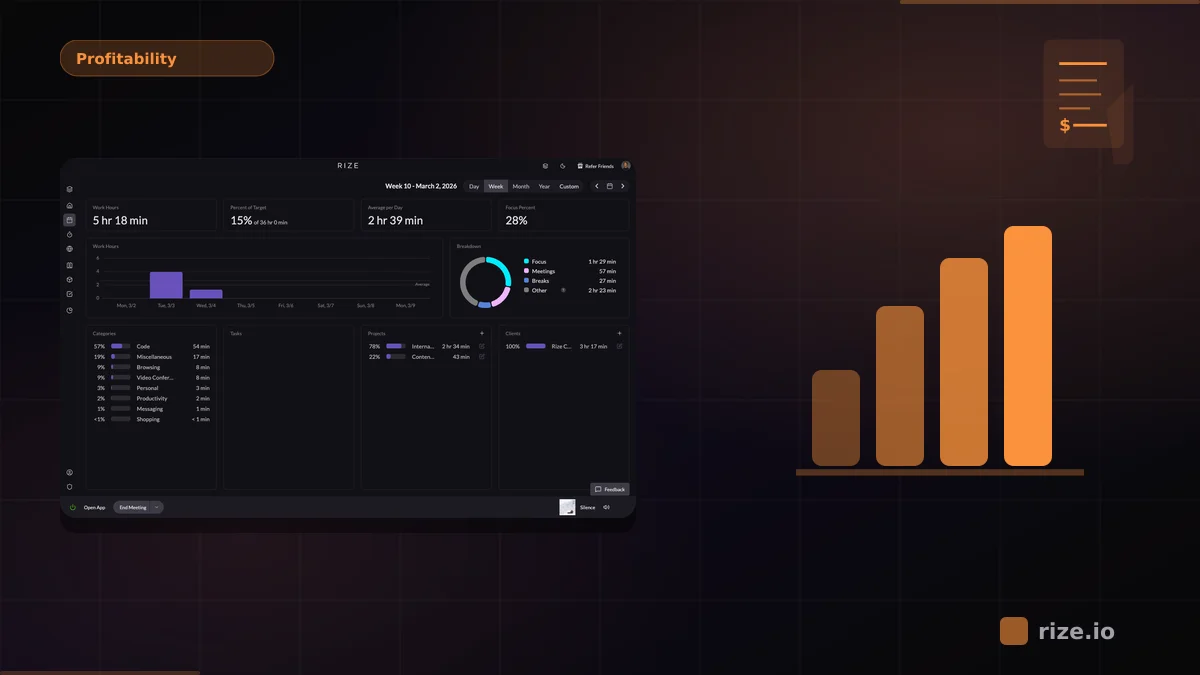
The shift from manual timers to automatic capture is not incremental. It removes the compliance burden entirely. Your team does not think about time tracking — the data just exists. That changes the conversation from "did everyone log their hours?" to "which clients are profitable and which are not?"
Automatic time tracking — background time capture that logs every app and work session without manual timers, recovering the billable hours lost to compliance friction.
Why hourly rates and retainers are breaking
Watch this section (28:36)AI is compressing delivery time while increasing operating expenses, breaking the traditional 50-30-20 agency revenue split between delivery, overhead, and profit.
This is the pricing shift most agencies are not prepared for. Tasks that took hours now take minutes — but those minutes involve AI tool costs, API fees, and infrastructure that did not exist before.
"Agencies are 100% underestimating the cost that comes with AI," Tessa says. "They're seeing their cost of goods dip, but their operating expenses get higher. And that's throwing off the 50-30-20 ratio that has existed for so many years."
Billable hours stop making sense when the value of the output is decoupled from the time spent. A designer who produces a full brand system in two hours using AI is delivering more value than the old model where that took two weeks — but billing for two hours does not capture that value.
Tessa sees performance-based pricing coming fast, especially in verticals like paid media for ecommerce where results are directly measurable. Some agencies are already selling based on FTE (full-time equivalent) allocations — "almost like a glorified staffing firm," she says.
Performance-based pricing — billing tied to measurable outcomes (revenue generated, leads delivered, rankings achieved) rather than hours worked or monthly retainers.
The downstream effect is not that agencies will make more or less money. It is that delivery quality becomes the only differentiator. "If your service can't hold up to it, you're not gonna last. And that's gonna just be even more true with performance-based pricing."
Should agencies niche down or generalize?
Watch this section (24:22)Agencies should niche down. Full-service integrated marketing agencies are losing to specialists who combine deep domain expertise with AI-powered efficiency.
"Gone are the days of a full-service integrated marketing agency," Tessa says. "Brands can see right through that."
This trend parallels the rise of fractional and contractor roles — 72.9 million Americans now work independently, nearly double pre-pandemic levels. Businesses and individuals are both getting more focused on doing one thing well. AI cannot replace the experience of someone who has solved a specific problem dozens of times.
"If I'm able to solve this specific use case — I've been there, I've done that, I can look you in the eye — of course they're gonna want to work with me over AI. You're not getting that level of confidence from AI."
At Rize, we see this firsthand. Our fastest-growing segment is not large agencies — it is fractional operators and small specialist teams who need accurate time data without the overhead of enterprise tools.
What should agency owners do this quarter?
Watch this section (31:51)Create space for your team to document their work as they do it. Do not hire someone to write SOPs — build the habit of real-time documentation first.
Tessa's number one recommendation is simple but often skipped: "Don't hire somebody to write SOPs for you. What you need to do is create the space for your team to document the work as they're doing it."
The logic ties back to her core thesis. You cannot automate what you have not documented. And you cannot document what your team does not have time to capture. Running Scribe or a similar tool in the background while your team works creates the baseline AI needs to be useful.
This is a lower barrier than most agency owners think. You are not building a documentation library from scratch. You are recording what already works so AI can amplify it.
Tessa's rapid-fire predictions:
- AI is going to kill manual time tracking inside agencies — "that was yesterday"
- The biggest mistake agencies are making with AI is automating without investing time to get it right
- In two years, agencies that have not changed their pricing model will struggle
- The old agency model is breaking because agencies are no longer just people businesses — there is intellectual property behind the work, and you need to price accordingly
See where your agency's hours actually go
Rize tracks time automatically in the background — no timers, no compliance battles. Free for 7 days.
Start Free TrialAbout Tessa Rolfe
Tessa Rolfe is a Fractional COO for agencies and founder of Agency Ops Co. She has spent 15 years in agency operations, rising from associate project manager to SVP of Operations at a $12M agency. She now works with agencies across the US on operations, pricing, and AI adoption. Connect with her on LinkedIn.
Start tracking time automatically
Join thousands of professionals who stopped guessing where their time goes. Free for 7 days.
“Rize has been a no-brainer for me.” — Ali Abdaal Read more →