Agencies that track time automatically recover 15-40% more billable hours than those using manual timesheets, according to research from the American Management Association. That gap is the difference between a 10% margin and a 25% margin on every client engagement.
We studied three agencies that made the switch to automatic time tracking. The numbers tell the story:
- Momentum Studio recovered 20% more billable time and saved 8 hours per week on admin
- Impulse Lab hit 98% billing accuracy and grew revenue 30%
- Salween Group achieved 75-95% time coverage with 5-10 minutes of daily effort per person
Here are the five decisions these agencies made that most agencies haven't.
1. Automatic capture beats manual tracking every time
Manual timesheets cost agencies 15-40% of their billable revenue because people forget to start timers, underestimate context switches, and round down. Automatic time tracking runs in the background and captures every app, document, and meeting without anyone touching a button.
Ben Jackson, CEO of Momentum Studio, put it simply:
"Rize allows my team to get deep into work and go where their creativity leads them without really having to think about time tracking."
Within one month, Momentum Studio discovered they'd been consistently underbilling clients by 15-20%. That's not a rounding error. That's a pricing problem hiding inside a process problem.
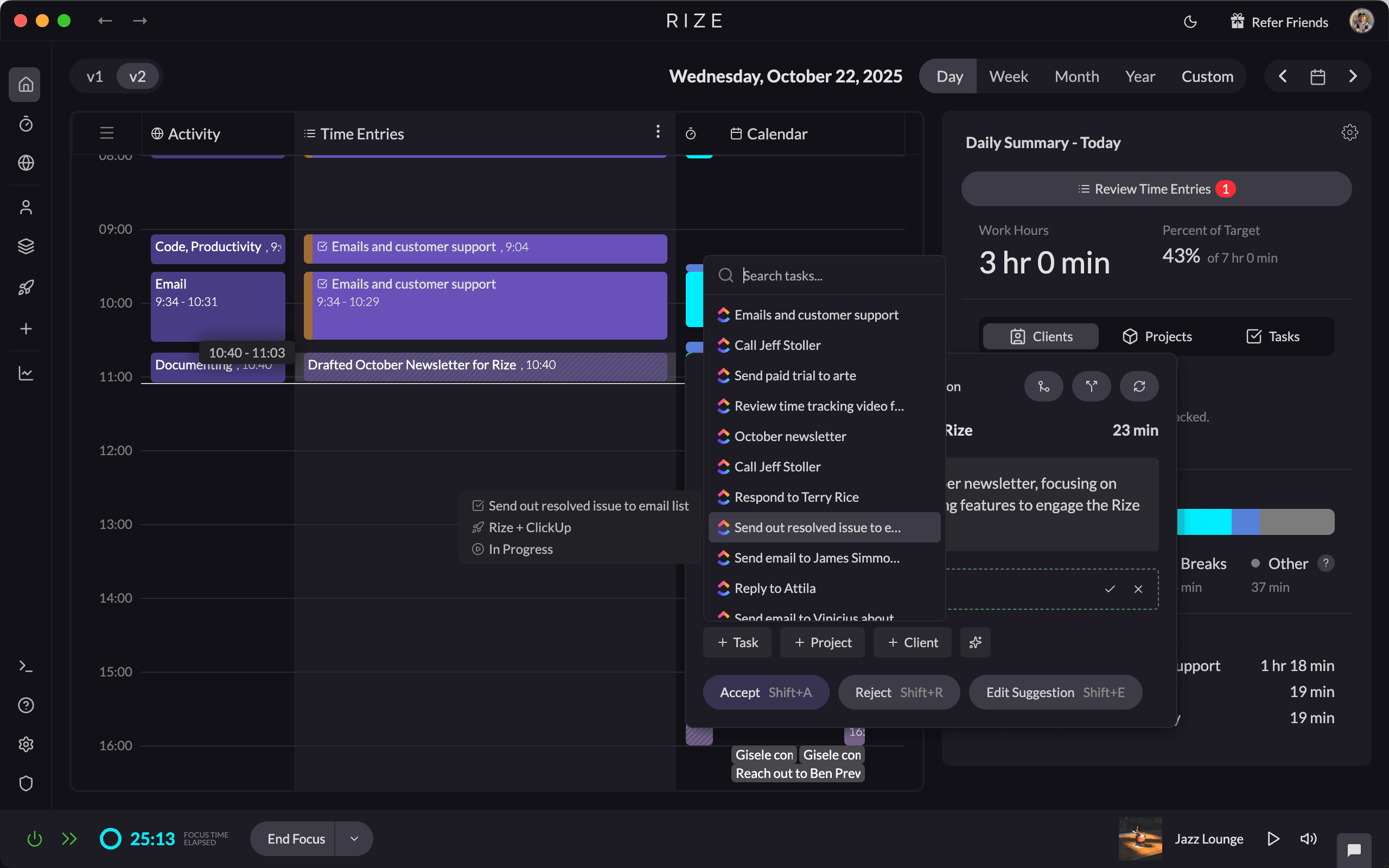
The decision: stop asking creative professionals to remember timesheets. Capture the data automatically, then let people review and approve. The Harvard Business Review found that manual time tracking costs $50,000+ per year for a 25-person firm in lost productivity alone. Rize eliminates that cost by running silently in the background on Mac and Windows, categorizing every app switch and document open without requiring anyone to touch a timer.
2. Buy infrastructure, build intelligence
Buy the undifferentiated tooling (time capture, report generation, integrations). Build the intelligence layer that's unique to your agency: pricing models based on actual delivery cost, utilization benchmarks per role, and client profitability dashboards that surface problems before they become write-offs.
Impulse Lab runs a 6-person product studio. They don't have time to build a time tracking system. But they do need to know exactly which clients are profitable and which ones eat margins.
Leonard Roussard, their CEO, uses Rize data to make strategic pricing decisions:
"We use Rize to know: 'We spent 30 hours on this client and got this result.' That's powerful when you're working lean and launching quickly."
That intelligence layer, knowing the real cost of delivery per client, is what drove their 30% revenue growth. They stopped pursuing unprofitable project types and raised prices on the ones that worked.
The decision: don't waste engineering or ops time on time capture mechanics. Use a tool that handles that (Rize captures time automatically). Spend your operational energy on what the data tells you: which clients to fire, which services to price up, where your team burns hours on non-billable work. Rize's project profitability reports surface these answers without building a single spreadsheet.
See your real client profitability
Rize shows you exactly where your team's hours go, by client, project, and task. Start your free trial.
Start Free Trial3. Start with the data, not the spreadsheet
Most agencies try to improve profitability by building better spreadsheets. The spreadsheet isn't the problem. The input data is. A 2024 SPI Research benchmark found that agencies with utilization above 70% average 18-22% net margins, while those below 60% average 8-12%. You can't manage utilization you can't see. Rize's productivity dashboard shows real-time utilization per person so you know who's at capacity and who has room before you staff the next project.
Salween Group tracks time against project estimates to keep their professional services operation running. Before Rize, they tried multiple time-tracking add-ins. None of them captured enough data to be useful.
David McKaige, their team leader:
"Our team members spend only 5-10 minutes per day in the tool approving entries, and we achieve 75-95% time coverage. It's amazing."
75-95% time coverage is a significant number. Most agencies running manual tracking see 40-60% coverage. The gap between those numbers is the gap between knowing your margins and guessing at them.
The decision: instrument your time data first. Everything downstream, pricing, staffing, client retention, depends on accurate input. Garbage hours in, garbage margins out.
4. Make your operations stack technical
The agencies that pull ahead treat their operations tooling like a product. They pick tools with APIs, export capabilities, and integration support. They connect their time data to their project management, invoicing, and reporting systems so nothing requires manual data re-entry.
Rize integrates with the tools agencies already use: project management systems, communication platforms, and calendar apps. The time data flows automatically into whatever reporting or invoicing workflow the agency runs.
This matters because manual data re-entry introduces errors at every step. A 2008 study published in Empirical Software Engineering found that manual data entry errors average 1-4% per field. Across hundreds of time entries per week, that compounds into billing errors clients notice. Rize eliminates this re-entry by integrating directly with the tools your team already uses, so time data flows into invoicing and project management without anyone copying numbers between tabs.
The decision: pick tools that talk to each other. Your time tracker should feed your invoicing. Your project management should sync with your time data. Every manual handoff is a place where accuracy degrades and hours disappear. See how other agencies handle this in our guide to solving scope creep and underbilling.
5. Keep the approval chain short
Every review step between raw time data and client invoice introduces delay, error, and overhead. Automatic time tracking collapses a 5-step manual process (remember, log, categorize, review, approve) into a 2-step process: review and approve. This is why Salween Group gets 75-95% coverage with 5-10 minutes of daily effort.
The compounding effect is real. If each manual step has a 5% error rate, five steps give you a 23% cumulative error rate. Two steps give you a 10% error rate. The math favors fewer steps.
Momentum Studio eliminated their weekly timesheet ritual entirely. Project managers reclaimed 8+ hours per week. That's not just efficiency. That's 8 hours of client-facing work that was being spent on internal admin.
The decision: audit your time-to-invoice pipeline. Count the steps. If it's more than two (review, approve), you're paying a hidden tax on every billable hour. Automatic time tracking eliminates the steps that shouldn't exist in the first place.
These five decisions compound
The agencies we studied didn't make one change. They made all five. Automatic capture feeds accurate data, which enables smart pricing, which funds better tooling, which reduces approval overhead, which frees up more billable time.
Momentum Studio went from chronic underbilling to 20% more recovered time. Impulse Lab went from billing disputes to 98% accuracy and 30% revenue growth. Salween Group went from patchy time data to 75-95% coverage in minutes per day.
The pattern is the same: replace manual process with automatic data, then build your agency's intelligence on top of accurate inputs.
Read the full Momentum Studio story to see how a 12-person creative agency recovered thousands in unbilled hours every month.
Related reads
- Agency Profitability Tracking Guide -- the metrics and dashboards that matter
- Best Agency Time Tracking Software -- how to evaluate tools for your stack
- How to Track Remote Agency Teams Without Surveillance -- privacy-first approaches for distributed teams
Start tracking time automatically
Join thousands of professionals who stopped guessing where their time goes. Free for 7 days.
“Rize has been a no-brainer for me.” — Ali Abdaal Read more →