Your agency runs on a mix of humans and AI agents now. But your profitability tracking hasn't caught up. You're billing clients based on human hours while AI agents handle 20-40% of the actual work — and nobody knows whether that's making you more profitable or less.
This is the gap between how agencies operate in 2026 and how they measure profitability. The tools haven't caught up to the reality. Here's how to fix that — and how to know which clients actually make you money when AI is part of the delivery team.
Quick Answer: What Is Agent Profitability Tracking?
Agent profitability tracking is the practice of measuring cost-per-deliverable across both human team members and AI agents. It combines automatic time tracking for human hours with cost attribution for AI tools — API calls, compute time, and licensing fees — to show true project margins.
The Problem: You Don't Know Your Real Margins Anymore
Agencies using AI agents are flying blind on profitability. Your designer spends 3 hours on a deliverable, but an AI agent drafted the first version in 12 minutes. Your strategist bills 5 hours for research, but Claude or GPT did 80% of the synthesis. The hours on the invoice don't reflect the work anymore.
This creates two failure modes. You're either undercharging — billing only for the human hours when the AI-assisted deliverable is worth more — or overcharging, billing human rates for work that cost you $0.15 in API calls. Neither is sustainable.
The deeper problem: you can't optimize what you can't measure. If you don't know the real cost of delivering a project (human time + AI costs), you can't set the right price. You can't compare client margins. You can't decide whether to automate more or less of a workflow.
How to Calculate Agent-Adjusted Profitability
True project profit = Revenue - (Human hours x cost rate) - (AI agent costs). Human hours include salaries, benefits, and overhead loaded at your blended rate. AI agent costs include API usage, SaaS subscriptions allocated per project, and any compute or hosting fees tied to agent work.
Here's how this looks in practice for a typical agency project:
| Cost Line | Before AI Agents | With AI Agents |
|---|---|---|
| Project revenue | $12,000 | $12,000 |
| Human hours (at $75/hr loaded) | 120 hrs ($9,000) | 80 hrs ($6,000) |
| AI agent costs | $0 | $340 |
| Total delivery cost | $9,000 | $6,340 |
| Profit margin | 25% | 47% |
The math is clear: AI agents can nearly double your margin on the same project. But only if you're tracking both sides of the equation. Without automatic time capture for the human hours and cost attribution for the AI work, you're guessing.
Why Current Project Profitability Software Falls Short
Most project profitability software was built for a world where all work is done by humans logging hours. Harvest, Toggl, and Clockify track time — but they rely on manual timers that miss 15-40% of billable work. They have no concept of AI agent costs or mixed human-AI deliverables.
On the other end, tools like Scoro and Productive.io offer deeper profitability dashboards — but they start at $26-59 per user per month and still depend on manual time entry. For a 20-person agency, that's $6,000-14,000/year before you've solved the accuracy problem.
None of these tools answer the question that matters now: "What did this project actually cost to deliver when half the work was done by an AI agent?"
| Tool | Tracks Human Time | Automatic Capture | Project Profitability | AI Cost Attribution |
|---|---|---|---|---|
| Rize | Yes | Yes (AI-powered) | Yes (real-time dashboard) | Tag agent-assisted work |
| Harvest | Yes | No (manual timers) | Basic (T&M reports) | No |
| Toggl Track | Yes | No (manual timers) | Basic (budgets only) | No |
| Clockify | Yes | No (manual timers) | Basic (budgets only) | No |
| Scoro | Yes | No (manual entry) | Yes (detailed) | No |
| Productive.io | Yes | No (manual entry) | Yes (detailed) | No |
How Rize Solves the Human Side of the Equation
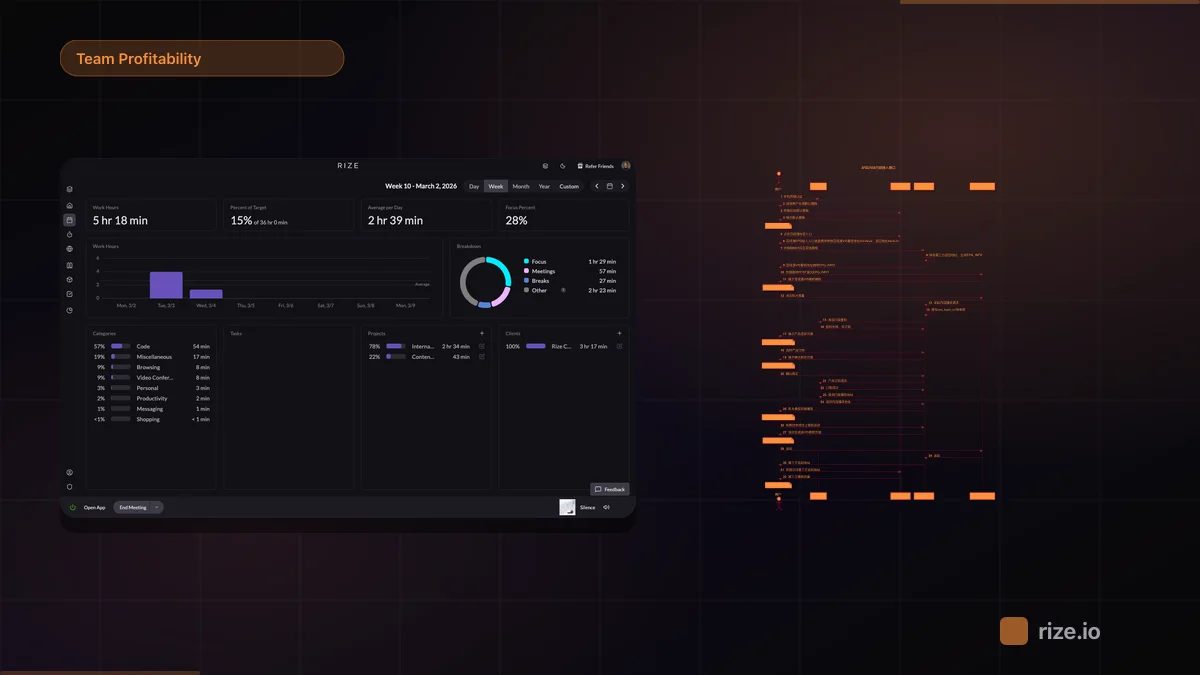
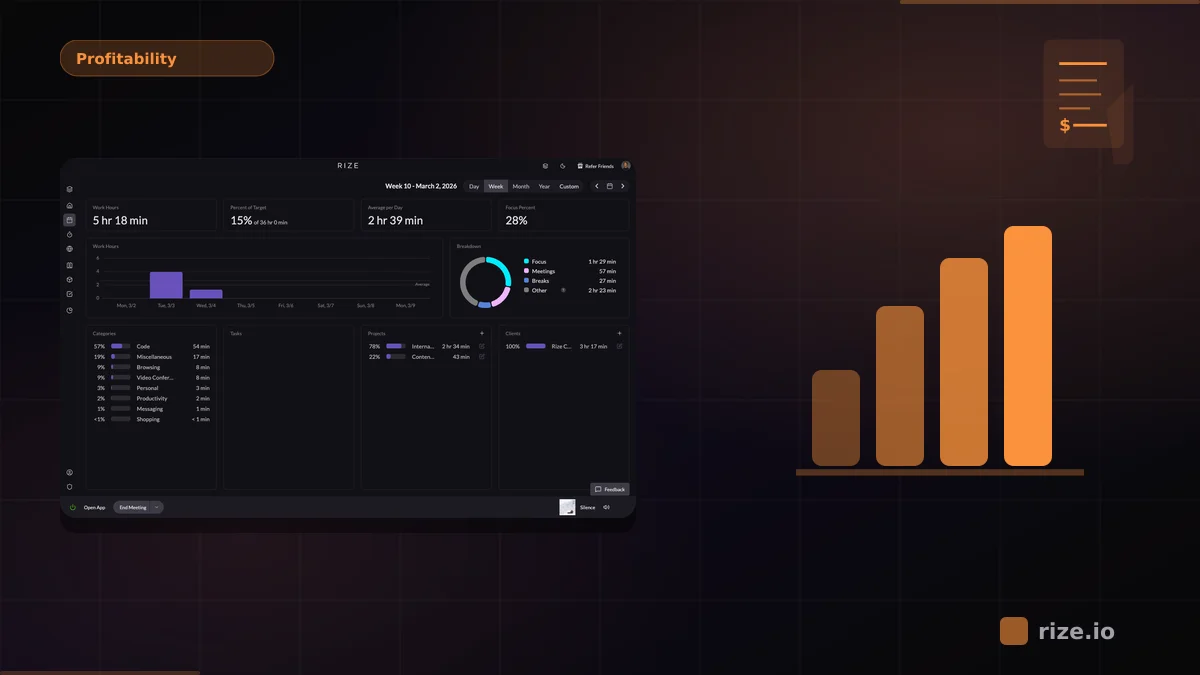
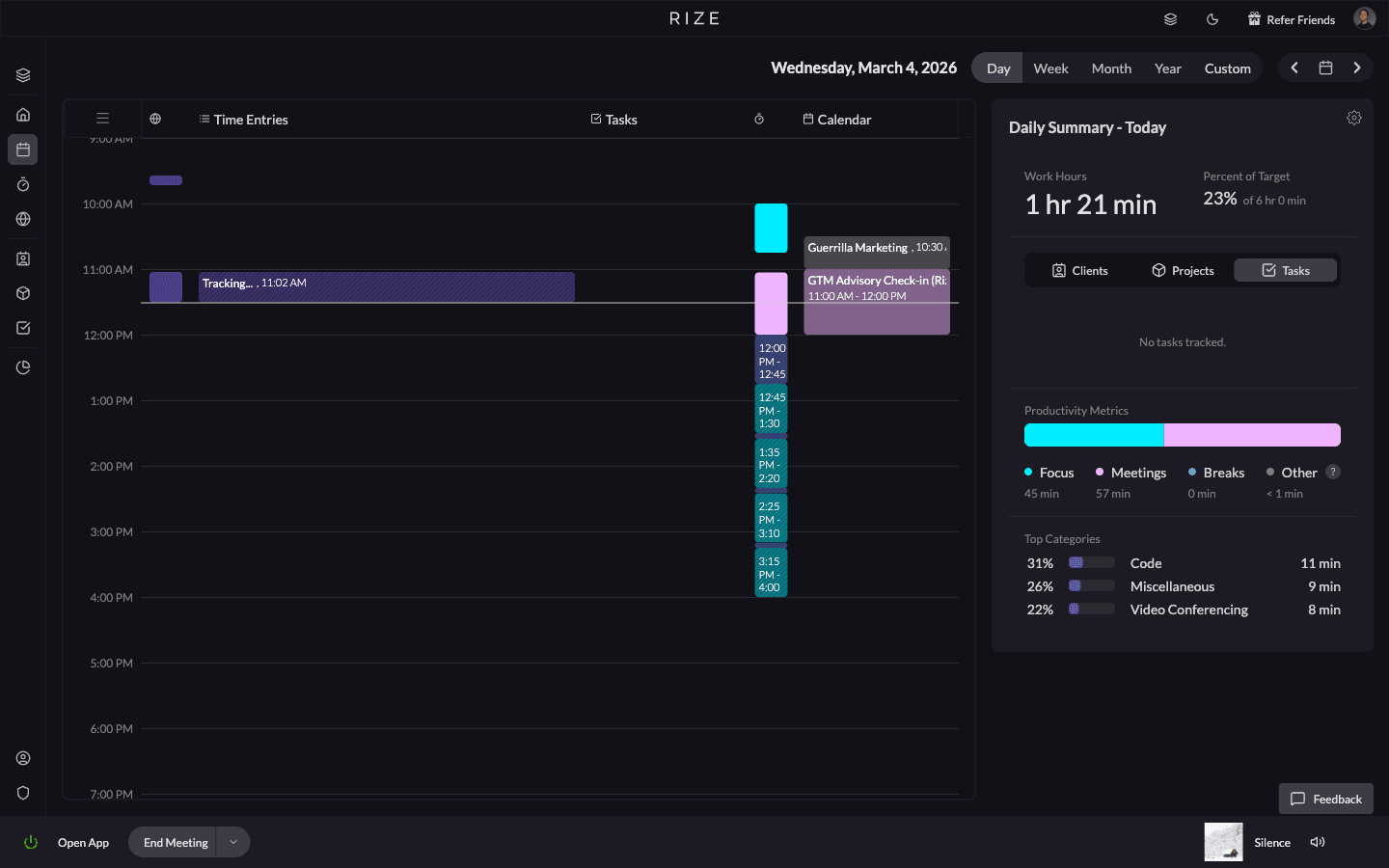
Rize is an automatic time tracker that captures every human work session in the background — no timers, no manual entry. It categorizes time by client and project using AI, and the profitability dashboard shows per-client margins in real time.
For agent profitability tracking, Rize handles the hardest part: accurate human hours. When your designer spends 45 minutes refining an AI-generated draft, Rize logs those 45 minutes against the right client automatically. When your strategist switches between three client Slack channels, two AI tools, and a Google Doc in a single hour, Rize attributes each segment correctly.
The workflow: Rize captures human time automatically. You track AI costs through your API billing (OpenAI, Anthropic, or whatever you use). Combine both in your profitability review to see true margins. Tag projects where AI agents contributed heavily and compare their margins against fully human-delivered projects.
"Rize allows my team to get deep into work and go where their creativity leads them without really having to think about time tracking." — Ben Jackson, CEO of Momentum Studio
Track every human hour automatically
Rize captures your team's billable time in the background while AI agents handle the rest. Start a free 7-day trial.
Start Free TrialThe Agentic Billing Shift
Agentic billing is the practice of billing clients for value delivered by AI agents alongside human team members. As agencies deploy AI for content drafts, code generation, research synthesis, and data analysis, the old hourly billing model breaks down. You need to account for what the agent produced, what it cost you, and what that output is worth to the client.
This shift is already happening. Agencies that used to bill 40 hours for a content strategy now deliver the same output in 15 human hours plus $50 in AI costs. The choice: bill 15 hours and watch revenue drop 62%, or shift to value-based pricing and keep margins high.
The agencies that track profitability per project — with real data on human time and AI costs — are the ones that can make this shift confidently. They know exactly when a project is profitable at a flat rate vs when it needs hourly billing. They know which clients generate enough margin to absorb AI experimentation and which ones don't.
Three Steps to Start Tracking Agent Profitability
You don't need a custom dashboard or a six-month rollout. Start with these three steps and you'll have real profitability data within a week.
1. Capture all human time automatically
Stop relying on timesheets. Install Rize across your team and let it run in the background. Within 48 hours, you'll have accurate per-client, per-project time data — including the Slack threads, research sessions, and review cycles that nobody logs manually. This is the foundation. Without accurate human hours, no profitability calculation means anything.
2. Tag AI-assisted projects and track agent costs
Flag projects where AI agents contribute meaningfully. Pull your monthly API costs from OpenAI, Anthropic, or whichever providers you use, and allocate them by project. Even a rough allocation (50% of your Claude spend goes to Client A's content) is better than ignoring AI costs entirely.
3. Compare margins and adjust pricing
With human hours from Rize and AI costs allocated per project, calculate your true margin for each client. Identify your most profitable clients — they're probably the ones where AI amplifies human work the most. Identify your least profitable clients — they're likely the ones where you're billing human rates for AI-assisted deliverables without adjusting scope or pricing.
Who Needs Agent Profitability Tracking?
Any agency where AI is part of the delivery workflow — which, in 2026, is most of them. But the urgency varies:
- Creative agencies using AI for drafts, mockups, and content production — you're saving hours but may not be capturing the margin improvement
- Dev shops using Copilot, Cursor, or Claude for code generation — your effective hourly cost dropped, but are you pricing accordingly?
- Consultancies using AI for research and analysis — the deliverable quality went up, but are you billing for the value or the (reduced) hours?
- Marketing agencies using AI for SEO content, social copy, and reporting — the volume went up, but did revenue follow?
If you're spending more than $200/month on AI tools across your team, you should be tracking how that spend maps to client profitability. The agencies that figure this out first will set the pricing norms for everyone else.
Bottom Line
Agency profitability tracking in 2026 requires measuring both human hours and AI agent costs per project. Manual time trackers miss 15-40% of billable hours and have no concept of AI costs. Rize solves the human side with automatic time capture and real-time profitability dashboards — pair it with your AI spend data to see true margins per client. Start by tracking every human hour automatically, then layer in AI cost attribution to find your real profit per project.
The agencies that track agent profitability now will price confidently while everyone else guesses. Check our pricing, browse time tracking comparisons, or book a demo to see how Rize fits your team's workflow.
Start tracking time automatically
Join thousands of professionals who stopped guessing where their time goes. Free for 7 days.
“Rize has been a no-brainer for me.” — Ali Abdaal Read more →