The measured ROI of automatic time tracking is between 50x and 200x for billable teams — recovered hours at a $150 rate return $18,000-$75,000 per person per year against a tool cost of $120-$360. Most software ROI claims are marketing math. This one is different because the input — hours worked — is captured automatically, not estimated.
Quick Answer
Automatic time tracking pays for itself after recovering about four minutes of billable time per month. The full ROI comes from three channels: recovered billable hours (the biggest), eliminated timesheet admin, and faster invoicing. Run the numbers for your rate and team size with the billable hours calculator.
Why most automation ROI numbers are guesses
Most automation ROI figures are estimated, not measured — and estimates run consistently high. According to a McKinsey Global Survey on AI, most organizations adopting automation still cannot connect the spending to revenue impact, and the share reporting measurable revenue lift remains a minority. The failure is not in the tools. It is in the measurement: vendor dashboards count usage, not outcomes.
The same gap exists in time tracking. A manual timer asks people to estimate their own work — and self-reported time is reliably wrong because people remember long focused sessions and forget the fragmented ones. When the input data is an estimate, every ROI calculation built on it is an estimate too. Automatic time tracking removes that distortion because the hours are captured, not recalled. That is what makes its ROI measurable rather than aspirational. Our guide to measuring AI ROI covers the same principle for AI spend.
The three places the return comes from
Automatic time tracking produces ROI through three channels: recovered billable hours, eliminated timesheet administration, and a faster invoice cycle. The first is an order of magnitude larger than the other two.
1. Recovered billable hours. Manual tracking commonly loses 15-40% of billable time to forgotten timers and unlogged short tasks. For a single person billing $150 per hour at 30 billable hours per week, a conservative 15% recovery is roughly $81,000 per year. Impulse Lab, a 6-person product studio, reached 98% billing accuracy after switching to automatic capture (case study), and Momentum Studio recovered 20% more billable time after leaving manual tracking.
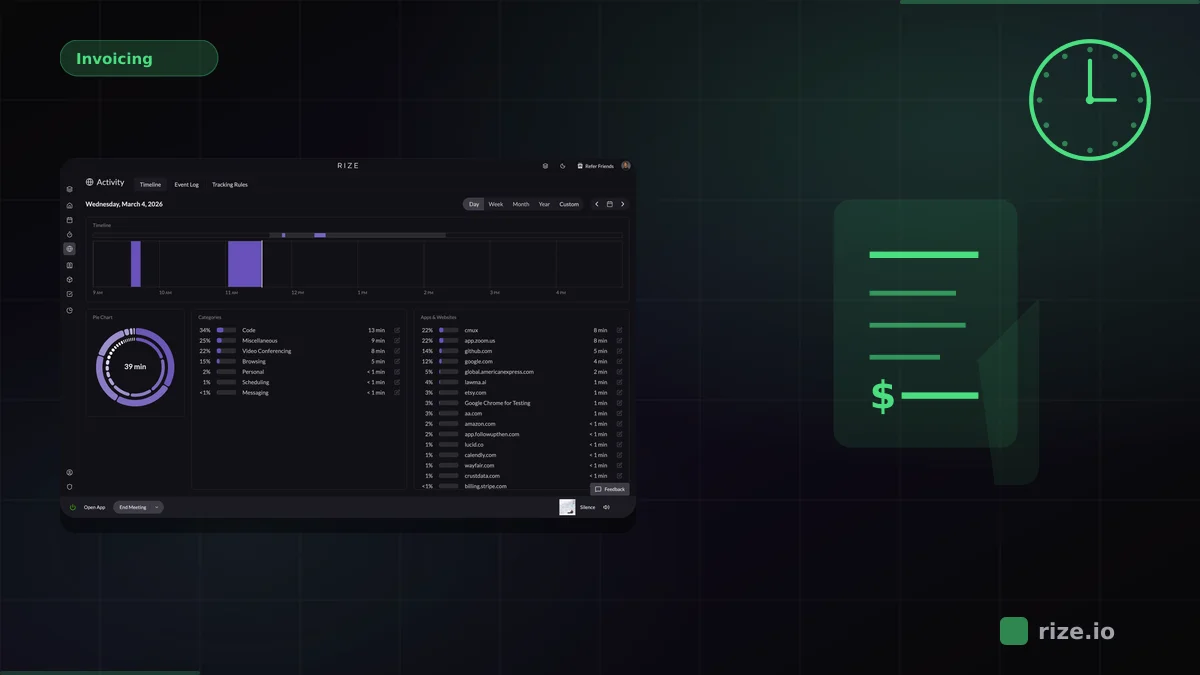
2. Eliminated timesheet admin. Agencies typically spend 3-5 hours per week fixing time entries before invoicing — adding missing project tags, correcting durations, chasing people for their timesheets. At a $75 loaded rate, that is $11,700-$19,500 per year of non-billable cleanup per small team. Automatic capture produces invoicing-ready time data — tagged, flagged, and approved — so the cleanup step largely disappears.
3. Faster invoicing. When the time data is already clean, the path from billing period close to sent invoice drops from days to minutes. Faster invoices mean faster payment and less end-of-month panic. This channel is hardest to price but easiest to feel — the billing run stops being a project.
The math for your situation
The ROI formula is (recovered billable hours x rate + admin hours saved x loaded cost - tool cost) / tool cost. At $9.99 per month and a $150 billable rate, automatic tracking breaks even after recovering about four minutes of billable time per month.
| Scenario | Hours recovered/mo | Rate | Annual recovered | Tool cost/yr | ROI |
|---|---|---|---|---|---|
| Freelancer, light leakage | 1 | $150 | $1,800 | $120 | 15x |
| Freelancer, typical leakage | 5 | $150 | $9,000 | $120 | 75x |
| Agency employee (15% recovery) | 18 | $150 | $32,400 | $360 | 90x |
| Agency employee (25% recovery) | 30 | $150 | $54,000 | $360 | 150x |
Even the most skeptical scenario — a freelancer who only recovers one hour a month — returns 15x. No other business software category has a breakeven measured in minutes. Run your own numbers with the billable hours calculator.
The hidden cost automatic tracking removes
Manual timers tax your focus, not just your memory. Research by Gloria Mark at UC Irvine shows it takes about 23 minutes to refocus after a context switch — and every timer start, stop, and project selection is a context switch imposed by the tool.
This is why manual tracking fails structurally, not through laziness. The tool interrupts deep work to log deep work. Within weeks, most people stop doing it consistently — and the invoice inherits the gaps. Automatic capture has no such tax: Rize runs in the background on Mac and Windows, uses AI to categorize time by client and project, and asks for review instead of entry. The logging happens whether or not anyone remembers it.
When automatic tracking does not pay back
Automatic time tracking has near-zero ROI when nobody bills for time and nobody needs to know where hours went. If your team does not invoice clients, does not measure project margins, and does not care about utilization, there is nothing to recover. The ROI case assumes billable or accountable hours exist.
There are also honest fit limits. Rize tracks desktop work on Mac and Windows — field teams, retail staff, and phone-first workers need a different tool. And if your invoicing workflow already captures every billable hour through strict task discipline (rare, but it exists), the recovery channel shrinks to admin savings only. For everyone else — agencies, consultancies, freelancers — the measured math above is the honest version of a claim most vendors make without numbers.
Download Rize and start a free 7-day trial; paid plans start at $9.99 per month on Rize pricing. Measure your own recovery rate for a month — that is the only ROI figure that will convince your CFO anyway.
Related reading
For the measurement framework applied to AI spend, read how to measure AI ROI without guessing. For the billing workflow downstream of accurate capture, see invoicing-ready time data and the best time tracking tools for invoicing. For proof, read the Impulse Lab case study on 98% billing accuracy.
Start tracking time automatically
Join thousands of professionals who stopped guessing where their time goes. Free for 7 days.
“Rize has been a no-brainer for me.” — Ali Abdaal Read more →