Deltek runs billing and project accounting for thousands of consulting, architecture, and engineering firms, but it can only bill the hours people actually enter. End-of-week timesheet reconstruction under-captures real work by 15-40%, and the missing hours are disproportionately billable. The fix is not replacing Deltek. It is fixing what goes into it.
Why Do Deltek Timesheets Under-Report Hours?
Deltek timesheets are manual entry. Whether the firm runs Vantagepoint, Vision, Ajera, or Maconomy, the input is the same: a person reconstructing their week on Friday afternoon. The work that survives entry is the memorable work, not the billable work.
The fragments are the problem. A seven-minute client call, an email thread that resolved a design question, a quick review of redlines between meetings. None of it is memorable enough to reconstruct, and all of it is billable. According to a Harvard Business Review analysis, unrecorded work costs the U.S. economy an estimated $7.4 billion per day, and professionals who fill in timesheets less than daily produce the least accurate records.
Finance sees the symptom as low realization or thin utilization. The actual cause is upstream: complete hours never existed as data, so no Deltek report can show them. According to Deltek's own Clarity research on architecture and engineering firms, project profitability is the top financial challenge firms report, and it starts with accurate cost data at the task level.
How Does Automatic Capture Work With Deltek?
The pattern that works for firms committed to Deltek: capture happens automatically upstream, and Deltek stays the system of record.
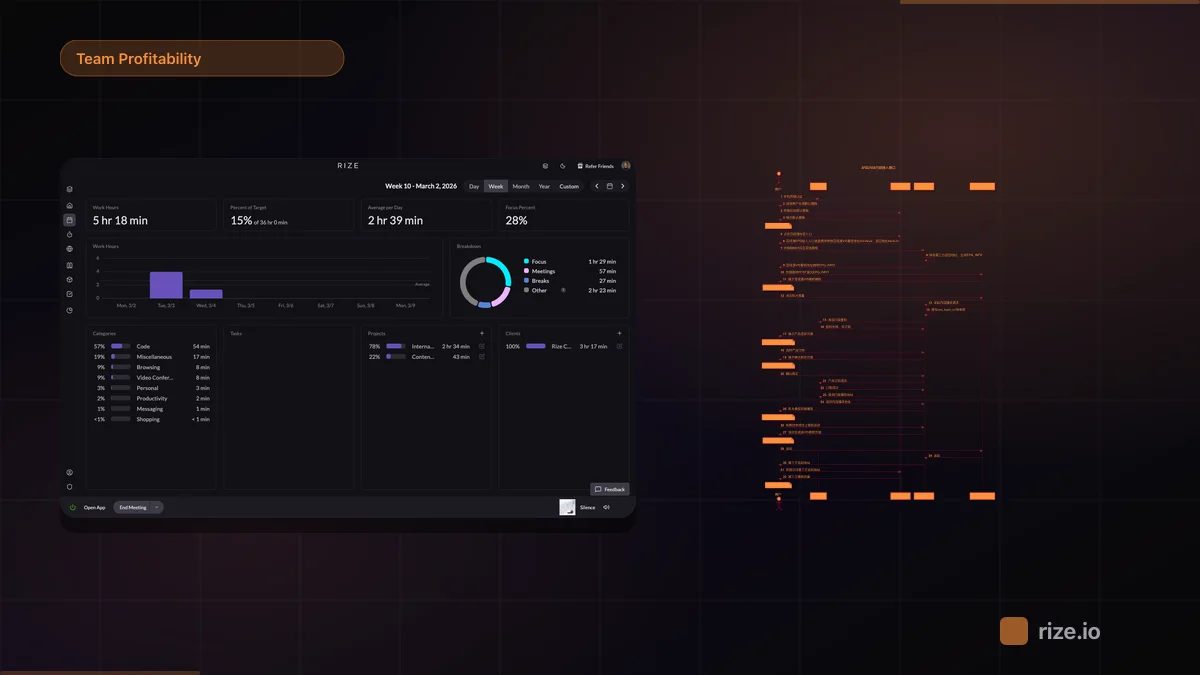
Rize is an automatic time tracker that records every work session in the background: applications, documents, calls, browser work. It categorizes each session to the right client and project with no timer to start and nothing to reconstruct. Staff review and approve a categorized day in about two minutes instead of rebuilding the week from memory.
Approved entries export to CSV with client, project, duration, and description, mapped to the project structure Deltek already bills against. On the invoicing cycle, complete hours flow into Deltek. No duplicate system, no parallel billing, no re-implementation of a project accounting stack the firm spent years configuring.
The result: Rize captures 100% of tracked sessions, so the hours reaching Deltek reflect the real workload rather than the remembered 60-80% of it.
What is your timesheet missing?
Rize shows the gap between tracked work and logged hours. Start a free 7-day trial.
Start Free TrialWhat Changes When the Hours Are Complete?
Invoice recovery. At $150 per hour, thirty recovered minutes per person per day adds roughly $18,000 per person per year in revenue that was earned but never billed. For a 25-person firm, that is $450,000 a year hiding in untracked fragments.
Real utilization. Utilization stops measuring timesheet diligence and starts measuring workload. The principal asking why a team looks under-utilized gets an answer about workload, not about who forgot to log.
Project costing that holds up. Phase-level actuals in Deltek mean estimates improve on every proposal. The next bid prices measured work instead of the optimistic version of it, which is how firms stop repeating the same overrun. Our profitability tracking guide covers the reporting loop in detail.
Zero downstream change. PMs, billing coordinators, and finance keep the Deltek workflows they already run. The only thing that changes is the completeness of the input.
How Is This Different From Deltek's Built-In Timers?
Deltek products include timer widgets, but a timer is still manual capture: someone has to start it, stop it, and remember which project it belongs to. Research from the Harvard Business Review found knowledge workers switch between apps roughly 1,200 times a day, and every switch is a chance for a running timer to be wrong. Automatic capture has no start button to forget.
There is also a review difference. Timer entries arrive in Deltek already written, so errors are caught at invoice review, the worst possible time. Rize produces a draft categorized day that the person approves before export, so corrections happen daily while memory is fresh.
What Does the Day-to-Day Workflow Look Like?
For the person doing the work, almost nothing changes, and that is the point. Rize runs in the background on Mac and Windows, recording each work session and sorting it to the right client and project. At the end of the day, the employee opens a categorized timeline, approves or corrects it in a couple of minutes, and moves on. Nobody touches a Deltek timesheet until the billing cycle.
For the billing coordinator, the cycle looks familiar. At invoicing time, approved Rize entries export to CSV with the client, project, phase, duration, and description fields Deltek expects. The import lands on the same WIP review the firm already runs. The only visible difference is that the hours being reviewed are complete.
For principals and CFOs, the reporting layer gets honest. Deltek's utilization and realization numbers have always been arithmetically correct; they were just computed over incomplete inputs. Once the inputs are real, the existing reports start answering the questions they were designed for.
What About Phase Codes and Approval Chains?
A&E and consulting firms do not just track hours; they track hours against phase codes, disciplines, and approval chains that Deltek enforces at billing. The CSV export carries the same granularity: project, phase, and task-level attribution mapped during setup, so imported time lands on the right charge codes instead of a suspense bucket someone has to clean up.
Approval stays human on both sides. Employees approve their categorized day in Rize, and the exported entries still run through the supervisor and billing review already configured in Deltek. Automatic capture replaces the reconstruction step, not the review steps the firm relies on for audit defense.
How Long Does Setup Take?
Measured in days, not months. There is no implementation project because nothing in Deltek is reconfigured. The work is mapping: connect the client and project structure, set cost and billing categories, and let the first week of data accumulate. Most firms see a complete categorized week inside five working days and run the first export alongside the next normal billing cycle.
Compare that to the alternative projects firms usually consider: a Deltek module rollout, a workflow retraining program, or switching ERPs entirely. Capture layering is the cheap option precisely because it respects the system that is already there.
Teams that want proof before committing run the same experiment: keep the normal Deltek timesheet process for two weeks while Rize captures in the background, then compare. The delta between logged and actual hours is the recovery opportunity, measured rather than estimated, on the firm's own project mix. Most firms that run the comparison stop debating after the first week.
Which Firms Run This Setup?
The common profile is a 10-to-200-person professional services firm where Deltek is entrenched and timesheet compliance is poor. Architecture and engineering firms on Vantagepoint or Ajera, consultancies on Maconomy, and agencies on WorkBook all hit the same wall: the ERP is fine, the entry is not.
A useful test: pull last month's timesheet compliance. If more than a third of entries were submitted after Friday, the firm is running on reconstruction, and every downstream number inherits that error. Firms in that position typically recover the cost of the capture layer inside one billing cycle, because even a few recovered hours per person per week exceeds the per-seat price.
Firms that bill fixed-fee rather than hourly still benefit. Fixed fee divided by actual hours is the real rate, and automatic capture makes the denominator honest for the first time. Project post-mortems stop being arguments about memory.
Government contractors and firms under DCAA-style audit scrutiny benefit from a different angle: contemporaneous records are the audit standard. A captured activity log with daily approval is a stronger defense than a batch-entered Friday timesheet, regardless of which tool generated it.
The Objection: "We Don't Duplicate Systems"
Fair, and it is the reason this architecture exists. Firms running Deltek consistently refuse to add a second system of record. Rize is not one. It is a capture layer. Deltek remains where hours are billed, projects are accounted, and the P&L lives. Rize's only job is making sure the hours that reach Deltek are complete.
The firm keeps its ledger, its WIP reports, and its billing approval chain exactly as they are. What changes is that the numbers inside them finally include all the work.
See how Rize works with your billing system, run a time audit to measure what current capture is missing, or read how firms report margin on the professional services page.
Start tracking time automatically
Join thousands of professionals who stopped guessing where their time goes. Free for 7 days.
“Rize has been a no-brainer for me.” — Ali Abdaal Read more →