The best team profitability calculator connects tracked hours to cost rates and project revenue, giving agencies real-time margin data per client. If your profitability numbers come from manual timesheets, they are wrong — manual tracking undercounts hours by 15-40%, which inflates margins and hides unprofitable projects. This guide compares 7 tools on the features that determine whether your margin data reflects reality.
Quick Answer
Choose Rize if you want the most accurate margin data (automatic time capture, no timers). Choose BigTime if you need phase-level P&L for professional services. Choose Productive.io if you want resource planning alongside profitability. Choose Harvest if you want manual timers with built-in invoicing and budget tracking.
Rize vs Teamwork vs Wrike for project profitability
Rize, Teamwork, and Wrike solve different parts of project profitability. Rize is the automatic time-capture and margin layer: it records work without timers, assigns hours to projects, and updates cost-versus-revenue views as work happens. Teamwork combines logged time, cost rates, billable rates, expenses, budgets, profit, and margin inside a client-work platform. Wrike combines time tracking with project budgeting and financial fields on eligible plans. If missing hours are making margins unreliable, choose Rize. If your primary need is broader project delivery with financial controls in the same suite, compare Teamwork and Wrike.
| Tool | Profitability strength | How hours enter the calculation | Best fit |
|---|---|---|---|
| Rize | Real-time project and client margins from automatically captured work | Background capture with AI project categorization | Teams whose profitability data is distorted by missing timesheet hours |
| Teamwork | Project budgets, cost and billable rates, expenses, profit, and margin reports | Time logged to Teamwork projects | Client-service teams wanting project delivery and financial reporting together |
| Wrike | Project budgeting and financial fields alongside work management | Wrike time tracking and billable-time data | Larger teams already standardizing project operations in Wrike |
Feature availability varies by plan. Verify the current details in Teamwork's profitability report documentation and Wrike's budgeting documentation before choosing a plan.
Why profitability calculators fail without accurate time data
A profitability calculator is only as accurate as its weakest input, and for most agencies that input is hours. Project revenue comes from your invoicing tool. Cost rates come from payroll. But hours? Those come from manual timesheets — which systematically undercount actual work.
A designer who spends 40 minutes in Figma on a client project, 15 minutes in Slack answering questions about it, then joins a 30-minute client call — with a manual timer, she probably logged the Figma time. Maybe the call. Almost never the Slack time. That is 45 minutes of delivery cost that disappears from the profitability calculation.
Multiply that gap across a team of 10 over a billing cycle and you have hundreds of hours of unlogged work. The margin number your calculator returns is not wrong because of the formula — it is wrong because the inputs understate real cost. Projects appear profitable on paper while losing money in delivery. According to the PMI Pulse of the Profession, only about 58% of projects are completed on time and on budget.
What to look for in a profitability calculator tool
Not every time tracker includes profitability calculation. The gap between "we tracked hours" and "we know our margin per project" requires five specific capabilities. Tools that lack any of these force you into spreadsheet workarounds.
1. Accurate time capture. The tool needs to capture actual hours worked — not estimates reconstructed from memory. Automatic tracking eliminates the 15-40% gap from manual entry. Without accurate hours, every downstream margin calculation is unreliable.
2. Cost rate assignment. You need to set a fully-loaded cost rate per team member — salary plus benefits, taxes, and overhead share. A senior developer at $90,000/year costs $115,000-$125,000 fully loaded. Tools that do not support cost rates force this calculation into a spreadsheet.
3. Revenue mapping. The tool should let you enter project revenue (fixed bid, retainer, or hourly billing) and map it against tracked hours. Without both sides of the equation, you cannot calculate margin.
4. Real-time margin visibility. Profitability data should update as hours accrue, not after the project ships. If you discover a project went over budget after the invoice is sent, the opportunity to intervene has passed.
5. Client-level rollup. Agencies need margin data per client, not just per project. A client running three concurrent projects might show one profitable and two underwater — the client-level view reveals the true relationship economics.
The 7 best team profitability calculator tools
1. Rize — best for data-accurate profitability (automatic capture)
Rize is an automatic time tracker that captures every work session in the background and connects hours to project profitability in real time. When a team member works in Figma, switches to Slack, and joins a Zoom call — all three activities are logged and assigned to the correct project using AI. No timers. No manual entry.
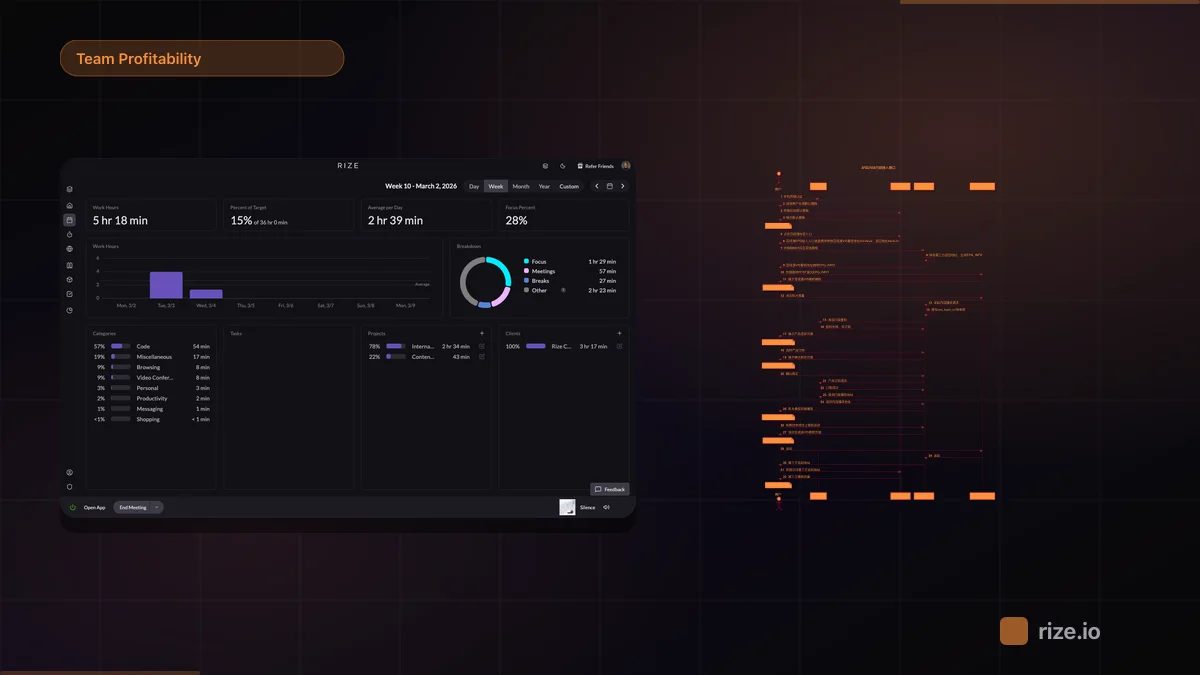
Rize's profitability dashboards apply cost rates per team member and compare total delivery cost against project revenue. Managers see margin per project, per client, and per team member as hours accrue. The margin calculation uses the same formula as a spreadsheet — but runs on data that reflects what actually happened, not what someone remembered to log.
Impulse Lab, a 6-person product studio, achieved 98% billing accuracy after switching to Rize. Momentum Studio, a 12-person creative agency, saw a 15% increase in project profitability. Both results came from removing the manual step — the projects did not change; the accuracy of the hours data did. Read the Impulse Lab case study.
- Profitability features: Real-time P&L dashboards, cost rates per team member, client-level margin rollup, utilization tracking, CSV export.
- Best for: Agencies and consultancies where margin accuracy directly affects revenue.
- Pricing: Basic $9.99/mo, Pro $23.99/mo, Team $29.99/seat/mo (annual billing). Free 7-day trial.
- Honest tradeoff: Invoicing is built in, but there is no card payment processing on the invoice. Pair with Harvest, FreshBooks, or QuickBooks if clients pay by card.
2. BigTime — best for professional services P&L
BigTime provides the most detailed built-in profitability reporting in the category. Per-project P&L with phase-level margins, client-level rollup, and integrated invoicing make it the standard for accounting firms and consultancies where project billing complexity is high.
Cost rates, billing rates, and budget tracking are built into the project structure. Invoices generate directly from time entries with automatic rate application. The tradeoff is setup time and manual data entry — BigTime requires consistent timesheet compliance from your team, and the learning curve is steeper than simpler tools.
- Profitability features: Per-project P&L, phase-level margins, integrated invoicing, budget tracking, resource planning.
- Best for: Professional services firms (accounting, consulting) with complex billing structures.
- Pricing: From $20/user/mo.
- Honest tradeoff: Manual timesheets only. Steep learning curve. Margin accuracy depends on team compliance.
3. Harvest — best for budget tracking with invoicing
Harvest combines project time tracking with budget alerts and built-in invoicing. When a project reaches 80% of its hour budget, Harvest notifies the team — a useful early warning for scope creep. Invoices generate directly from time entries with Stripe and PayPal payment processing.
For profitability, Harvest shows budget vs. actual hours per project but does not include built-in margin dashboards. Calculating margin requires exporting time data and applying cost rates in a spreadsheet. The strength is the direct line from time entry to invoice — the limitation is that every data point depends on manual timer input.
- Profitability features: Budget vs. actual hours, budget alerts at 80%, built-in invoicing, QuickBooks/Xero sync.
- Best for: Teams with strong manual timer habits that want integrated billing.
- Pricing: Free (1 seat, 2 projects), Teams $9/seat/mo (annual) plus usage-based fees for additional invoices, projects, and clients.
- Honest tradeoff: No built-in margin dashboards. Manual timers only. Margin calculation requires spreadsheet export.
4. Scoro — best for end-to-end work management
Scoro is an all-in-one work management platform that combines project management, time tracking, CRM, invoicing, and profitability reporting. The real-time profitability dashboard shows margin per project with labor cost, external costs, and revenue in a single view.
For agencies that want project management, resource planning, and profitability in one platform, Scoro eliminates the need to sync between multiple tools. The pricing is higher than dedicated time trackers, and time tracking is manual (timers or timesheet entry). Best for mid-size agencies already looking for a full work management platform.
- Profitability features: Real-time margin per project, labor + external cost tracking, CRM, invoicing, resource planning.
- Best for: Mid-size agencies wanting one platform for PM, billing, and profitability.
- Pricing: From $26/user/mo.
- Honest tradeoff: Manual time tracking. Higher per-seat cost. Complex setup for small teams.
5. Productive.io — best for agency resource planning
Productive.io is built specifically for agencies, combining project profitability, resource scheduling, and budget tracking. The profitability dashboard shows margin per project and per client, including both labor costs and expenses. Resource scheduling helps prevent overbooking team members across concurrent projects.
Time tracking is manual (timers or logged entries) but tightly connected to the budgeting system. Budget burn rates update in real time, and you can see projected profitability based on scheduled vs. actual hours. The product is designed for agencies with 15-100 people that need operational visibility alongside financial reporting.
- Profitability features: Project and client-level margin, resource scheduling, budget burn rates, projected profitability.
- Best for: Agencies (15-100 people) that need resource planning alongside profitability.
- Pricing: From $11/user/mo (Essential), $28/user/mo (Professional).
- Honest tradeoff: Manual time tracking. Pricing can add up for larger teams. Less suited for very small teams.
6. Float — best for capacity planning with cost visibility
Float is a resource management tool with time tracking and basic profitability views. It excels at capacity planning — seeing who is available, who is overbooked, and what upcoming project demand looks like. Cost rates per team member connect scheduled and logged hours to financial impact.
Float is not a full profitability calculator — it shows scheduled vs. actual hours with cost rates, which gives a directional view of project economics. For agencies where the primary problem is resource allocation rather than margin calculation, Float provides the right level of visibility without the complexity of full PSA tools.
- Profitability features: Scheduled vs. actual hours, cost rates, capacity planning, workload views.
- Best for: Agencies focused on resource allocation and capacity planning.
- Pricing: Starter $6/person/mo, Pro $10/person/mo.
- Honest tradeoff: Not a full profitability calculator. Manual time tracking. Limited invoicing integration.
7. Toggl Track — best free option with project reporting
Toggl Track is a manual timer tool with strong project-level reporting and a wide integration library. The free tier supports up to five users with project tracking and detailed exports. Reports break down hours by project, client, and team member in CSV, PDF, and Excel formats.
For profitability, Toggl Track does not include built-in margin calculation. You export time data and apply cost rates in a spreadsheet. Billable rate tracking on paid plans gives you the revenue side, but connecting it to cost requires manual work. The product is a solid time tracker that stops short of profitability analysis.
- Profitability features: Project-level reporting, billable rates (paid), CSV/PDF/Excel export.
- Best for: Small teams that want free project tracking with manual margin calculation.
- Pricing: Free (up to 5 users), Starter $9/user/mo.
- Honest tradeoff: No built-in profitability dashboards. Manual timers only. Margin calculation requires spreadsheet export.
Stop guessing which projects make money
Rize tracks every hour automatically and shows real-time margin by project. Free for 7 days.
Start Free TrialComparison table: team profitability calculator tools
| Feature | Rize | BigTime | Harvest | Scoro | Productive.io | Float | Toggl Track |
|---|---|---|---|---|---|---|---|
| Automatic capture | Yes (AI) | No | No | No | No | No | Partial |
| Built-in margin dashboards | Real-time P&L | Full P&L | Budget only | Full P&L | Margin + forecast | Cost view | No |
| Cost rate support | Per person | Per person/role | No | Per person | Per person | Per person | No |
| Client-level rollup | Yes | Yes | No | Yes | Yes | No | No |
| Resource planning | No | Yes | No | Yes | Yes | Yes | No |
| Starting price | $9.99/mo | $20/user/mo | $9/seat/mo | $26/user/mo | $11/user/mo | $6/person/mo | $9/user/mo |
Which tool is right for your team?
The right profitability tool depends on what is broken in your current margin calculation. Here is a decision framework based on the most common scenarios.
Your margin numbers look good but cash flow does not match. This is a data accuracy problem — manual hours are undercounting delivery cost. Choose Rize. Automatic tracking captures every hour so margin calculations reflect reality. Impulse Lab achieved 98% billing accuracy after switching.
You need per-project P&L with phase-level detail. Choose BigTime. It handles complex project structures with integrated invoicing and the deepest financial reporting in the category.
You want profitability alongside resource planning. Choose Productive.io or Scoro. Both combine margin dashboards with capacity planning and resource scheduling for mid-size agencies.
You want budget tracking with invoicing in one tool. Choose Harvest. It handles the full workflow from timer to invoice to payment. Budget alerts catch overruns at 80%.
You want accurate margin data AND invoicing. Use Rize + Harvest together. Rize handles capture — logging every hour automatically and calculating real-time margin. Harvest handles billing — turning hours into invoices and collecting payment. The pairing gives you both accurate cost data and a complete billing workflow.
How Rize calculates profitability
Rize is a time intelligence layer that fixes the data going into your profitability calculations. It captures hours automatically, assigns them to the correct project using AI, and applies cost rates to calculate margin in real time. The formula is the same as a spreadsheet — revenue minus fully-loaded cost, divided by revenue — but the hours are accurate.
Three ways to use Rize for profitability tracking:
- Real-time dashboards. Rize's project profitability dashboards show margin per project and per client as hours accrue. Managers see which engagements are profitable and which are bleeding margin — before the invoice goes out.
- Profit calculator. The free profit calculator estimates hidden revenue loss based on team size, billing rates, and current tracking method. It shows the gap between logged hours and actual hours worked.
- Export to billing. Export billable time reports with accurate hours already tagged by project and team member. Import into QuickBooks, Xero, or FreshBooks. No spreadsheet cleanup.
Review team pricing to see which plan includes profitability dashboards, or start a free 7-day trial to see your actual project margins.
Related reading
Go deeper on profitability calculation: Agency profitability tracking calculator walks through the fully-loaded cost formula with worked examples. Team profitability calculator for agencies covers margin benchmarks by agency type. Best project-based time tracking with profitability compares 5 tools in detail. See all tools on the comparisons page.
Start tracking time automatically
Join thousands of professionals who stopped guessing where their time goes. Free for 7 days.
“Rize has been a no-brainer for me.” — Ali Abdaal Read more →