AI Is Replacing Bad Processes, Not People
Yvonne 'Yvi' Heimann, CEO of AskYvi.com, joins Macgill Davis to explain why AI works best when it eliminates the admin tasks no one wants to do.
Guest
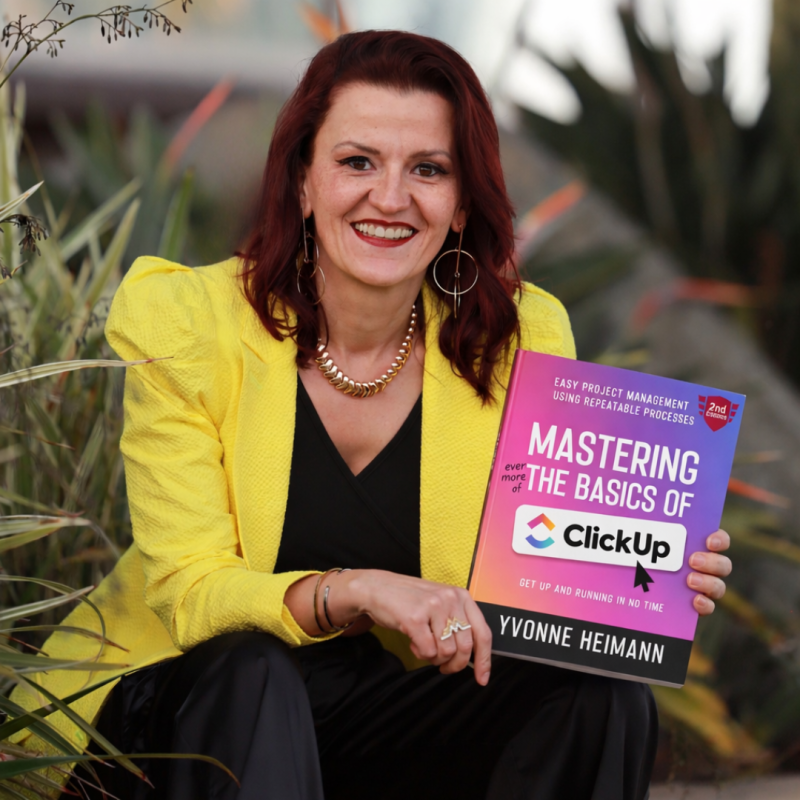
Yvonne 'Yvi' Heimann
CEO, AskYvi.com
Yvi is the CEO of AskYvi.com, a ClickUp evangelist, and an AI operations leader who helps agencies build efficient systems by combining ClickUp, Claude, and Make.com automations. She specializes in turning manual admin processes into AI-powered workflows.
Key Takeaways
- 1.Start AI implementation with your biggest admin pain point, not your money-maker process — you need proven data points before automating revenue-critical workflows
- 2.Well-prompted AI agents are replacing rigid 15-route automations in Make.com and ClickUp — one trained agent can handle routing that used to require complex branching logic
- 3.Designate 'Shiny Fridays' for intentional experimentation — playing with new AI tools without production pressure builds the innate knowledge your team needs
- 4.AI content is cleaning out low-quality operators the same way website builders and coaching floods did — the differentiator is human connection and strategic depth
- 5.The only right way to use AI in business is in connection with humans — AI handles the Eisenhower matrix tasks that must be done but nobody wants to do
- 6.Don't automate what you haven't manually tested — treat AI like a five-year-old that needs at least 75% of the context to do the job right
Full Transcript
Hey everybody. My name is Macgill. I am co-founder and CEO of Rize. We are continuing our chats with AI operations leaders in the consultancy space. Today I'm really excited to welcome Yvonne 'Yvi' Heimann. She's the CEO of AskYvi.com, a ClickUp evangelist and expert, and she is extremely passionate about business efficiency and scalability.
Thanks so much for having me. We've been nerding out behind the scenes already, so I'm excited to take it live and show your audience how this stuff works in real life.
You're working with Claude and closely with ClickUp, which has been leading with a lot of their own AI tools internally. How are you approaching that? Are you leaning more toward ClickUp's internal AI features or building things in Claude?
For me it's about the goal. If clients want to stay tight and small, there's a lot we can do with standard AI and just ClickUp Brain. ClickUp has done an amazing job connecting to other things. One of my biggest issues is when a company integrates AI but stays in their own environment. I need the capability to step out and pull other information in.
My bigger agencies are tapping into straight connections to Claude AI — building wikis, building skills, building automations to take it to a broader level. I can train the AI specifically on my voice, my visual brand, and build skills to create content or standard operating procedures. It's not necessarily an either-or. It's the focus on the goal.
How have you seen the landscape change with your clients? When clients come to you, are they looking for AI strategy or efficiency? How are you thinking about that at a high level?
Most of my clients come to me with 'oh my god, we need to build ClickUp.' That's usually where it starts. We dive into the processes — I pride myself on working closely between technology and human, because I can build the best processes, but if the humans don't use it, it's worth nothing.
While working through these processes, my brain just goes: why are we doing this manually? Why are you doing this three times over? I'm a lazy person — if I have to do something manually three times, can I just automate that? Can I template that? I tell my teams: if something gives you 3 AM wakeups because you have to do it tomorrow morning, let me know. We'll find a process for it, automate it, bring AI in to do the admin you don't want to do, so you can stay in your genius zone.
We have actually moved away a lot from structured automation to well-prompted AI agents. It's so much easier as long as you can be specific. Dumb stuff in, dumb stuff out — it needs to be prompted really well. But I can build a knowledge base and say 'when this happens, I need that to happen' and give additional information. A well-prompted super agent takes care of things I couldn't do before because I didn't have the right trigger or action in ClickUp.
We talked in the green room — you guys just rolled out Claude access and MCP. I was nerding out this morning because my brain went into overdrive. We run on EOS, and I'm like, oh my god, I can now combine scorecards and times and all of the stuff from Rize without me having to dig in. I can build a skill in Claude to pull data from Rize and get a weekly or monthly rundown on my team based on ClickUp data, Rize data, and whatever I taught it.
I'm curious — where do you recommend clients start with AI? A lot of people know AI is powerful but don't even know how to get going with automating or leveraging it more.
With AI specifically, your money maker is usually where you spend the most admin time. But we need to be careful — do you know how to prompt right yet? We want to build up to your money maker, not start there. Internally, our money maker is ClickUp builds and business efficiency consulting, but we started AI implementation with content creation and repurposing. We'd been doing it for ages, the team knows the process, the brand is clear, we have tons of YouTube videos to pull from. It was an easy win to program Claude Code with the wiki, knowledge base, social media skill, and brand skill.
Number one: what makes the highest impact? Improvements to your bottom line. Secondary: what's the low-hanging fruit you can implement right now? It could be as simple as you as the CEO spending an hour developing the AI around sorting your call recordings, pulling information out, and extracting the data points you want to be better at next time.
We've been doing that with the Rize MCP — querying it like 'what are some areas based on all our team's time entries where we could use AI more?' It keeps you accountable. I also find with AI processes, I fall into old habits. I know there's a better way but then I go back to how I always used to do it.
That's where I love your guys' general approach. I can't go on Facebook without Rize being like, 'is this a distraction?' It's proactive. We are humans running certain programming, and Rize at its core has been a proactive measure for the things we usually don't want to deal with. It says 'hey, we took care of some of your times and assignments' but also comes back with 'we got five here I didn't know what to do with, you need to handle this.' It helps change the habits we know we want to change.
In ClickUp you mentioned shifting from structured templates to well-honed prompts. Can you share more specifics on that?
Let me clarify — we still use task templates and workflow templates. The more I can put work into a box and template it, the less my team needs to think about it. Many creatives think systems stifle creativity. It's actually the opposite — it frees up your brain when you know exactly what needs to happen. What we've moved away from is fixed workflow automations with rigid routing.
ClickUp automations where 'if this status changes, do this' can be a problem when you don't have the right data point for the specific remap you want. A well-prompted AI can work around that. For example, call organization — I want to analyze my call scripts and reflect client language back. I don't want to spend three hours on Friday organizing them. So I prompt an AI agent to identify client calls vs team calls, organize them, and it runs every evening.
Taking it even bigger with Make.com and MCPs — I don't need to build huge automations with 15 different routing angles anymore. I program an AI. What you put in is what you put out. It's not simple to set up, but it's simple in the long run if you program it right. Now I can create a general skill for content creation, train it on good content without AI language based on 20 years of learning, and combine it with a wiki for specific brand knowledge. My team suddenly has resources to batch content and not spend 50 hours a week on ideation and analytics.
How are you thinking about business efficiency in the next one to two years? What will efficient look like? What metrics should heads of organizations focus on?
A lot of companies are going to clean themselves out. There's only one right way to use AI, and that is in connection with humans. Right now, especially in agencies and content creation, we're getting inundated with AI content that's not high quality. We had the same thing when everyone learned to build websites, and when everyone became a coach who coaches coaches. It's a human pattern — people get excited, jump in, and it's going to clean out bottom-quality operators.
We hire based on personal goals, personality profile, and who you are. If I match the position to your goals, I get the best out of you. AI becomes the extension of this. Nobody wants to do time tracking — that's what we got Rize for. Nobody wants to do analytics when they want to be creative. AI at its best shows up in the things your team doesn't want to do — the Eisenhower matrix tasks that always need to get done and nobody wants to because they're not important but still necessary.
Small companies and bootstrapped companies now suddenly have the resources. I don't believe AI is going to take jobs — it's going to make our life easier and therefore require fewer employees for the same output. You either learn AI and work with it, or you get left behind.
It parallels so many technological advancements, except the pace is 10x. Sometimes at Rize we say we need to just work for a few weeks — we can't keep changing processes because every two weeks there's something completely new.
You need to go in seasons. You don't want to do a three-hour process to replace a three-and-a-half-hour process. You don't want to shift your company 10,000 times in a week. And you don't want to bring AI in for something you haven't manually tested yet.
What you put in is what you put out. You need to manually test what you want to automate because you won't have the data points to train the AI. It's like a five-year-old that has never seen or done what you were doing — you need at least 75% of the information to build that knowledge. You can play in a sandbox, but really integrating it in a business without burning the whole thing down requires doing it first and having the answers.
My Claude mentor had 500-plus sales calls. The data in there — the language your client uses, analyzing the sale you got versus the one you didn't — even if you're not implementing AI right now, you should be collecting that data.
Companies rolling out AI well encourage it from the top down and give team members space to play around with new tools and have fun. We almost have to set time aside that's not about finishing a task with AI but just learning.
I have Shiny Fridays — that's where I play with new features in ClickUp, dive into your updates, have my call with my Claude mentor to learn and test new things without having to produce. We always say shiny objects are bad. I say let's intentionally go down a shiny object route because you're stepping out of your comfort zone, testing new things, and learning. You don't need to finish. And you learn what not to do — that's just as valuable.
There's so much innate knowledge in using AI well — like how we learned to Google. You need to play with it to understand how to prompt well, where it does well, and where there could be mistakes.
Exactly. I started just playing in Claude and building skills, and my mentor said, 'Hold on — that specific piece should be a wiki and knowledge base, not a skill.' He's been there, he broke it, and he knows why. You're not going to get that from watching a four-hour YouTube video.
Yvi, thank you so much for joining. Such an interesting and fun conversation.
Thanks so much for having me. The easiest way to find me is on social media — AskYvi everywhere. ASK-Y-V-I. It's all linked on askyvi.com, and I'm Yvonne Heimann on LinkedIn. I'm one of those people attached to their phone, so wherever you reach me, I'll be there.