Hacker News is where the AI conversation happens. DeepSeek's "Sputnik moment." Claude's rise. The Cursor phenomenon. But how much of the conversation maps to what people actually do at their desks? We compared HN mention trends with desktop tracking data from 50,000+ Rize users to find out.
Why HN discussion diverges from real usage
Hacker News has a specific demographic: software engineers, technical founders, and infrastructure builders. That shapes which tools get front-page threads, which get celebrated, and which get ignored entirely.
DeepSeek's model capabilities, Anthropic API announcements, and open-source releases land on HN because they matter to the people who build on top of AI systems. But most AI adoption happens at the workflow layer, not the infrastructure layer. A product manager who builds their daily brief in Claude does not post about it. A designer using Midjourney for client decks does not file a Show HN. The signal is in the usage data.
According to McKinsey's 2024 State of AI survey, 72% of companies now use AI in at least one business function, up from 55% a year earlier. That adoption is happening across marketing, operations, finance, and design teams, most of which generate zero HN discussion. The tools driving that adoption often go unmentioned on HN for months.
The gap this creates is measurable. Here is where the narrative diverges most sharply from the reality.
| Tool | HN discussion | Actual usage (rank, share of AI tool time) |
|---|---|---|
| ChatGPT | Very high | #7, ~8% of AI tool time |
| DeepSeek | Very high (Jan 2025 spike) | Not in top 13 |
| Claude | High | #1, ~31% of AI tool time |
| Cursor | Moderate | #2, ~30% of AI tool time |
| Lovable | Low | #8, ~7% of AI tool time |
| Devin | Low | #4, ~20% of AI tool time |
| Perplexity | Low | #11, ~3% of AI tool time |
The hype cycle vs the usage data
ChatGPT: Most discussed, not most used
ChatGPT dominated HN from late 2022 through 2025. It is still the most recognized AI brand. But in actual desktop usage, it ranks 7th among AI tools, accounting for roughly 8% of all AI tool time.
Claude, which gets roughly a third of ChatGPT's HN mentions, has 3.7x higher engagement per user. The tool people talk about most is not the tool they use most. This matters for any team evaluating AI ROI: brand recognition is not a proxy for workflow value. See our full Claude vs ChatGPT comparison for the data.
DeepSeek: Biggest spike, zero desktop presence
DeepSeek produced the largest single-week spike in HN AI discussion history in January 2025. The model benchmarks were genuinely impressive, and the cost implications for the AI infrastructure market were real. But in our 50K-user tracking dataset, DeepSeek does not appear in the top 13 AI tools by daily usage. The conversation was about the model, not the product.
This is the clearest example of the HN/reality gap: technical significance and end-user adoption are different things.
Cursor: Quiet on HN, dominant in practice
Cursor gets moderate HN discussion compared to ChatGPT or Claude. But among AI coding tools, it leads with ~30% of all AI tool time, beating both VS Code with Copilot and every other AI-enhanced editor. The users who adopted Cursor spend more time in it than any other AI tool except Claude. However, our Cursor vs Windsurf comparison shows the AI IDE market is shifting fast -- Windsurf dropped 65% in June while Claude Code gained share.
According to the Stack Overflow 2024 Developer Survey, AI coding tools have become standard practice among professional developers, with adoption accelerating faster in 2024 than any prior year in survey history. Cursor's growth happened largely through direct adoption and word-of-mouth, not sustained HN front-page coverage.
Claude: The crossover
Claude is the only tool where HN discussion and usage data align. HN mentions have risen steadily since 2024. Usage data shows it as the #1 app overall across all tools tracked by Rize. The discussion is catching up to the reality. The desktop app is the key driver: Claude desktop users account for ~31% of AI tool time versus ~10% for web users.
Where HN misses
AI builders (Lovable, Bolt, v0)
Lovable, Bolt, and v0 are barely discussed on HN but show meaningful usage in our data. Lovable accounts for ~7% of AI tool time among its active users. These tools serve a different audience: non-developers building apps, not the engineer audience that drives HN discussion.
The builder category is the most underrepresented on HN relative to actual usage. The people building with Lovable and v0 are not the people writing about AI on HN. Their absence from the conversation does not reflect the size of the audience, or the tool's real-world footprint.
According to the GitHub Octoverse 2024 report, developer AI tool adoption is concentrated in a subset of highly active users rather than distributed evenly. The same pattern shows up in our data: the users who adopt builder tools go deep, while the tools themselves remain invisible in the HN conversation.
AI agents (Devin, Codex)
Devin and Codex get occasional HN threads but their usage numbers are striking: Devin accounts for ~20% of AI tool time among its users, Codex for ~25%. Users who adopt these tools go deep. The engagement per user rivals Cursor.
The agent category is early-stage in terms of user count, but the engagement rate of adopters is high. A tool that commands 20%+ of your team's AI time is changing how they work, whether or not it trends on HN.
Perplexity: The quiet workhorse
Perplexity gets minimal HN attention but appears consistently in our tracking data, accounting for ~3% of AI tool time. It is used in short bursts for research and fact-checking. It functions more as a utility than a destination app, which is why it generates less discussion despite steady usage.
What predicts real adoption
Based on our data, four patterns predict which AI tools actually get used versus which get discussed:
Desktop apps win over web apps. Claude's desktop app commands 3x the share of AI tool time as Claude's web interface. Cursor is a desktop app. The tools that become part of the workflow, not a browser tab, get used consistently. When an AI tool ships a native app, usage follows.
Per-user engagement matters more than user count. ChatGPT has more users. Claude has 3.7x more engagement per user. The tool that captures ~31% of a user's AI time is stickier than one capturing ~8%. For budget decisions, habitual tools have higher actual ROI than widely adopted but rarely used ones.
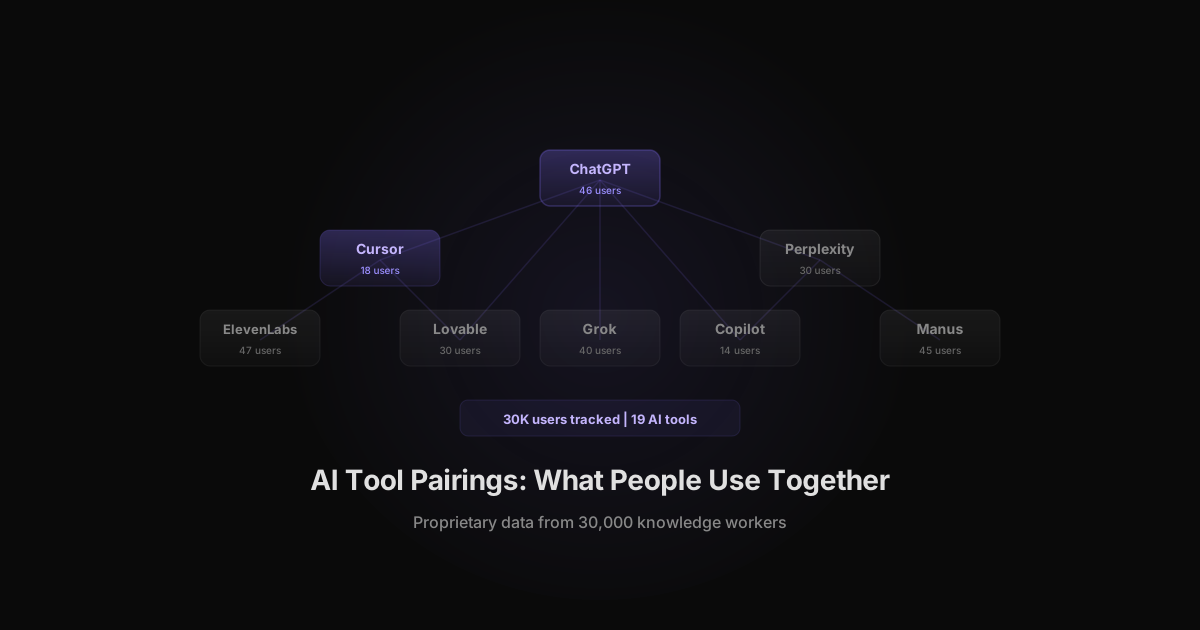
Pairing patterns reveal intent. ChatGPT + Claude is the most common pairing in our data. Users appear to use ChatGPT for quick questions and Claude for longer work sessions, based on the engagement time difference. The "which tool is better" debate misses that most power users run both, with different tools serving different depths of work.
Enterprise licensing does not equal enterprise usage. GitHub Copilot web usage accounts for roughly 1% of AI tool time in our data, despite widespread enterprise licensing. Enterprise AI rollouts often generate procurement activity without generating actual usage. The license count is not the adoption rate, and the HN discussion is not the daily habit.
How to use this
If you are choosing AI tools for your team, these implications follow directly from the data:
Do not optimize for HN discussion volume. The tools that trend on HN are the tools the HN demographic finds interesting. Your team's workflow may look nothing like theirs.
Measure engagement per user, not seat count. A Cursor license capturing ~30% of a developer's AI tool time is delivering value. A Copilot web license at ~1% is a budget line that buys nothing. Most procurement decisions are made without this data.
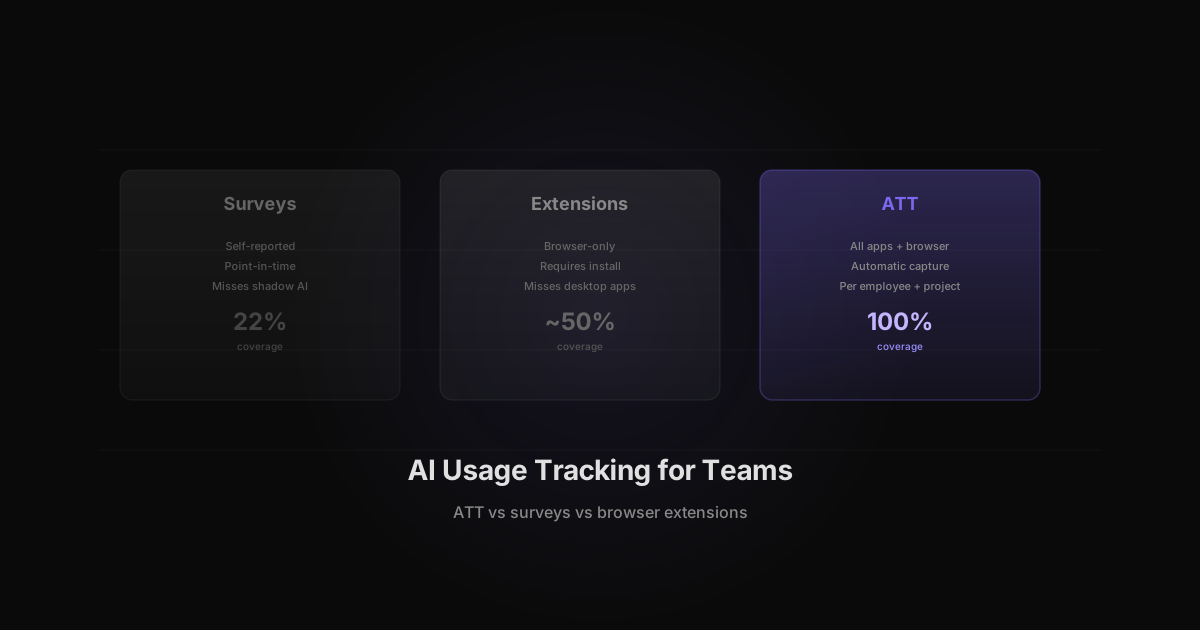
Shadow AI is a measurement problem before it is a security problem. According to HelpNetSecurity, 78% of workers use AI tools their company does not officially provision. Before you can evaluate AI tool ROI, you need a complete picture of which tools your team actually uses. Rize's automatic time tracking detects every AI tool in use, approved or not, without surveys or self-reporting.
Pilot with usage data, not with votes. If you want to compare Cursor versus VS Code with Copilot for your team, run a 30-day trial and measure actual time spent in each tool per developer. The tool with higher engagement is the one your team is genuinely finding useful. Rize's AI productivity metrics captures this automatically across your whole team.
The only reliable benchmark is your own data. HN trends tell you what technical builders find interesting. Desktop tracking tells you what your team actually does.
How we collected this
Rize automatically tracks all desktop apps and websites via an Electron agent. We detect 23+ AI tools by app name and URL pattern. No screenshots, no keylogging, just window titles and active app time. The data in this post comes from our aggregated tracking data, a two-week rolling window across 50,000+ users in 40 countries.
Start tracking time automatically
Join thousands of professionals who stopped guessing where their time goes. Free for 7 days.
“Rize has been a no-brainer for me.” — Ali Abdaal Read more →