AI agent deployment is accelerating. Gartner projects $2.52 trillion in AI spending in 2026. Enterprises are rolling out Copilot, ChatGPT Team, Cursor, and custom agents across every department. But deployment is not measurement. The moment an AI agent goes live, the hardest question lands on the CFO's desk: "What is this actually producing?"
Key Takeaway
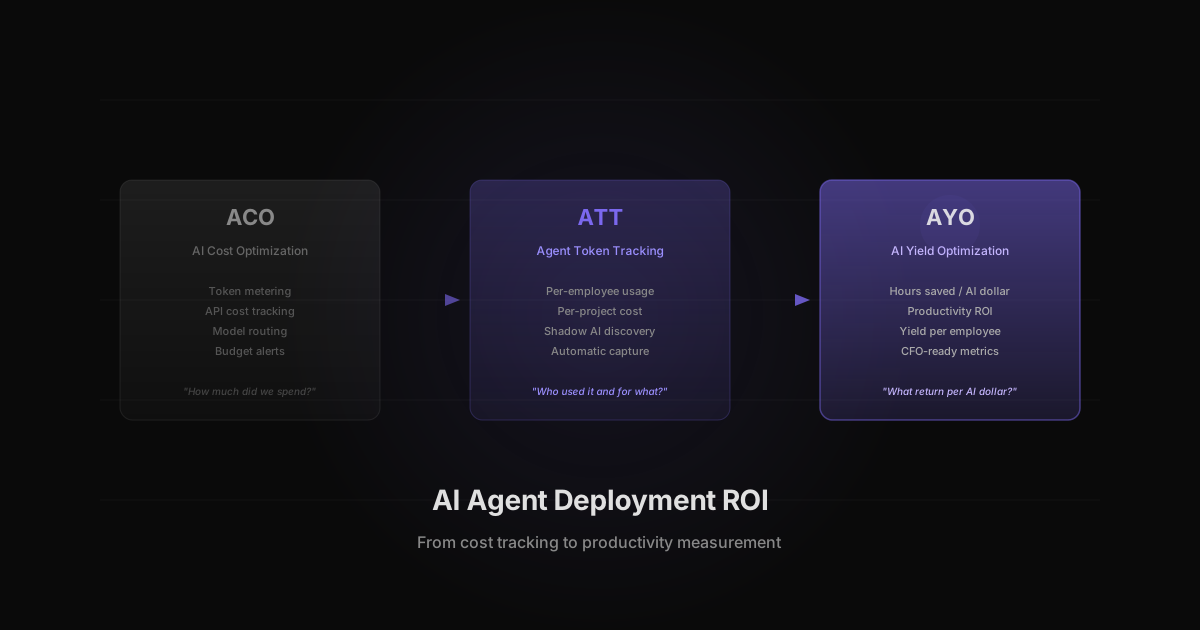
AI agent deployment without employee-level measurement is guesswork. ACO (AI Cost Optimization) tracks token spend. ATT (Agent Token Tracking) maps that spend to individual employees and projects. AYO (AI Yield Optimization) turns both into a productivity ROI metric. Companies that reach AYO are the 20% that PwC says capture 74% of AI-driven returns.
The Deployment-to-Measurement Gap
Deploying AI agents is the easy part. Measuring what they produce per employee is where most organizations stall. InformationWeek reports that 67% of enterprises still estimate AI ROI instead of measuring it — even after deploying agents at scale.
The gap is structural, not cultural. FinOps dashboards show aggregate API spend. License management tools show seat counts. But neither tells you that Developer A saved 12 hours last week using Copilot on Project X while Developer B used the same tool and saved zero hours on Project Y. That per-employee, per-project attribution is the missing layer.
Deloitte's State of AI 2026 found that 93% of AI budgets go to technology and only 7% toward the people and workflows expected to generate returns. Only 10% of organizations report measurable ROI from agentic AI deployments. The other 90% have agents running but no way to prove what those agents are worth.
This is not a technology problem. It is a measurement problem. And it follows a predictable progression from cost tracking to yield optimization.
ACO: Where Most Companies Start (and Get Stuck)
AI Cost Optimization is the practice of tracking and reducing AI infrastructure costs — token usage, API calls, model selection, and compute resources. Tools like Helicone, Langfuse, and Vantage provide ACO by monitoring spend at the API level. The FinOps Foundation reports that 98% of organizations now have some form of AI cost management in place.
ACO answers one question well: "How much did we spend on AI compute?" It can break that number down by model, by API endpoint, and sometimes by team. It catches runaway prompt loops and duplicate API calls.
But ACO has a blind spot that matters after deployment. When Uber's 6,500 engineers burned through the entire 2026 AI budget in four months at $500 to $2,000 per engineer per month, ACO tools could show the total spend. They could not show which teams or projects consumed the budget — or whether that consumption produced proportional engineering output.
ACO is a necessary starting point. But for companies that have already deployed AI agents and need to justify the investment, cost tracking alone is not sufficient. The next question is always "who used it and what did it produce?" — and ACO cannot answer that.
ATT: The Missing Employee Layer
Agent Token Tracking (ATT) is the practice of measuring per-employee AI tool usage and compute cost automatically. Where ACO tracks infrastructure, ATT tracks the humans interacting with that infrastructure — which person used which AI tool, for how long, on which project, without manual logging or SDK instrumentation.
ATT fills the attribution gap that appears the moment you move from proof-of-concept to deployment. Consider a 200-person consulting firm that deployed Microsoft Copilot across all staff. Six months later, the CTO can show that the firm spent $72,000 on Copilot licenses. What the CTO cannot show — without ATT data — is that 140 of those 200 employees used Copilot fewer than 3 hours per month while 30 power users used it 40+ hours per month. That distribution changes every decision about scaling, training, and budget allocation.
ATT captures four categories of data that ACO cannot:
| What ACO tracks | What ATT adds | |---|---| | Token count per API call | Hours per AI tool per employee | | Cost per model per month | Cost per project (human + AI blended) | | Rate limit utilization | Shadow AI tool discovery | | Budget alerts at threshold | Net productivity delta per person |
Rize pioneered ATT because existing tools only measure one side. FinOps tracks the infrastructure cost. Time trackers track human hours. Nobody was capturing both automatically, per employee, per project — until Rize's desktop agent started detecting AI application usage alongside regular work sessions.
Shadow AI: The Hidden Variable in Deployment ROI
Shadow AI — employees using unapproved AI tools without IT oversight — directly undermines deployment ROI calculations. HelpNetSecurity reports that 78% of workers use unapproved AI tools, costing companies $412,000 per year on average. When 34% of that shadow spending duplicates tools the company already pays for, the cost side of any ROI equation is incomplete.
ACO tools cannot see shadow AI because they only monitor instrumented API endpoints. When an employee opens a personal ChatGPT tab or installs an AI coding assistant the IT team never approved, the FinOps dashboard shows nothing. ATT detects shadow AI by tracking which AI applications each employee actually runs — including tools the organization did not provision.
For enterprise AI deployment, shadow AI is not a security footnote. It is a measurement prerequisite. You cannot calculate deployment ROI when you do not know what you deployed versus what your team deployed on their own.
AYO: From Tracking Spend to Measuring Yield
AI Yield Optimization (AYO) measures productivity return per AI dollar per employee. Where ACO asks "how much did we spend?" and ATT asks "who spent it?", AYO asks "what did we get back?" It is the layer that turns AI from a cost center into an investment with auditable returns.
AYO requires ATT data as input. You cannot optimize yield without knowing who used which tools, for how long, on which projects, and what the hours-saved delta was. The formula:
AI Yield = (Hours Saved per Employee x Loaded Hourly Cost) / AI Cost per Employee
A yield of 3.0x means every $1 of AI spend produces $3 in labor value.
Anthropic's research across 100,000 conversations shows AI reduces task completion time by 80% on average. But InformationWeek reports that 40% of AI-generated outputs require rework. The net gain after corrections is closer to 48% — still significant, but half the headline number from your vendor dashboard.
AYO measures both the AI-assisted acceleration and the correction overhead. That is the difference between telling your CFO "Copilot is saving us time" and telling your CFO "each Copilot dollar produces $3.20 in labor savings across the engineering team, and expanding to the product team projects a 218% return."
The ACO to ATT to AYO Progression
The three measurement layers form a progression, not a menu. ACO is the foundation. ATT adds per-employee attribution. AYO delivers the productivity yield metric that justifies continued AI agent deployment. Skipping a layer produces unreliable numbers.
| Dimension | ACO | ATT | AYO |
|---|---|---|---|
| Focus | Infrastructure spend | Employee-level usage | Productivity ROI per person |
| Primary metric | Cost per token / API call | Cost per employee / workflow | Hours saved per AI dollar |
| Data source | API billing, FinOps dashboards | Automatic time tracking | Time tracking + cost data combined |
| CFO question | "Are we overspending on AI?" | "Who is using AI and how much?" | "What return per AI dollar?" |
| Deployment insight | Total cost known | Adoption gaps visible | Scale/cut decisions defensible |
| Blind spot | No employee or project data | No before/after comparison | None — full cost-to-outcome chain |
PwC's research found that 20% of companies capture 74% of AI-driven returns. The differentiator is not spending — it is measurement discipline. Companies stuck at ACO can show they spent efficiently. Companies at AYO can show the investment produced measurable productivity gains per employee.
Measure AI deployment ROI per employee
Rize captures every AI tool session automatically. See which employees use which agents, how much time they save, and what each AI dollar produces. No manual logging.
Start Free TrialRize ATT vs Manual Tracking vs FinOps-Only
Three approaches exist for measuring AI agent deployment outcomes: manual surveys and self-reported usage, FinOps-only dashboards (ACO), and automatic per-employee tracking (ATT). Each produces different data quality and different decisions.
| Capability | Rize ATT | Manual tracking | FinOps only (ACO) |
|---|---|---|---|
| Per-employee AI usage | Automatic | Self-reported | Not available |
| Shadow AI detection | Real-time | Depends on honesty | Invisible |
| Per-project cost attribution | Automatic | Manual tagging | Team-level only |
| Hours-saved measurement | Before/after delta | Estimates | Not tracked |
| Compliance burden | Zero — runs in background | High — requires employee input | Zero — API-level |
| Yield calculation (AYO) | Full formula | Estimated inputs | Cost side only |
| Privacy model | No screenshots, no content | No surveillance | API-level only |
Manual tracking fails at scale because compliance drops. A quarterly survey asking "how much do you use AI tools?" produces estimates, not data. FinOps-only approaches fail because they lack the human side entirely. ATT is the only approach that captures both cost and productivity data automatically, per employee, per project.
Three AI Agent Deployment Scenarios
Real deployment ROI measurement looks different across industries. Here is how the ACO-ATT-AYO framework applies to three common scenarios.
Agencies Deploying AI Agents for Client Work
A 40-person creative agency deploys ChatGPT Team and Midjourney across all staff. After 90 days, the agency lead needs to answer: "Are these tools paying for themselves on client projects?"
Without ATT, the agency knows total AI spend ($6,800/month) and total client revenue. With ATT, the agency sees that designers using Midjourney save 8 hours per week on asset creation, copywriters using ChatGPT save 5 hours per week on first drafts, and account managers use neither tool more than 2 hours per month.
The AYO calculation reveals that the design team produces a 4.2x yield while the account management team produces 0.3x. The decision: expand AI tooling for designers, redirect account management licenses to the production team, and track the yield shift over 60 days.
For agencies, Rize's automatic time tracking captures the per-client dimension that makes this calculation actionable. Knowing that Designer A saved 8 hours this week is useful. Knowing they saved 5 of those hours on Client X's project — whose blended rate is $175/hour — turns a time metric into a revenue metric.
Consulting Firms Measuring Copilot ROI
A 500-person consulting firm rolled out Microsoft Copilot at $30/seat/month across all consultants. Six months in, the Managing Partner wants proof that the $180,000 annual investment produces returns.
The ACO layer shows $15,000/month in Copilot licensing. The ATT layer reveals that only 280 of 500 consultants use Copilot regularly — meaning 220 licenses ($6,600/month) are underutilized. Among active users, ATT shows an average of 18 hours saved per month on document drafting, data analysis, and meeting summaries.
The AYO calculation at a $95/hour loaded rate: (280 users x 18 hrs x $95) - $15,000 cost = $463,200/month in labor value against $15,000 cost. That is a 30.9x yield. The underutilized seats reduce it to 20.6x overall. The decision: cut 100 unused licenses, invest the savings in Copilot training for the remaining 120 low-usage consultants, and re-measure in 90 days.
Enterprises Tracking AI Adoption Across Departments
A 2,000-person enterprise deployed AI agents across engineering (Cursor, Copilot), marketing (ChatGPT, Jasper), and operations (custom GPTs). The CTO needs a unified view of AI deployment ROI across all departments.
The Federal Reserve Bank of Atlanta reports the average company spends $2,068 per employee on AI — but the top 10% spend $2,800 or more while the median spends under $200. That 14x gap exists within enterprises too, between departments.
ATT surfaces this internal distribution. Engineering might consume 70% of the AI budget while marketing consumes 20% and operations 10%. But if marketing's 20% produces a 5x yield and engineering's 70% produces a 1.8x yield, the optimal allocation shifts dramatically. Without per-department, per-employee data, the CTO cannot make that call.
Rize's AI productivity metrics dashboard provides this cross-department view. Each department's AI tool usage, hours saved, and yield calculation is visible in one place — without requiring each team to use a different measurement tool.
How to Measure AI Agent Deployment ROI in 8 Weeks
Moving from "we deployed AI" to "here is the ROI per employee" takes 8 weeks of data collection and follows four steps. The process works for any team size from 10 to 2,000+ employees.
Week 1-2: Baseline capture. Deploy automatic time tracking across the teams using AI tools. Track work patterns for 2 weeks before any changes. This captures baseline task durations — how long each workflow takes without AI assistance. Rize runs in the background and requires no manual input from employees.
Week 3-4: Cost mapping. Attribute AI tool costs to individual employees. For per-seat tools (Copilot, ChatGPT Team), this is straightforward — the license cost maps 1:1. For API-based tools, tag requests with user identifiers. For shadow AI, use ATT data to discover which unapproved tools employees are using and estimate their cost.
Week 5-6: Post-deployment tracking. With AI agents deployed and time tracking running, compare task durations to the baseline. ATT captures the hours each employee spends in AI tools versus their regular workflow — automatically distinguishing AI-assisted work from unassisted work.
Week 7-8: Yield calculation. Calculate AYO per employee: (hours saved x loaded hourly cost) / AI cost per employee. Aggregate by team, department, project, and tool. Identify high-yield employees and workflows. Flag low-yield or negative-yield deployments for review.
A 50-person team running this process produces a first AYO report at week 8 showing which employees and which workflows generate the highest yield — and where AI spend produces low or negative returns.
What the Data Actually Looks Like
After 8 weeks of ATT data collection, a team of 50 produces a yield distribution. The typical pattern: 15-20% of employees generate 60-70% of the total AI yield. Another 30% produce moderate returns. The remaining 50% use AI tools rarely or ineffectively.
This distribution mirrors PwC's finding that 20% of companies capture 74% of AI-driven returns — except ATT lets you see the same concentration at the individual level. The power users are identifiable. Their workflows are replicable. The gap between high-yield and low-yield employees is usually a training problem, not a tool problem.
The actionable insight is not "fire the low-yield users." It is "study the high-yield users, document their workflows, and train everyone else to replicate them." The employees producing 4x yield are doing something specific — using AI for first drafts then editing aggressively, routing complex tasks to specialized models, building prompts that reduce rework. ATT data surfaces those patterns.
Why Enterprise AI Deployment Needs ATT Before AYO
Enterprise AI deployment at 200+ employees creates measurement challenges that ACO cannot handle. When multiple departments use different AI tools on different projects with different cost structures, aggregate cost data is meaningless for allocation decisions.
ATT provides four capabilities that enterprise AI deployment requires:
-
Cross-tool visibility. Enterprises deploy Copilot, ChatGPT, Cursor, Claude, Midjourney, and custom agents simultaneously. ATT tracks all of them through a single measurement layer — the desktop agent sees which AI applications each employee runs regardless of whether IT provisioned them.
-
Project-level attribution. When a consultant uses three different AI tools on two client projects in the same day, ATT maps the time to each tool and each project. This granularity turns "we spent $50K on AI this quarter" into "Client A's project consumed $8,200 in AI-assisted labor while Client B's consumed $3,100."
-
Adoption velocity tracking. After deploying AI agents, enterprises need to know adoption rate by department and by week. ATT shows whether usage is growing, plateauing, or declining — and which departments are driving each trend.
-
Privacy-first measurement. Rize's ATT captures application-level data — which tool, how long, which project — without screenshots, keystroke logging, or content inspection. This matters for enterprises where surveillance tools create compliance and trust issues. The measurement layer has to be sustainable, or adoption data becomes unreliable.
How Competing Tools Measure AI Deployment
Current tools for measuring AI agent deployment outcomes fall into three categories: developer-focused LLMOps, cloud-focused FinOps, and employee-focused productivity analytics. None of them cover the full ACO-ATT-AYO stack alone.
| Category | Tools | What they measure | What they miss | |---|---|---|---| | Developer LLMOps | Langfuse, Helicone, LangSmith | Token costs, latency, model quality | Who used it, for how long, on which project | | Cloud FinOps | Vantage, Finout, CloudZero | Infrastructure cost, budget alerts | Employee-level attribution, productivity | | Employee productivity | Worklytics, Microsoft Copilot Dashboard | Usage frequency, adoption rates | Actual time saved, per-project cost, shadow AI | | Rize ATT | Rize | Per-employee usage, time saved, project attribution | — (connects all three layers) |
Microsoft's Copilot Dashboard shows adoption metrics — how many people used Copilot this week, how many documents they created. But it cannot show hours saved per person because it does not track work time outside of Copilot. Worklytics measures collaboration patterns but lacks per-tool cost attribution. Rize bridges the gap by tracking both the AI tool usage and the surrounding work context automatically.
From Measurement to Decision
The purpose of measuring AI agent deployment ROI is not to generate reports. It is to make three decisions faster: where to expand AI tooling, where to cut underperforming deployments, and where to invest in training.
Expand where yield exceeds 3x. If the design team produces 4.2x yield from Midjourney, invest in advanced prompting training and expand to similar creative roles. The data justifies the budget ask.
Cut where yield is below 1x after 90 days. If account managers produce 0.3x yield from ChatGPT, the tool is not the right fit for their workflows. Reallocate the licenses rather than hoping adoption improves on its own.
Train where yield is between 1x and 2x. These employees are using AI tools but not effectively. The gap is usually workflow-specific — they have not found the highest-value use cases. Study the 4x users in the same role, document their patterns, and run targeted training sessions.
Without ATT data, these decisions are political. With AYO metrics, they are quantitative. The CFO does not need to guess which deployment worked. The numbers show it.
Getting Started
If your organization has deployed AI agents and needs to measure what they produce, start with the employee-level data layer. Rize's AI productivity metrics capture AI tool usage per person, per project, automatically. Combined with your existing FinOps cost data, Rize provides the ATT foundation that AYO requires.
For a broader look at the ACO-ATT-AYO framework, read our guides on AI cost management and moving from token tracking to productivity ROI. Consultancies billing clients for automation work should also read our guide to AI automation solutions for consulting firms, which covers measuring client efficiency gains alongside process mining platforms. For enterprise deployments of 50+ employees, book an AI efficiency audit to see how ATT applies to your specific tool stack and team structure.
Start tracking time automatically
Join thousands of professionals who stopped guessing where their time goes. Free for 7 days.
“Rize has been a no-brainer for me.” — Ali Abdaal Read more →