Pre-IPO teams do not just work more hours. They work differently. Based on aggregate patterns from Rize's 30,000-user base, startup and pre-IPO teams show distinct work signatures -- longer hours, more uninterrupted focus blocks, higher AI tool adoption, and measurable weekend activity. This data tells a more nuanced story than the "hustle culture" cliche suggests.
Key Takeaway
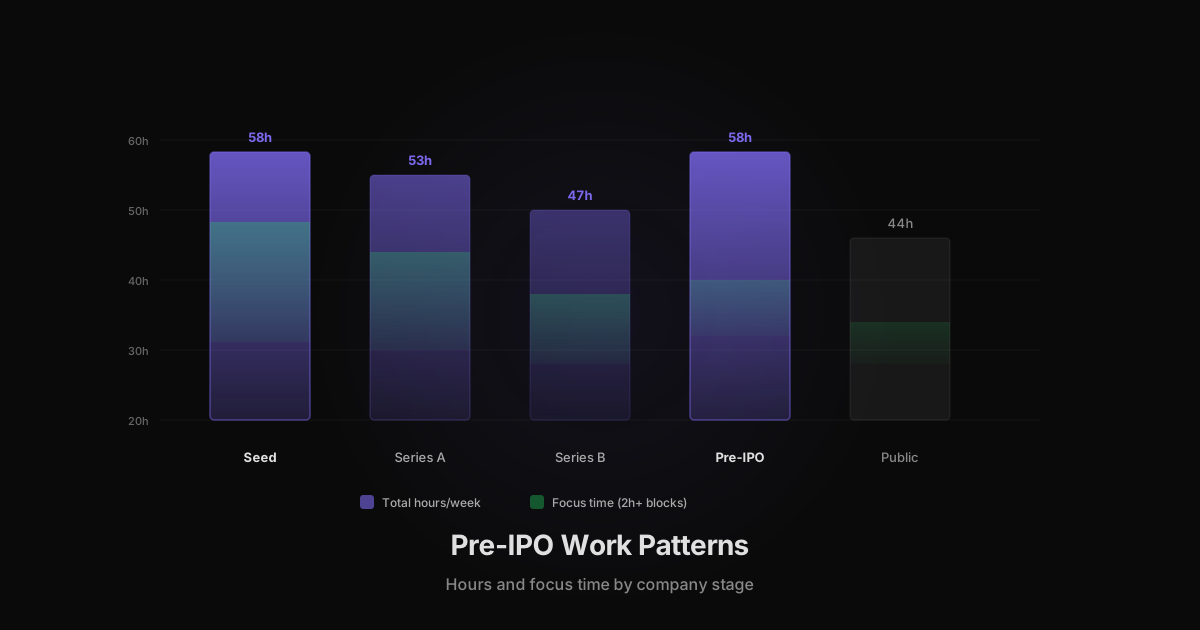
Startup teams work roughly 50 to 60 hours per week at seed stage, normalize around 45 to 50 after Series B, then spike back to 55+ during pre-IPO crunch. But the real difference is not total hours -- it is how those hours break down. Early-stage teams get more sustained focus time per hour worked, while pre-IPO teams lose focus time to meetings even as total hours climb. AI tool adoption runs 2 to 3x higher at startups than at established companies.
Pre-IPO Teams Work Differently, Not Just More
Startup employees work longer weeks than their public-company counterparts, but the gap is smaller than most founder mythology suggests -- and the real difference is in how those hours are structured, not how many there are.
Founder surveys consistently report 50 to 60 hour weeks as the startup norm. A National Bureau of Economic Research study on founder time allocation found that founders spend an average of 50 hours per week on their startup. Y Combinator cohorts during batch periods report 60 to 80 hours, though that intensity is seasonal and concentrated around demo day.
What makes startup work patterns distinct is not the raw number. It is the composition: more contiguous focus blocks, fewer scheduled meetings, more asynchronous communication, and more weekend work sessions. These are structural differences that show up clearly in time tracking data.
Startup work culture -- the aggregate behavioral patterns of how startup teams structure their hours, allocate focus time, and adopt tools. It differs from enterprise work culture not primarily in quantity but in structure.
Hours Per Week by Company Stage
Our data suggests that weekly hours follow a U-shaped curve across company stages: high at seed, declining through Series B, then climbing again during pre-IPO preparation.
| Company Stage | Typical Hours/Week | Trend | |---|---|---| | Seed | ~55-60 | High -- small team, everything is urgent | | Series A | ~50-55 | Slightly lower -- early specialization begins | | Series B | ~45-50 | Normalizing -- processes and roles formalize | | Pre-IPO | ~55-60 | Spikes -- compliance, board prep, growth push | | Public | ~42-45 | Steady -- structured schedules, more boundaries |
The seed-stage intensity is intuitive. Small teams wear many hats. When you are three engineers and a designer building toward a launch, there is no slack in the system. According to a Gallup survey of business owners, 39% of small business owners work more than 60 hours per week -- roughly double the rate of salaried employees.
The pre-IPO spike is the more interesting signal. After the relative calm of Series B, hours climb back to seed-stage levels. But the composition is different. At seed stage, those extra hours are building time. At pre-IPO, they skew toward compliance documentation, board preparation, and cross-functional coordination. The hours are the same, but the work is not.
The Focus Time Gap: Startups Get More Deep Work
Early-stage startup teams spend a higher share of their work hours in sustained focus blocks -- uninterrupted sessions of two hours or more -- despite working longer total hours than established companies.
This pattern is visible in aggregate Rize data. At seed stage, users show more frequent two-hour-plus focus sessions during their workday. As companies pass Series B and headcount grows, meeting density increases and these extended focus blocks become rarer.
According to research by Gloria Mark at UC Irvine, it takes roughly 23 minutes to refocus after a context switch. In a day with five meetings scattered across the schedule, the cost is not just the meeting time -- it is the fragmented blocks between meetings that are too short for meaningful focus work.
The startup advantage here is structural. A ten-person company has fewer standing meetings, fewer Slack channels, fewer cross-team dependencies. Deep work happens by default because there is less organizational overhead pulling people out of it.
By pre-IPO stage, this advantage erodes. Meeting load scales with headcount, and the focus-to-meeting ratio inverts. Teams that once spent the majority of their day in deep work find themselves in a pattern closer to enterprise norms: fragmented days punctuated by scheduled collaboration.
Focus time ratio -- the percentage of total tracked work hours spent in uninterrupted sessions of two or more hours. In our data, this ratio is highest at seed stage and declines as organizations add people, processes, and meetings.
Meeting Load Scales With Company Size
Meeting time as a share of the workday climbs steadily with company size, and our data suggests the steepest jump happens between Series B and pre-IPO.
Small teams under 20 people tend to spend less than 20% of their tracked time in meetings. This makes sense -- when everyone sits in the same room (physical or virtual), ad hoc conversations replace scheduled meetings. There is no need for a weekly sync when you sync constantly.
A 2024 study by Otter.ai found that the average professional spends roughly 18 hours per week in meetings. Microsoft's 2024 Work Trend Index reported that time spent in meetings has tripled since 2020 for the average Teams user.
At pre-IPO stage, meetings consume a larger share of the workday for two reasons. First, cross-functional coordination increases as departments formalize. Product, engineering, legal, finance, and sales all need alignment on IPO readiness. Second, board and investor meetings intensify. According to SVB's IPO advisory practice, pre-IPO companies typically begin formal readiness preparation 12 to 24 months before filing, which adds regular meetings with auditors, bankers, and legal counsel.
The paradox: pre-IPO teams work the same total hours as seed-stage teams, but a growing share goes to coordination rather than creation. That is where the burnout risk concentrates.
AI Tool Adoption Runs 2 to 3x Higher at Startups
Startup teams adopt AI tools at roughly two to three times the rate of larger organizations, based on aggregate patterns across Rize's user base.
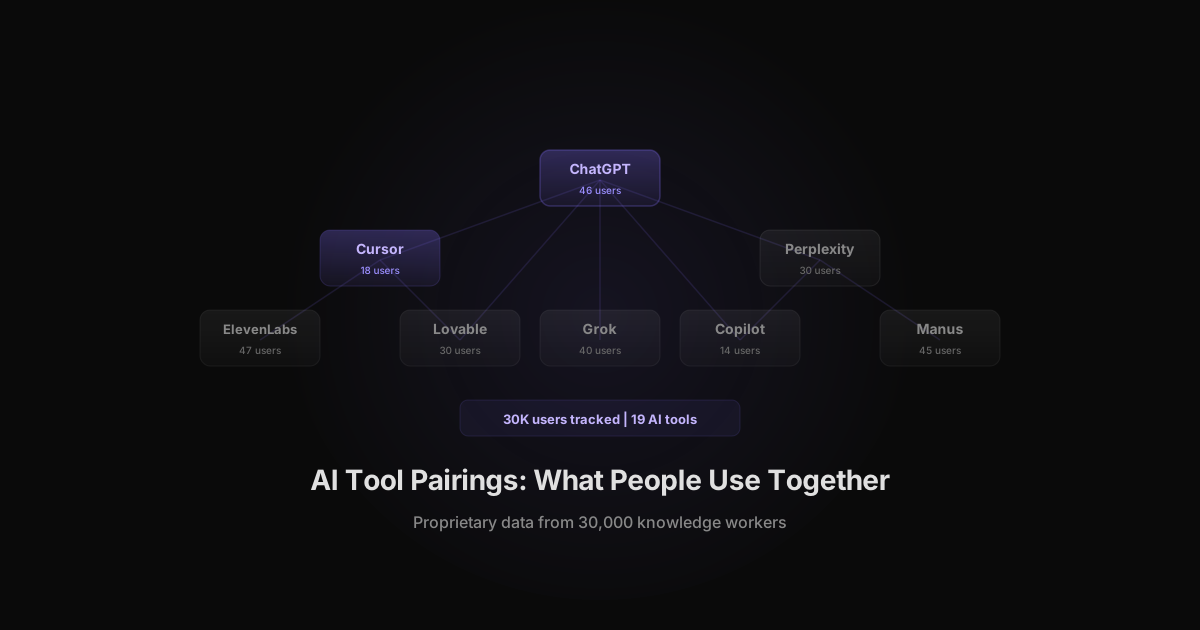
Among Rize users, ChatGPT appears on 46 user dashboards, GitHub Copilot on 26, and Cursor on 18. The users with the highest AI tool density skew toward smaller, earlier-stage teams. This is consistent with broader adoption data: Menlo Ventures' 2025 State of Generative AI found that enterprise AI adoption reached 72%, but much of that is concentrated in specific departments rather than distributed across every individual contributor.
The startup advantage in AI adoption comes from three factors:
No procurement barriers. A seed-stage engineer who wants to try Cursor signs up with a credit card. An enterprise engineer files an IT request, waits for security review, negotiates a vendor agreement, and gets access months later.
Higher pressure to multiply output. When your team is five people doing the work of fifteen, every tool that saves an hour per day is a meaningful productivity multiplier. The ROI calculation is immediate and personal, not abstract.
Culture of experimentation. Startup teams are self-selected for comfort with new tools. They adopted Slack before enterprise, GitHub before enterprise, and now they are adopting Claude, Copilot, and Cursor before enterprise procurement catches up.
According to McKinsey's 2024 Global AI Survey, 65% of organizations are now regularly using generative AI -- but the intensity of per-person usage varies dramatically. Startup employees tend to integrate AI into daily workflows, while enterprise adoption is often limited to pilot programs.
The gap matters for work patterns because AI-heavy teams structure their days differently. They spend more time reviewing AI output and less time on first-draft creation. The work rhythm shifts toward prompting, reviewing, and editing rather than blank-page writing and coding.
Weekend Work: When "Always On" Shows in Data
Weekend activity is a measurable signal in time tracking data, and it follows a predictable pattern by company stage -- highest at seed, lower in mid-stage, and spiking again at pre-IPO.
At seed stage, weekend sessions are common because the boundary between work and not-work barely exists. When you are three co-founders in a garage (or a co-working space), Saturday afternoon coding sessions are just part of the rhythm.
Post-Series B, weekend work drops. The team is large enough that no single person needs to cover every gap. Processes exist. On-call rotations replace the "everyone is always on" default. Slack's 2023 State of Work report found that 37% of desk workers regularly work outside standard hours, but this is higher among smaller companies and those in high-growth phases.
The pre-IPO spike is distinct. Weekend work re-emerges, but it looks different from seed-stage weekends. Instead of building, it tends to be preparation -- updating financial models, reviewing compliance documents, rehearsing board presentations. The weekend time tracker logs look less like focused development sessions and more like fragmented administrative work.
This matters because the type of weekend work affects recovery. A four-hour Saturday coding session in flow state is not the same as a four-hour Saturday of scattered email, document review, and anxiety about Monday's board meeting. The first can be energizing. The second is a burnout accelerant.
Burnout Signals: What to Watch in the Data
Time tracking data reveals burnout patterns before they become resignation letters. The signals are consistent and measurable: sustained high hours, declining focus time, weekend normalization, and shrinking recovery windows.
Based on patterns visible across our user base, here are the warning signs founders and HR leaders should watch:
Sustained weeks above 55 hours. A single 60-hour week is a sprint. Six consecutive 55-hour weeks is a pattern. According to the World Health Organization, working 55 or more hours per week is associated with a 35% higher risk of stroke and a 17% higher risk of heart disease compared to a 35-to-40-hour week.
Focus time dropping below 25% of total hours. When most of the day is meetings, email, and Slack, the work that requires concentration gets pushed to evenings and weekends. This creates a cycle: fragmented days lead to longer days, which lead to less recovery, which leads to lower output, which leads to even longer days.
Weekend sessions becoming the default. Occasional weekend work is normal at a startup. Weekly weekend sessions are a signal that the workload exceeds weekday capacity. When weekend work becomes expected rather than optional, the team is understaffed or overcommitted.
Shrinking gap between first and last activity. If the first tracked session starts at 7 AM and the last ends at 11 PM, the recovery window is too small. Even if total hours are "only" 50, spreading them across 16 hours leaves no room for the downtime that prevents chronic fatigue.
Harvard Business Review research makes the case that burnout is a workplace condition, not a personal failure. The data confirms this -- burnout signals cluster at organizational transition points (pre-IPO, post-acquisition, rapid scaling) rather than in specific individuals.
For Founders and HR: What to Measure
The difference between a team that performs under pressure and one that burns out is not willpower -- it is measurement. Founders and HR leaders who track work patterns can intervene before they lose their best people.
Here is what to track with automatic time tracking:
Hours per person per week (rolling 4-week average). The rolling average matters more than any single week. Look for sustained upward drift. A team averaging 52 hours is fine. A team averaging 52 hours that was averaging 45 hours two months ago is trending toward trouble.
Focus time ratio. What percentage of tracked hours are in uninterrupted blocks of two or more hours? For engineering and design teams, target at least 40%. Below 25% is a red flag that meeting culture is crowding out the work that requires concentration. Our team analytics dashboard breaks this down per member so managers can spot who is losing focus time to meetings.
Meeting time by role. Not everyone needs the same meeting load. Individual contributors should spend less than 20% of their time in meetings. Managers will be higher. But if your engineers are spending 30% of their day in meetings, they are doing management work without the title.
AI tool adoption rate. Track which AI tools your team actually uses and how much time they spend in them. Teams that adopt AI tools tend to produce more output per hour -- but only if the tools are integrated into real workflows, not just installed and forgotten.
Weekend and after-hours activity. Track it, but do not optimize for it. The goal is not to eliminate all weekend work -- it is to notice when it becomes chronic and intervene. A founder who sees weekend sessions climbing across the team can respond by hiring, reprioritizing, or pushing a deadline before someone quits.
The companies that track these patterns have a structural advantage in retention, hiring, and investor conversations. "Our team works 50 hours a week with 42% focus time and zero involuntary attrition in twelve months" is a stronger pitch than "our team is scrappy and works hard."
Pre-IPO companies spending heavily on AI tools should also benchmark their AI spending per employee against industry averages. Our data shows startups spend 2-3x more per employee on AI than established enterprises, but the ROI is measurable only when you combine spend data with actual usage hours.
Rize captures all of this automatically -- no timesheets, no manual logging, no surveillance. The tool runs in the background, categorizes time by project and application, and gives founders aggregate dashboards that show team patterns without exposing individual browsing history.
Start tracking time automatically
Join thousands of professionals who stopped guessing where their time goes. Free for 7 days.
“Rize has been a no-brainer for me.” — Ali Abdaal Read more →