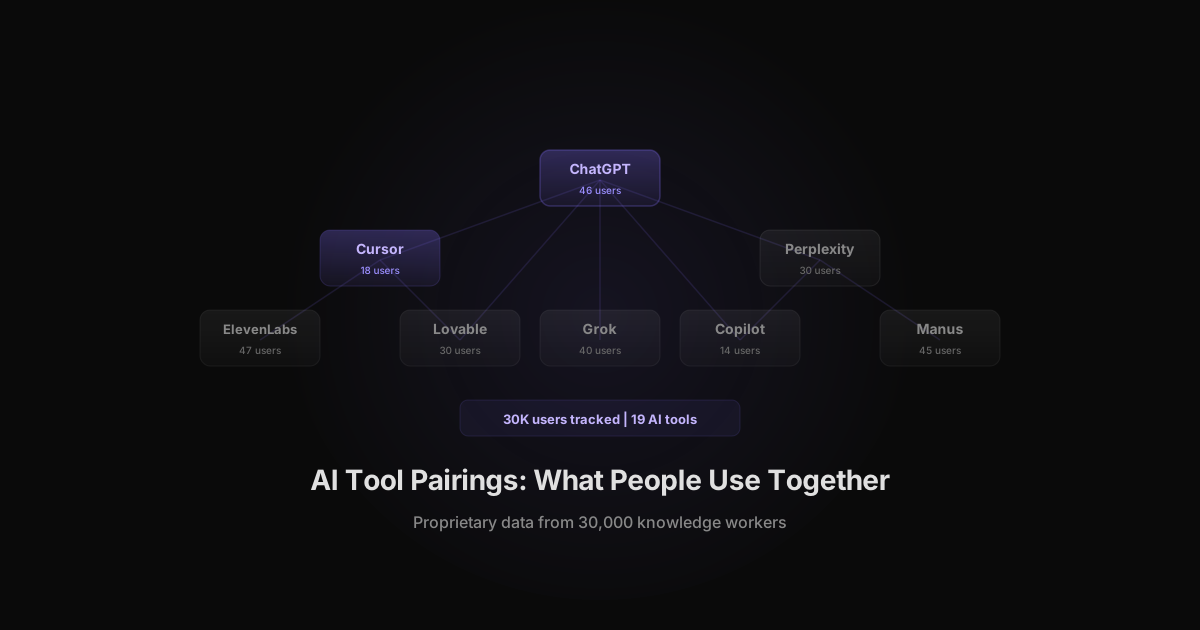
AI adoption is not uniform across industries. Some sectors are 3x ahead of others in weekly AI usage per employee, and the gap is widening. According to a 2024 McKinsey Global Survey, 72% of companies have adopted AI in at least one business function. But that top-line number hides enormous variation. Based on Rize tracking data from 30,000 users, agencies and tech companies average 8 to 12 hours of AI tool usage per week per employee, while finance teams average 3 to 5 hours. The industries pulling ahead are not just spending more on AI. They are using fundamentally different tools for fundamentally different tasks.
Key Takeaway
AI adoption varies up to 3x by industry. Agencies lead on creative AI tools (ElevenLabs, Midjourney). Tech concentrates on coding assistants (Cursor, Windsurf). Professional services defaults to LLM chat (ChatGPT, Claude). Finance lags because of compliance friction, not lack of interest. The only way to know where your team stands is to measure actual AI usage hours per employee, not license counts.
The 72% Headline Hides a 3x Gap
Seventy-two percent of companies now use AI somewhere in their organization, up from 55% a year earlier according to McKinsey's 2024 Global Survey. But "adopted AI" can mean one intern using ChatGPT or an entire engineering team running Cursor on every commit.
The better question is not whether an industry uses AI, but how much time workers actually spend in AI tools each week. Based on Rize tracking data from 30,000 users, that number varies dramatically by sector.
| Industry | Estimated AI Hours/Week Per Employee | Primary AI Category | |---|---|---| | Creative agencies | 10+ | Creative AI, LLM chat | | Technology / engineering | 8-12 | Coding assistants, LLM chat | | Professional services | 5-8 | LLM chat, AI search | | Finance / insurance | 3-5 | LLM chat, document analysis | | Healthcare | 2-4 | Clinical AI, LLM chat | | Manufacturing | 1-3 | Engineering AI, LLM chat |
These ranges are directional estimates based on Rize tracking data. Your team's numbers will depend on role mix, tool access, and whether AI usage is officially sanctioned.
AI adoption by industry is not a single number. It is a distribution shaped by workflow compatibility, regulatory environment, and tool maturity in each sector.
Agencies: The Creative AI Cluster
Agencies are among the heaviest AI adopters. Based on Rize tracking data, agency workers interact with the widest variety of AI tool categories of any industry, spending time across creative AI, LLM chat, and AI builders in a single workday.
The tool mix tells the story. In Rize's user base, creative AI tools like ElevenLabs (47 active users), Midjourney (4), and Suno (9) cluster heavily in agency and creative workflows. These are not general-purpose chat tools. They are production tools -- generating voiceovers, images, and music that used to require external vendors or specialized staff.
Agencies also show the highest overlap with AI builder tools. Lovable (30 active users), Bolt (5), and Replit (15) appear frequently in agency time logs, suggesting teams use them for rapid client prototyping. A designer who used to mock up a landing page in Figma over two days can now generate a working prototype in Lovable in an afternoon.
This makes agencies a leading indicator for AI adoption patterns. When an agency adopts a tool like ElevenLabs, it replaces a line item on a client invoice -- voiceover production that used to cost $500 per minute. The ROI feedback loop is immediate and measurable, which accelerates further adoption.
For agencies tracking their own AI usage, Rize's AI productivity metrics capture every tool by name, per employee, per project -- including shadow AI tools the team adopted without IT approval.
Technology: The Coding AI Cluster
Tech companies concentrate their AI usage in coding assistants. Based on Rize tracking data, Cursor (18 active users), Windsurf (8), Replit (15), Bolt (5), and OpenCode (7) form a distinct cluster that barely appears outside engineering teams.
This is the deepest single-category adoption in any industry. A developer using Cursor does not dip into it for five minutes -- they run it as their primary IDE for hours. That drives the high per-employee AI hours in tech even though the tool count is narrower than agencies.
The LLM chat layer runs in parallel. ChatGPT (46 active users), Grok (40), and Atlas (27) show up across tech teams for code review, documentation, and debugging. The combination of a coding assistant plus an LLM chat tool is the default stack for most AI-active developers.
Ramp's 2025 AI report found that AI spend per firm increased 13x since January 2025, with engineering tools driving a disproportionate share. This matches what we see in the Rize data: tech companies may use fewer AI categories than agencies, but they go deeper in each one.
Professional Services: The LLM Chat Default
Professional services firms -- consulting, legal, accounting -- default to LLM chat tools. ChatGPT, Claude, and Copilot dominate usage, with professional services spending $3,470 per employee on AI in 2026 according to Oxford Economics, the highest of any sector.
The spending is high but the tool mix is narrow. Unlike agencies that spread across five or more AI categories, professional services firms concentrate on two: LLM chat for research and drafting, and AI search (Perplexity, with 30 active users in the Rize dataset) for fact-checking and client research.
This pattern makes sense structurally. Consulting and legal work is text-heavy. A partner drafting a client memo or a consultant building a market analysis can redirect hours of manual research into a 10-minute Perplexity session. The time savings per task are large, which justifies the per-employee spend even though the tool diversity is low.
The risk is over-reliance on a single AI category. If LLM chat is 80% of a firm's AI usage, a single vendor outage or price increase affects the entire AI workflow. Automatic time tracking through AI efficiency tools can flag this concentration before it becomes a problem.
Finance: Compliance Friction Slows Adoption
Finance and insurance firms adopt AI more slowly -- not because they lack interest, but because compliance review cycles add months to tool deployment. Based on Rize tracking data, finance workers average 3 to 5 hours per week in AI tools, roughly half the rate of tech or agency workers.
The tools that do get approved tend to be enterprise-grade LLM deployments (Azure OpenAI, Claude for Enterprise) rather than consumer-facing tools. This creates a paradox: finance spends approximately $2,200 per employee on AI according to Oxford Economics, but much of that spend sits in approved tools with low actual usage.
The shadow AI problem is acute in finance. When official procurement takes six months, employees turn to personal ChatGPT Plus subscriptions for immediate productivity. According to HelpNetSecurity, 78% of workers use unapproved AI tools, and industries with strict procurement processes see the highest shadow rates.
This means finance teams often have two AI adoption numbers: the official rate (low) and the actual rate including shadow AI (moderate). The only way to reconcile them is to track what people actually use, not what IT approved.
The Tool Mix Table: AI Categories by Industry
The type of AI tool an industry adopts reveals which tasks AI is replacing. Based on Rize tracking data from 30,000 users, here is how AI tool usage clusters by sector.
| AI Category | Example Tools | Agencies | Tech | Prof. Services | Finance | |---|---|---|---|---|---| | LLM Chat | ChatGPT, Claude, Grok, Copilot | High | High | High | Moderate | | Coding Assistants | Cursor, Windsurf, Replit, OpenCode | Moderate | Very High | Low | Low | | Creative AI | ElevenLabs, Midjourney, Suno | Very High | Low | Low | Very Low | | AI Search | Perplexity | Moderate | Moderate | High | Moderate | | AI Agents | Manus | Moderate | High | Low | Low | | AI Builders | Lovable, Bolt, Replit | High | Moderate | Low | Very Low |
LLM chat is the universal category -- it appears in every industry because text generation applies to every knowledge role. The differentiator is the second and third category. Agencies add creative AI. Tech adds coding assistants. Professional services adds AI search. Finance stays mostly in LLM chat.
This matters for planning. If you are benchmarking your team's AI adoption against your industry, the tool mix matters as much as the total hours.
Hours Per Week in AI Tools: The Real Adoption Metric
License counts and login rates are vanity metrics for AI adoption. The number that matters is hours per employee per week actually spent in AI tools -- because that is what correlates with productivity impact.
Based on Rize tracking data, the spread within industries is as wide as the spread between them. In a typical tech company, the top 20% of AI users spend 15+ hours per week in AI tools while the bottom 20% spend fewer than 2 hours. The company-wide average of 8 to 12 hours masks a 7x internal gap.
This internal variance matters more than the industry benchmark. A finance team where every analyst spends 5 hours per week in AI search tools will likely see more ROI than a tech company where one power user runs Cursor 20 hours a week while 10 teammates never open it.
The metric to track: median AI hours per employee per week, not the mean. The mean gets inflated by power users. The median tells you what a typical team member actually does.
Automatic time tracking captures this metric without asking employees to self-report. Self-reported AI usage data skews high by 40-60% in most internal surveys because employees know the company wants to see adoption.
The Shadow AI Problem by Industry
Shadow AI -- employees using unapproved AI tools -- is not evenly distributed across industries. The highest shadow AI rates appear in industries with the most friction between tool demand and procurement speed.
In Rize's data, the AI agent tool Manus appears across 45 sessions, nearly all from users who also have approved enterprise tools. These are not employees without AI access. They are employees who find the approved tools insufficient and adopt alternatives on their own.
The shadow AI pattern by industry based on what Rize tracking data suggests:
- Finance/healthcare: Highest shadow rate. Strict procurement plus high demand equals widespread personal subscriptions. ChatGPT Plus ($20/month) is the most common shadow tool.
- Professional services: Moderate shadow rate. Partners adopt tools faster than the firm can vet them. AI search tools like Perplexity are the most common shadow category.
- Tech: Lower shadow rate for coding tools (companies approve these quickly) but moderate for non-coding AI. Developers who have approved Cursor may still use personal ChatGPT or Claude accounts for non-code tasks.
- Agencies: Lowest shadow rate paradoxically, because agencies tend to approve tools quickly. Small team sizes and flat hierarchies mean less procurement friction.
According to HelpNetSecurity, shadow AI costs companies an average of $412,000 per year, with 34% of that spend duplicating tools the company already pays for. Tracking actual usage with automatic time tracking is the only way to close the gap between what you think your team uses and what they actually use.
Geographic Patterns in AI Adoption
AI adoption also varies by geography. According to the 2024 McKinsey Global Survey, North America and developed Asia-Pacific markets lead adoption, followed by Western Europe. The gap tracks with per-employee AI spending and commercial tool availability.
Several factors drive the geographic difference:
- Tool availability: Most major AI tools (ChatGPT, Cursor, Claude) launched first in the US market. Early access creates earlier adoption curves.
- Regulatory environment: The EU AI Act creates compliance obligations that slow enterprise deployment. US companies face lighter initial regulation, allowing faster experimentation.
- Spending capacity: The Federal Reserve Bank of Atlanta reports the average US employer spends $2,068 per employee on AI in 2026. European and APAC averages are lower.
- Industry concentration: Metros with high agency and tech density (San Francisco, New York, London, Singapore) show higher per-capita AI adoption regardless of national averages.
Within any geography, the industry pattern holds. A finance team in New York and a finance team in London both adopt AI more slowly than tech teams in the same city. Industry structure is a stronger predictor than location.
How to Measure Your Own AI Adoption
Industry benchmarks give you a starting point. But the only number that matters for your budget and hiring decisions is your team's actual AI adoption rate -- and most companies cannot measure it today.
Step 1: Measure adoption breadth. What percentage of your team uses any AI tool at least three times per week? If it is below 50%, you have an access or training problem before you have an ROI problem.
Step 2: Measure usage depth. How many hours per employee per week does your team spend in AI tools? Use automatic time tracking to capture this without surveys. Self-reported numbers are unreliable.
Step 3: Map your tool mix. Which AI categories does your team use? Compare against the industry benchmarks above. If you are an agency with no creative AI usage, you may be leaving the highest-ROI category untouched. If you are a professional services firm with no AI search usage, your team might be manually researching what Perplexity could answer in seconds.
Step 4: Find your shadow AI. Deploy automatic time tracking with AI tool detection to see which tools your team actually uses versus what IT approved. The gap between those two numbers is your shadow AI exposure.
Step 5: Calculate yield. Once you have per-employee AI usage hours, combine that with your AI cost per employee to calculate AI Yield Optimization (AYO) -- the ratio of labor value saved to AI dollars spent. A yield above 2.0x means your AI investment is producing net positive returns.
The companies that treat AI adoption as a number to report will keep guessing. The ones that measure it per employee, per tool, per project will know exactly where to invest next.
The industry-level patterns in this report will shift as AI tools mature, new categories emerge, and pricing models change. What will not change is the need for per-employee, per-tool measurement. The companies that instrument AI adoption early will have the longitudinal data to make better decisions when the market shifts. The ones that wait will be starting from zero every time a new tool arrives.
Start tracking time automatically
Join thousands of professionals who stopped guessing where their time goes. Free for 7 days.
“Rize has been a no-brainer for me.” — Ali Abdaal Read more →