Idle detection is one of the most critical features in any time tracker. It determines whether your logged hours reflect actual work — or include time you spent grabbing coffee, thinking away from the keyboard, or simply stepping away. Not every tool handles it the same way, and the differences matter.
Below is a practical, side-by-side comparison of how eight leading time-tracking tools approach idle detection, covering detection methods, default timeouts, configurability, and platform coverage. Whether you're evaluating tools for yourself or your team, this guide will help you make an informed choice.
Rize Product Offerings at a Glance
Before diving into the comparison, here's what Rize provides as an automated time-tracking platform:
- Automated Time Tracking — AI-powered, runs silently in the background with no manual timers
- Idle Time Detection — Category-aware automatic pause and break detection
- Billable Time and Reporting — Track billable hours and generate client-ready reports
- Integrations — Connect with tools like Linear, ClickUp, Zapier, and more
- Productivity Analytics — Daily and weekly focus scores, category breakdowns, and trends
How Idle Detection Works Across Time Trackers
Most time-tracking apps monitor keyboard and mouse activity to decide when you've gone idle. The differences come down to three things: how long they wait before flagging inactivity, what happens when you return, and how much control you get over the behavior.
According to a Harvard Business Review analysis, accurate time tracking directly correlates with productivity gains — and idle detection accuracy is a major factor in that equation.
Side-by-Side Idle Detection Comparison
| Tool | Detection Method | Default Timeout | Configurable | When Idle Detected | Platforms |
|---|---|---|---|---|---|
| Rize | Keyboard/mouse inactivity + AI categorization | 5 min | Yes — per-category rules | Auto-pause; break session created in timeline; skips pause for Meetings/Entertainment categories | macOS, Windows |
| Toggl Track | Keyboard/mouse inactivity | 5–10 min | Yes | Prompt with 4 options: keep, discard, discard + continue, discard + stop | macOS, Windows, Linux, Web, iOS, Android |
| Clockify | Keyboard/mouse inactivity | 10–20 min | Yes | Timer continues but marks time as idle; prompt with 3 options: discard, discard + continue, keep | macOS, Windows, Linux, Web, iOS, Android |
| Harvest | Keyboard/mouse inactivity (desktop only) | 10 min | Yes | Notification: keep or remove idle time | macOS, Windows, Web, iOS, Android |
| TimeCamp | Keyboard/mouse monitoring | 5 min | Yes — 2, 5, 7 min, or custom | Auto-pause; auto-resume on activity; prompt to explain idle period | macOS, Windows, Linux, Web, iOS, Android |
| Hubstaff | Keyboard/mouse monitoring over 10-min intervals | 5 min warn / 20 min full idle | Yes — 5, 10, 20 min, or custom; admin overrides | Two-tier: prompt every 5 min during idle, then Idle Time mode after 20 min continuous inactivity | macOS, Windows, Linux, Web, iOS, Android |
| Time Doctor | Keyboard/mouse monitoring | 15 min | Yes — 3 min to 6 hours | Auto-stop + pop-up: stop and break, or continue; special "don't timeout on calls" option | macOS, Windows, Linux, Web, iOS, Android |
| RescueTime | Keyboard/mouse monitoring | 5 min | No | Fully automatic — 5-min countdown, then record ends and idle time is subtracted; returns within 5 min counted as thinking time | macOS, Windows, Web |
Key Takeaways from the Comparison
Default Timeouts Vary Widely
The most common default is 5 minutes (Rize, TimeCamp, RescueTime, Hubstaff's warning threshold). Clockify is the most lenient at up to 20 minutes on macOS. Time Doctor defaults to 15 minutes, which may miss shorter breaks. Research from the American Psychological Association suggests that even short breaks of 5–10 minutes improve focus, so a shorter idle timeout generally produces more accurate data.
User Control Ranges from None to Full
RescueTime is fully automatic — zero decisions required, but zero configurability. Toggl Track offers the most flexibility when you return with four action choices. Rize takes a middle path: automatic pausing with category-aware rules so meetings and passive media consumption aren't interrupted. Hubstaff provides admin-level controls ideal for team managers.
Platform Coverage Matters for Distributed Teams
If you need idle detection across every platform, Toggl Track, Clockify, TimeCamp, Hubstaff, and Time Doctor cover macOS, Windows, Linux, web, and mobile. Harvest limits idle detection to its desktop apps. Rize focuses on macOS and Windows with deep OS-level integration for the most accurate desktop tracking. As Zapier's 2026 roundup notes, the best tool depends on where your team actually works.
Automatic vs. Manual: The Tradeoff
Tools that auto-pause (Rize, TimeCamp, RescueTime) reduce interruptions but may occasionally misclassify intentional idle time like reading a whiteboard or thinking through a problem. Tools that prompt you (Toggl, Clockify, Harvest) give more control but add friction. For teams tracking billable hours, the accuracy of idle detection directly affects revenue.
How Rize Handles Idle Detection
Rize monitors keyboard and mouse activity and automatically pauses tracking after 5 minutes of inactivity. What sets Rize apart is category-aware idle rules — if you're watching a tutorial video (categorized as Entertainment) or in a video call (Meetings), Rize won't pause, because those activities don't require constant keyboard input.

Idle periods automatically appear as break sessions in your timeline, giving you an accurate picture of how your day unfolded — no manual start/stop required.
Running Rize in the Background
If you want Rize to run in the background without taking up space in your dock, click the red close button on the dashboard. Rize will be removed from your dock but continue tracking in the background. Click the tray icon and then "View Dashboard" to return at any time.
Tutorial Videos
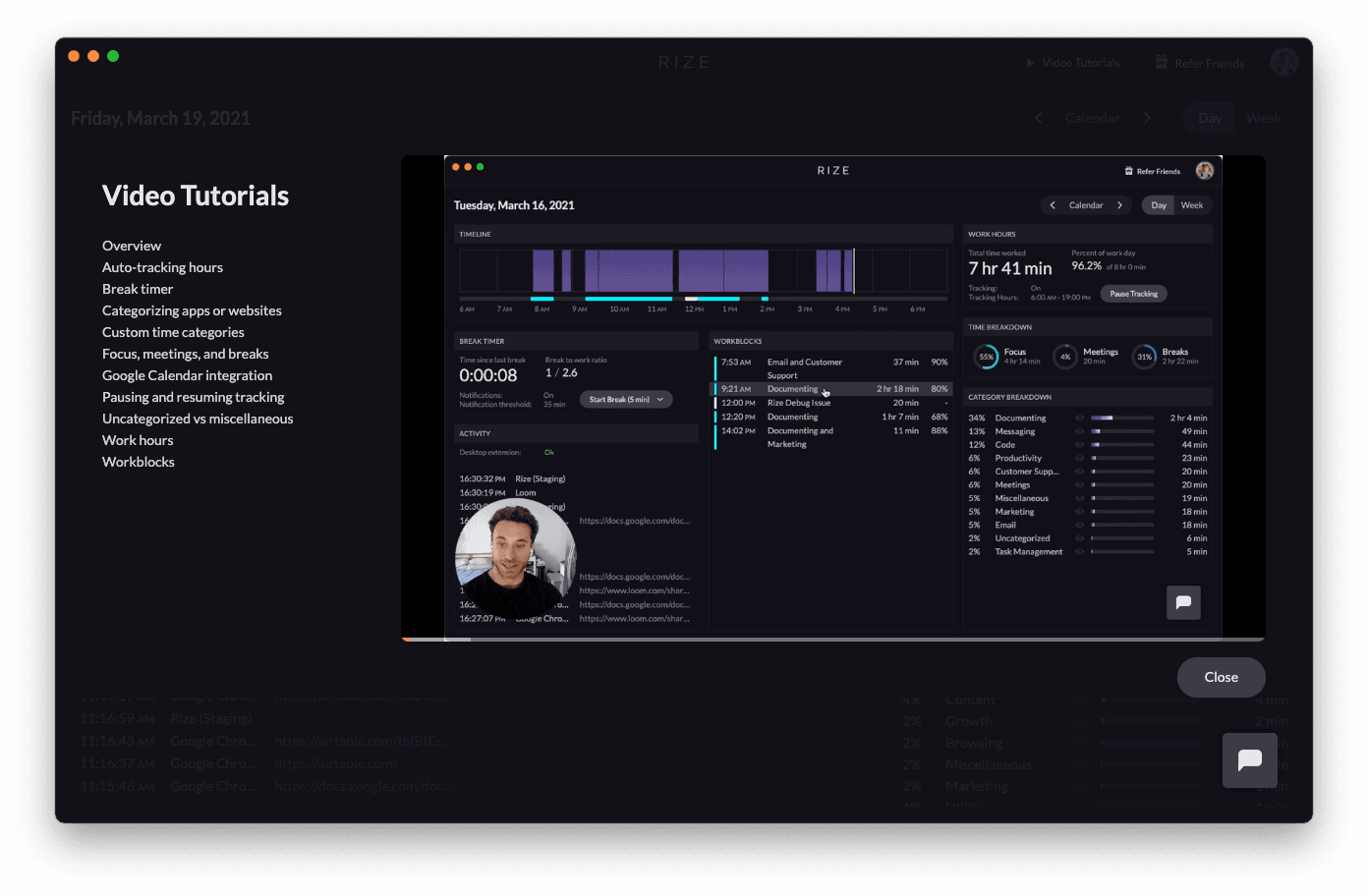
We added tutorial videos to the dashboard for new users. They appear during your first week of using Rize, but you can also watch them on our YouTube channel.

Official Documentation and Resources
Dive deeper into each tool's idle detection configuration:
- Rize — Changelog and Feature Updates
- Toggl Track — Idle Detection in Browser Extension
- Clockify — Idle Detection and Reminders
- Harvest — How the Idle Timer Works
- TimeCamp — Idle Time Settings
- Hubstaff — Inactivity Warning Configuration
- Time Doctor — Timeout Configuration
- RescueTime — Away From Computer Behavior
Real-World Case Studies
See how teams use automatic time tracking and idle detection in practice:
- How Momentum Studio Improved Billing Accuracy with Rize
- Powering Agency Growth with Data-Driven Time Tracking
- Rethinking the Timesheet: Automating Time Tracking for Agencies
Frequently Asked Questions
What is idle detection in time tracking?
Idle detection is a feature that monitors keyboard and mouse activity to determine when you've stepped away from your computer. When no input is detected for a configured period (typically 2–20 minutes), the tracker either pauses automatically, prompts you to decide what to do with the idle time, or subtracts it from your logged hours.
Which time tracker has the best idle detection?
Rize offers the most intelligent idle detection by combining inactivity monitoring with AI-powered category awareness. Unlike tools that simply pause after a timeout, Rize understands that watching a meeting or a tutorial video doesn't require keyboard input — so it won't interrupt those sessions. For teams needing cross-platform coverage with admin controls, Hubstaff and Time Doctor are strong alternatives.
Can I customize the idle timeout in most time trackers?
Yes — seven out of eight tools in this comparison allow you to customize the idle timeout. The exception is RescueTime, which uses a fixed 5-minute threshold. The most flexible option is Time Doctor, which supports timeouts from 3 minutes to 6 hours. Rize allows per-category customization, so different types of work can have different idle rules.
Does idle detection work on mobile devices?
Idle detection is primarily a desktop feature. While tools like Toggl Track, Clockify, and Hubstaff have mobile apps, idle detection on mobile works differently — it typically relies on GPS or app-foreground checks rather than keyboard/mouse monitoring. For accurate idle detection, desktop apps provide the most reliable experience.
How does idle detection affect billable hours?
Idle detection directly impacts billing accuracy. Without it, logged hours may include significant non-work time, leading to either overbilling clients or inaccurate internal cost tracking. Tools that auto-pause (like Rize) or prompt you (like Toggl Track) help ensure that only active work time is billed. See how Momentum Studio improved billing accuracy using automated idle detection.
Macgill Davis is cofounder of Rize, an automatic time tracker that improves focus and builds better work habits.