Selective attention is the ability to focus on one piece of information while filtering out everything else — and it is the single biggest predictor of how much deep work you get done in a day. In 2026, the average knowledge worker switches apps hundreds of times per day, making selective attention harder and more valuable than ever.
As Cal Newport writes in Deep Work, "The ability to perform deep work is becoming increasingly rare at exactly the same time it is becoming increasingly valuable in our economy. As a consequence, the few who cultivate this skill, and then make it the core of their working life, will thrive."
This guide covers what selective attention is, the key theories behind it, real-world examples, and practical tips to strengthen your selective attention at work. If you want to improve your work performance, understanding selective attention is the place to start.
What Is Selective Attention?
Selective attention is a cognitive process that allows you to focus on specific information in your environment while filtering out irrelevant stimuli. It operates across both auditory and visual channels and is considered a limited resource by cognitive psychologists.
We rely on selective attention constantly. The most well-known example is the Cocktail Party Effect — your ability to follow a single conversation in a noisy restaurant filled with competing sounds, movement, and visual distractions. Another common example: taking a phone call while driving, where you selectively attend to the caller's voice over road noise.
Without selective attention, the volume of incoming stimuli would be cognitively overwhelming. A core principle is that irrelevant information must be actively disregarded — not just ignored passively. This is why psychologists treat attention as a finite resource that depletes with use.
Original Theories of Selective Attention
Attention is one of the researched concepts in psychology, brain research, and cognitive neuroscience, with the first studies dating back to 1858. Research on selective attention ramped up in the mid-twentieth century and spawned a number of theories.
Broadbent's Filter Model
One of the first theories of selective attention was developed by Daniel Broadbent. Broadbent hypothesized that stimuli are filtered very early in the cognition process, with certain stimuli being filtered out through a bottleneck and others allowed to pass through. Broadbent proposed that filtering of stimuli was based on physical properties like color, loudness, direction, and pitch.
Treisman's Attenuation Theory
The psychologist Anne Treisman built upon Broadbent's theory with one major difference. Treisman proved in several studies that the initial filter attenuates rather than eliminates irrelevant information. This means that people can still process the meaning of information that they are not fully focused on.
Memory Selection Models
Memory selection models further built upon Broadbent's and Treisman's theories. In memory selection models, attended and unattended information is assessed based on the meaning of the information in a second-stage after initial filtering.
Kendra Cherry lays out a great example of this while also explaining the Cocktail Party Effect:
Imagine that you are at a party and paying attention to the conversation among your group of friends. Suddenly, you hear your name mentioned by a group of people nearby. Even though you were not attending to that conversation, a previously unattended auditory stimuli immediately grabbed your attention based on meaning rather than physical properties.
Resource Theories
In more recent years, researchers increasingly agree that attention in the human brain is a limited resource that can only be divided over a fixed amount of information. This means that we can only allocate our attention to so many sources at any given amount of time.
Track your focus automatically
Rize measures how much deep work you get each day — no manual tracking. See exactly what pulls you out of flow.
Start Free TrialSelective Attention and Your Productivity
Selective attention directly determines how much focused work you produce each day. Research suggests the average knowledge worker gets only a few hours of truly uninterrupted focus time per 8-hour workday — the rest is lost to app switches, notifications, and context changes that break selective attention.
Remove all distractions
In 2026, the average knowledge worker faces an endless stream of distractions — Slack messages, Gmail notifications, social media alerts, and AI assistant pings all compete for limited attention. These interruptions push you toward divided attention, the opposite of selective attention.
With attention as a limited resource, focused work is becoming increasingly rare. Research shows that phones reduce your ability to focus even when they are not actively distracting you — their mere presence in the room drains cognitive capacity.
In order to combat these distractions, you can take the following actions when you want to avoid divided attention and improve focus:
- Remove your phone from the room.
- Close all non-essential apps and websites.
- Turn off all notifications.
Taking these steps removes those sources of information that act as cognitive drains on your attention.
Stop multitasking
Since attention is a limited resource, splitting our attention while multitasking reduces our ability to complete tasks. A 2009 Stanford study found that heavy multitaskers performed worse at sorting relevant from irrelevant information — and a 2010 meta-analysis confirmed that task-switching consistently degrades performance. This is why context switching is so costly — every switch forces your brain to reload the previous task's context.
As Dr Robert F. Bornstein, a psychology professor at Adelphi University, explained in Psychology Today, "It's not really possible to be texting (or chatting) and devoting adequate attention to another resource-intensive task (like editing a document.) Each task fades from short-term memory. We must then refocus to regain that information when we switch our attention back to the original task, which takes time and effort."
Reducing multitasking means you keep a single task in your attention and working memory. This improves information processing and enables you to produce higher-quality work in less time.
Optimize for periods of intense focus
Setting aside explicit periods for single-task focus is one of the most effective ways to train selective attention. Techniques like timeboxing — assigning a fixed block to one task — work because they remove the decision fatigue of choosing what to attend to. Rize users who schedule dedicated focus sessions and review their daily focus reports typically report noticeable increases in deep work time within the first few weeks.
Track your attention and focus
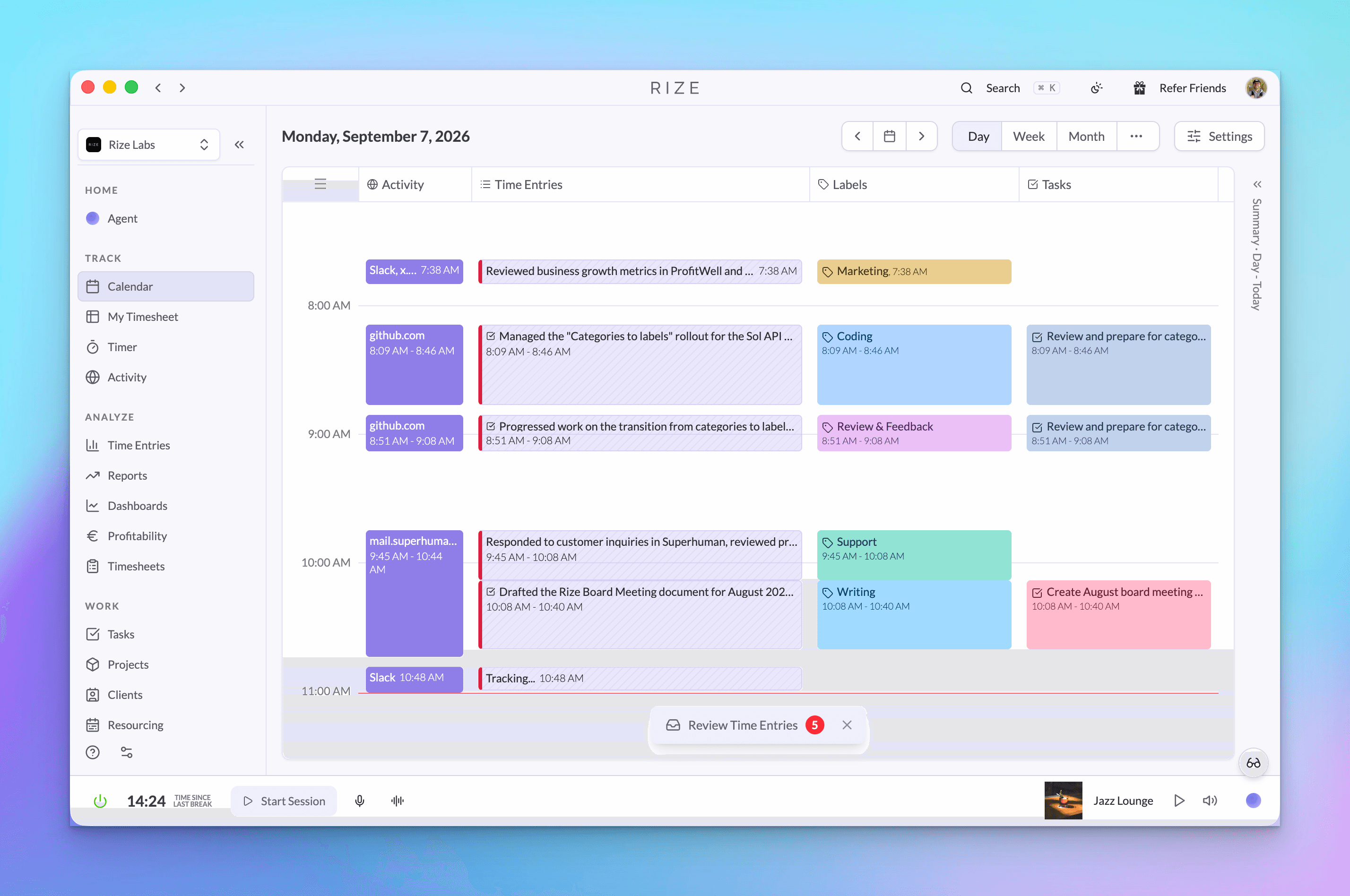
You can't improve what you can't measure. It's impossible to know if you're improving your focus without measuring it. James Clear writes in his article on selective attention, "the only way to figure out what works and what doesn't is to measure your results. If you repeat this cycle for 20 years, then you end up becoming very good at focusing on the things that matter and ignoring the things that don't." You can use an AI time tracker like Rize to track your focus and see exactly which apps or sites are distracting you. Rize's automatic time tracking captures every app switch in the background, giving you a precise picture of where your attention goes. If you're evaluating tools, see how Rize compares to other time trackers on accuracy and privacy.
How Time Tracking Data Reveals Selective Attention Patterns
Automatic time tracking turns selective attention from an abstract concept into measurable data. By logging every app switch, website visit, and focus session in the background, tools like Rize create a detailed map of where your attention actually goes throughout the day.
For example, Rize's daily focus reports show your longest uninterrupted work blocks — a direct measure of sustained selective attention. If your longest block is 12 minutes, you know distractions are breaking your attention before you can reach a flow state (which typically requires 15-25 minutes of uninterrupted focus). The data also shows which apps and sites act as attention traps, pulling you out of selective attention most frequently.
This feedback loop — measure, identify patterns, adjust environment, re-measure — is the most reliable way to strengthen selective attention over time. It is the same principle behind cognitive behavioral training: awareness of the pattern is the first step to changing it.
Start tracking time automatically
Join thousands of professionals who stopped guessing where their time goes. Free for 7 days.
“Rize has been a no-brainer for me.” — Ali Abdaal Read more →
Selective Attention Is a Trainable Skill
Selective attention is not a fixed trait — it is a skill you can strengthen by reducing distractions, eliminating multitasking, and tracking where your focus actually goes. In a world where the average worker faces dozens of interruptions per day, those who train their selective attention will consistently outperform those who do not.
The first step is measurement. Tools like Rize's automatic time tracking reveal your actual attention patterns — which apps pull you out of focus, how long your uninterrupted work blocks last, and where you lose time to context switching. Once you see the data, you can design a work environment that protects your selective attention instead of depleting it.
Sources
- https://www.verywellmind.com/what-is-selective-attention-2795022
- Broadbent DE. Perception and Communication. London: Pergamon Press; 1958.
- https://www.simplypsychology.org/attention-models.html.
- Treisman AM. Selective attention in man. British Medical Bulletin. 1964;20(1):12-16. doi:10.1093/oxfordjournals.bmb.a070274.
- https://psychology.wikia.org/wiki/Selective_attention
- Ophir E, Nass C, Wagner AD. Cognitive control in media multitaskers. PNAS USA. 2009;106(37):15583-15587. doi:10.1073/pnas.0903620106
- https://www.psychologytoday.com/us/blog/big-career-corner/201011/are-we-multi-tasking-our-way-zero-productivity
- https://jamesclear.com/selective-attention
Start tracking time automatically
Join thousands of professionals who stopped guessing where their time goes. Free for 7 days.
“Rize has been a no-brainer for me.” — Ali Abdaal Read more →
Photo by Romain Vignes


![Rize vs Time Doctor: Which time tracker is best? [2026]](/_next/image?url=%2Fassets%2Fblog%2Frize-vs-time-doctor%2Frize-vs-time-doctor.webp&w=3840&q=75)